

When the ALJ Says No: Understanding the Social Security Disability Appeals Council Review
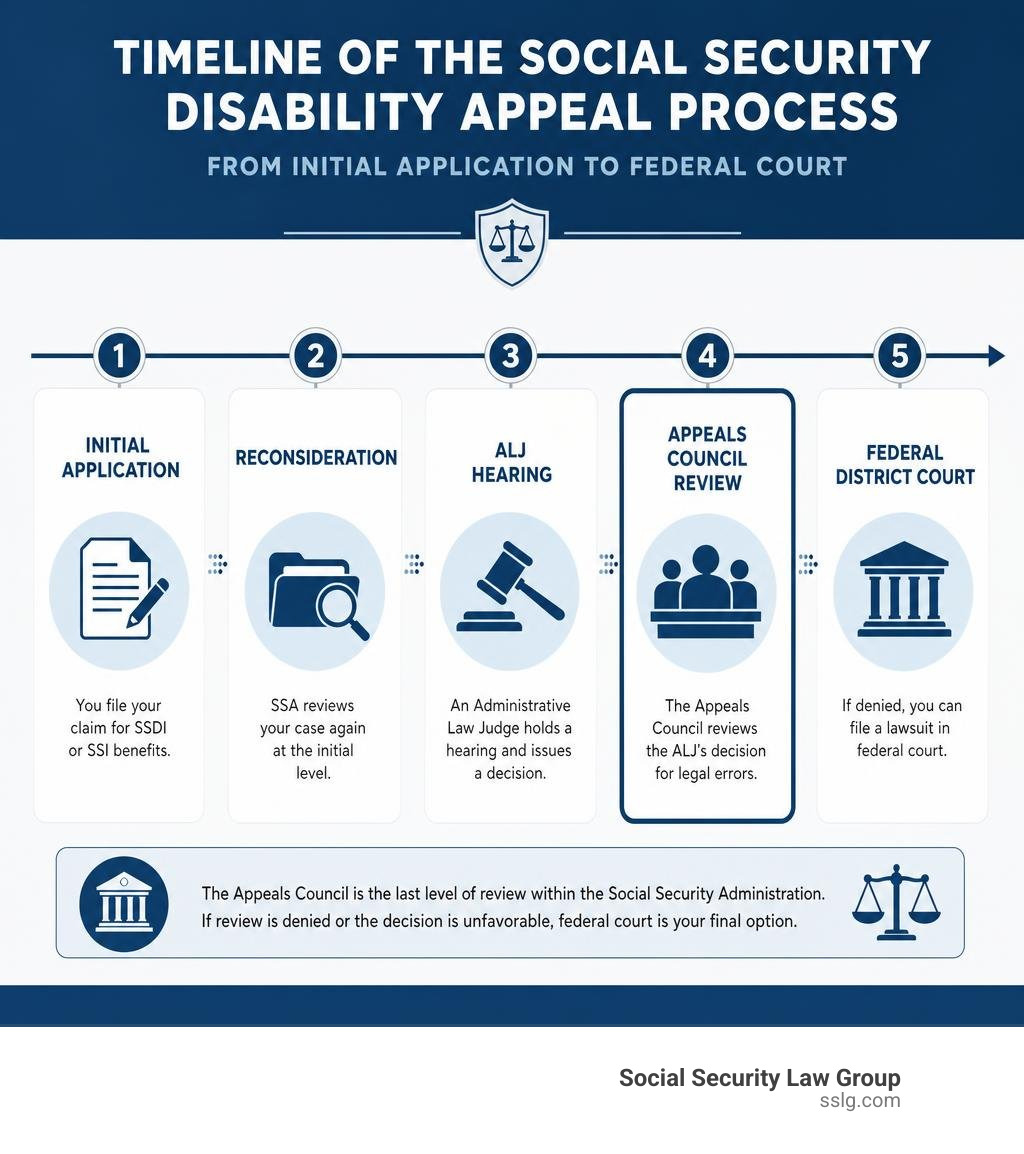
A social security disability appeals council review is the third level of appeal in the Social Security Administration’s four-stage process, and for many claimants, it is the last chance to win benefits before heading to federal court.
Here is a quick overview of where it fits:
- Initial application (the SSA denies nearly 80% of first-time claims)
- Reconsideration (a second look by the SSA; success rates are below 10%)
- ALJ hearing (an administrative law judge reviews your case; more than half of claimants win here)
- Appeals Council review (the Appeals Council checks the ALJ’s decision for legal errors)
- Federal district court (the final option if the Appeals Council rules against you)
If you just received an unfavorable decision from an administrative law judge, you are not out of options. The Appeals Council, based in Falls Church, Virginia, can review that decision and send your case back to an ALJ, or, in rare cases, award benefits directly.
That said, the odds are tough. As of 2026, the Appeals Council granted review in fewer than 15% of cases filed. Getting the process right matters enormously.
At Social Security Law Group, we have provided expert legal representation for SSD and SSI claims since 1994. With a 97% success rate and a no-win, no-fee structure, we help our clients understand exactly how work affects their eligibility. We support clients nationwide, from California, Oregon, and Washington, to Texas, Florida, and Massachusetts, using modern technology to ensure your claim is handled with the precision it deserves.
This guide walks you through every step of the Appeals Council process so you know exactly what to expect and how to give your case the best possible chance.
What is the Social Security Disability Appeals Council Review?
The Appeals Council represents the final stage of administrative review within the Social Security Administration (SSA). If an Administrative Law Judge (ALJ) denies your claim for Social Security Disability Insurance (SSDI) or Supplemental Security Income (SSI) after a hearing, you cannot immediately leap to federal court. You must first ask the Appeals Council to review the judge’s decision.
Unlike your hearing with the ALJ, the Appeals Council review is not a new trial. You will not stand before a judge, testify about your medical conditions, or bring witnesses to speak on your behalf. Instead, the Appeals Council operates strictly as a review board. Located primarily in Falls Church, Virginia, with supporting offices in Baltimore, Maryland, and Crystal City, Virginia, the council consists of administrative appeals judges and appeals officers who make up the Office of Appellate Operations (OAO).
The primary mission of these judges is to examine the written record of your case to determine if the ALJ made a harmful legal or factual mistake. They review the transcript of your hearing, the medical evidence that was before the ALJ, and the written decision itself. Because they do not conduct live hearings, their decision is based entirely on the administrative record and any written arguments submitted by you or your representative.
To understand where this step fits into your broader journey, you can read our comprehensive breakdown of the Social Security Disability Appeal Process. Understanding the structure of this review is crucial because the Appeals Council has the authority to change the outcome of your claim, but only if you can prove that the ALJ’s decision was fundamentally flawed under the SSA’s strict regulatory guidelines. For a detailed overview of how the agency manages these cases behind the scenes, you can consult the official Appeals Council Review Process in OARO.
When and How to Request an Appeals Council Review
You should request an Appeals Council review whenever you receive an unfavorable or partially favorable decision from an ALJ and believe the judge made an error. However, you must act quickly. The SSA enforces a strict deadline for filing this request.
The 60-Day Filing Deadline
You must file your Request for Review within 60 days of the date you receive the ALJ’s decision notice. The SSA presumes that you receive the decision letter within 5 days after the date printed on the notice, unless you can show a reasonable delay in the mail. This means you generally have a total of 65 days from the date on the letter to submit your appeal.
If you miss this deadline, the Appeals Council will likely dismiss your request, making the ALJ’s denial the final, binding decision of the Commissioner. If you do file late, you must submit a written statement explaining the reasons for the delay. The Appeals Council will review your statement to determine if “good cause” exists to extend your filing time, such as a serious illness, a death in the immediate family, or an unavoidable destruction of records.
How to File the Request
To initiate the review, you or your representative must submit the request in writing. The SSA provides multiple pathways to complete this step:
- The iAppeal Online Portal: This is the SSA’s preferred and most secure method. Filing online through the iAppeals system ensures immediate receipt and generates electronic confirmation.
- Form HA-520 (Request for Review of Hearing Decision/Order): This is the traditional paper form. You must fill out your personal information, state the specific reasons you disagree with the ALJ’s decision, and sign the document.
- A Detailed Letter: You can write a formal letter requesting review, provided it contains your name, Social Security number, claim number, and a clear statement of disagreement.
Once completed, paper requests can be mailed directly to the Office of Appellate Operations in Baltimore, Maryland, or submitted to your local Social Security field office. For step-by-step instructions on initiating this stage of your claim, see our guide on How Do I Appeal a Disability Claim. You can also review the strict guidelines the SSA field offices use to process these requests in the SSA POMS SI 04040.020 Requesting Appeals Council Review.

Legal Standards for a Social Security Disability Appeals Council Review
The Appeals Council does not grant reviews simply because you are unhappy with the ALJ’s decision. To secure a review, your appeal must demonstrate that your case meets one of the specific legal standards defined in the Social Security regulations. The council looks for very specific types of errors:
1. Abuse of Discretion
An abuse of discretion occurs when an ALJ acts in an arbitrary, unreasonable, or unjust manner. For example, if the ALJ refused to allow your attorney to cross-examine a vocational expert, or if they flatly refused to admit critical medical records that were submitted on time, this constitutes an abuse of discretion.
2. Error of Law
An ALJ must follow the Social Security Act, agency regulations, and Social Security Rulings (SSRs). If the judge misapplied a regulation, used an outdated medical standard, or failed to apply the correct legal framework when evaluating a medical opinion, they have committed an error of law.
3. Lack of Substantial Evidence
This is one of the most common arguments in an appeal. Substantial evidence is defined as such relevant evidence as a reasonable mind might accept as adequate to support a conclusion. If the ALJ decided you can perform light work, but the medical records show you cannot stand for more than ten minutes at a time, the judge’s finding is not supported by substantial evidence.
4. Broad Policy or Procedural Issues
The Appeals Council will review a case if it involves an issue that could affect the public interest or the overall administration of the disability program. This includes systemic procedural errors or new legal questions that require clarification.
For a deeper look into how these standards are applied specifically to Supplemental Security Income cases, you can read the SSA POMS SI 04040.010 Appeals Council Review for Supplemental Security Income Cases.
Submitting New Evidence During the Social Security Disability Appeals Council Review
Many claimants wonder if they can submit new medical records to the Appeals Council. The answer is yes, but the council enforces incredibly strict rules regarding what evidence it will actually consider.
Under the regulations, the Appeals Council will only examine additional evidence if it meets all of the following criteria:
- It is New: The evidence cannot be cumulative or duplicative of medical records that are already in your file. It must contain fresh, unique medical information.
- It is Material: The evidence must be relevant to the issue of whether you are disabled. There must be a reasonable probability that this new evidence would have changed the ALJ’s decision.
- It Relates to the Period on or Before the ALJ Decision: The medical records must describe your condition during the timeframe that the ALJ was evaluating, which ends on the date of the ALJ’s written decision. If you develop a completely new medical condition six months after the ALJ’s decision, the Appeals Council will not consider it.
- You Have Good Cause: You must show a valid reason why you did not submit this evidence to the ALJ before the hearing. Good cause might include a doctor’s delay in releasing records, a sudden hospitalization, or the fact that the medical test was not physically performed until after the hearing.
If the Appeals Council rejects your new evidence because it does not relate to the period before the ALJ’s decision, they will return it to you. However, this rejection acts as a protective filing date. This means if you choose to file a brand-new application for benefits, the SSA can use the date you submitted that evidence to the Appeals Council as your new application date, preserving your back-pay eligibility.
To explore the precise jurisdictional rules governing how the council handles new medical evidence, refer to the SSA POMS GN 03104.350 Appeals Council Jurisdiction.
Possible Outcomes and Success Rates of the Appeals Council
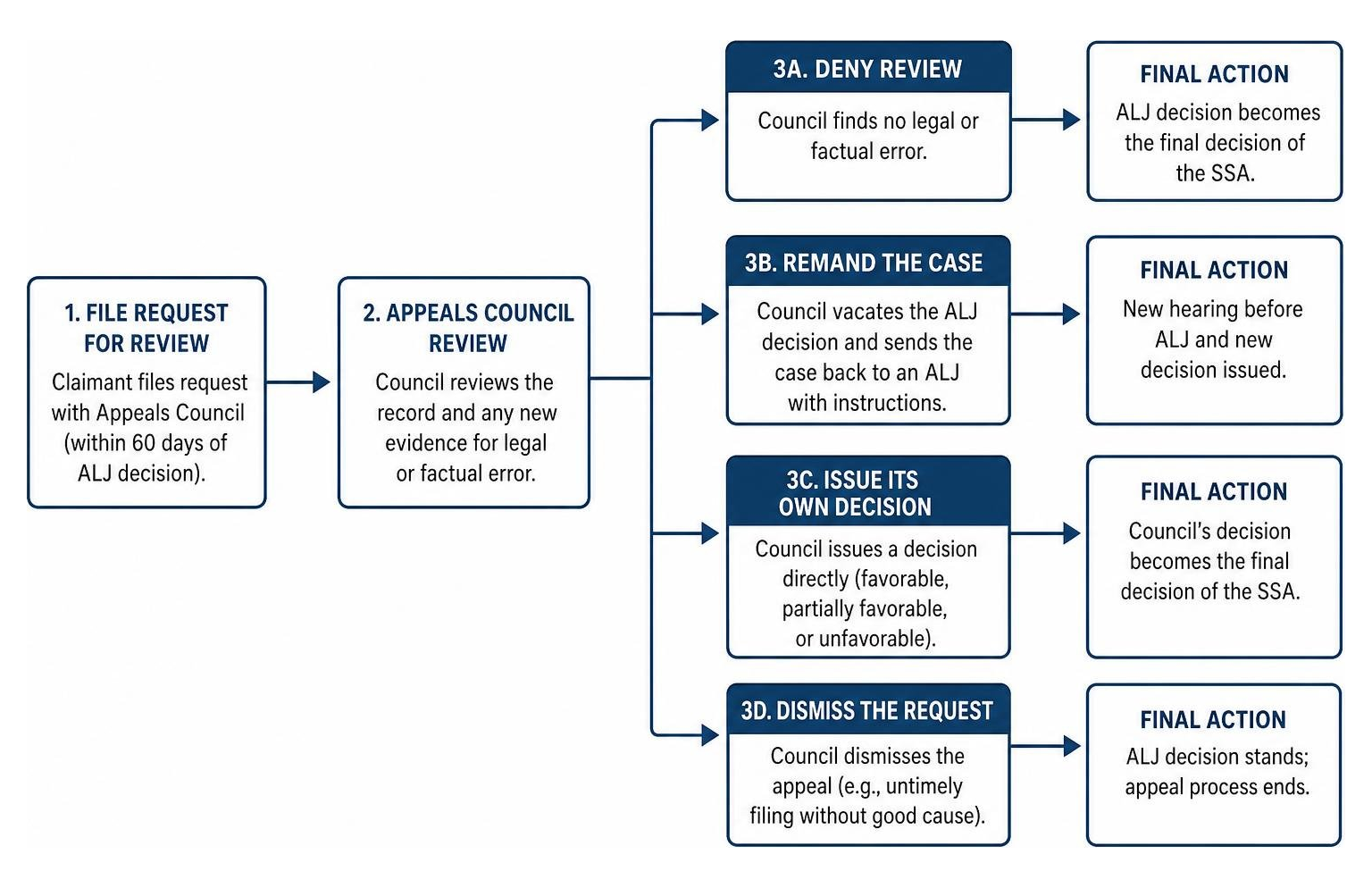
When the Appeals Council reviews your request, they will take one of four actions. Understanding these outcomes helps set realistic expectations for your appeal.
| Outcome | What It Means | Frequency / Likelihood |
|---|---|---|
| Deny Review | The council finds no legal or factual errors in the ALJ’s decision. The ALJ’s denial becomes the final decision of the SSA. | Most Common (Over 80% of cases) |
| Remand the Case | The council vacates the ALJ’s decision and sends the case back to an ALJ (usually the same one) with instructions to correct specific errors. | Most Common Successful Outcome |
| Issue Its Own Decision | The council bypasses the ALJ and issues a direct decision, which can be fully favorable, partially favorable, or unfavorable. | Rare |
| Dismiss the Request | The council dismisses the appeal, usually because it was filed late without a showing of good cause. | Occasional |
The Reality of Appeals Council Success Rates
It is important to be realistic about your odds at this level. The Appeals Council functions largely as a gatekeeper. According to historical agency data, the council grants less than 15% of all Requests for Review that are filed. In the vast majority of cases, the council denies the request for review, forcing claimants to either accept the denial or take their case to federal court.
When you do “win” at the Appeals Council, the outcome is almost always a remand rather than an outright award of benefits. A remand means you must attend a new hearing with an ALJ. While a second hearing can feel exhausting, it is a valuable second chance to present your case, submit updated medical evidence, and address the specific errors identified by the Appeals Council. To understand how timeline factors and legal representation play into these outcomes, read our guide on How Long Does a Disability Appeal Take with a Lawyer.
Next Steps After an Unfavorable Appeals Council Decision
If the Appeals Council denies your request for review, or issues an unfavorable decision, you have reached the end of the administrative appeal process within the Social Security Administration. The ALJ’s denial is now the final decision of the Commissioner of Social Security.
However, this is still not the end of the road. Your next step is to file a civil action in a United States District Court.
Filing a Federal Court Appeal
To appeal to federal court, you must file a civil lawsuit against the Commissioner of Social Security. Just like the previous steps, you must file this lawsuit within 60 days of receiving the Appeals Council’s denial notice. The federal court review is a highly formal legal process. There are no hearings or testimonies; instead, a federal judge reviews the administrative record and written legal briefs submitted by your attorney and the regional attorneys representing the SSA.
Filing a federal lawsuit requires specialized legal expertise. The federal judge will look to see if the SSA’s final decision is supported by substantial evidence and whether the agency applied the correct legal standards. If the federal judge agrees with your arguments, they can remand the case back to the SSA for further proceedings or, in rare instances, order the SSA to pay you benefits.
To understand the boundaries of this process and how many times you can push back against a denial, read our detailed article on How Many Times Can You Appeal Social Security Disability. You can also review the official guidelines on judicial reviews in the SSA Handbook Section 2194.
Frequently Asked Questions About the Appeals Council
Navigating a social security disability appeals council review can be confusing. Here are answers to some of the most common questions claimants ask during this stage of the process.
How long does an Appeals Council review take?
The Appeals Council is notorious for its lengthy processing times. On average, a review can take anywhere from 1 to 20 months, with most cases averaging around 12 months.
Expedited reviews are extremely rare, but they are possible under specific “critical case” circumstances. To qualify for an expedited review, you must demonstrate immediate, severe harm. This typically requires showing proof of a terminal illness, extreme financial distress such as an active eviction or foreclosure notice, or a utility shut-off notice. If you believe your case qualifies, your representative can submit a critical case request along with supporting documentation to the council.
Can I file a new disability application while my appeal is pending?
Generally, the SSA does not allow you to have two active applications for the same type of benefit at the same time. If you have an active appeal pending at the Appeals Council, you cannot file a new application for SSDI or SSI unless you drop your appeal or meet very specific exceptions.
However, under POMS DI 12020.001, if you have new medical evidence that relates to a completely different medical condition or a period after the ALJ’s decision, you may be able to establish a protective filing date for a future application. It is highly recommended to consult with a legal representative before making the decision to dismiss an appeal in order to file a new claim, as dismissing an appeal means giving up your potential back-pay dating back to your original application. You can review the complete policy on concurrent claims in the SSA POMS DI 12020.001 Appeals Council Review.
Do I need a lawyer for an Appeals Council appeal?
While you are not legally required to have an attorney at the Appeals Council level, attempting this stage on your own is highly risky. The Appeals Council does not look at your case with sympathy; they look at it through a highly technical legal lens.
An experienced disability lawyer understands how to read your hearing transcript, identify the exact legal errors made by the ALJ, and write a persuasive legal brief that cites specific regulations, rulings, and federal case law. Without this technical precision, many self-represented appeals are quickly denied because they fail to articulate a valid legal error. To learn more about how professional representation can protect your rights, explore our guide on finding a Lawyer for Social Security Disability Appeal.
Conclusion
Navigating a social security disability appeals council review is one of the most complex and legally demanding phases of the entire disability process. With success rates hovering below 15%, you cannot rely on simple explanations of your pain or limitations. You need a rigorous, legally sound argument that proves the administrative law judge failed to follow the law.
At Social Security Law Group, we have dedicated our practice to disability law since 1994. We bring unrivaled expertise, a 97% success rate, and a compassionate, client-focused approach to every case we handle. Because we operate on a no-win, no-fee structure, you will never pay us a single dollar in attorney fees unless we successfully win your benefits.
We proudly support clients across the nation, utilizing modern client technology to make representation seamless and stress-free. Whether you are in Denver, Boston, Dallas, Ft Lauderdale, Miami, Orlando, Sarasota, St Louis, Wichita, Raleigh, Fayetteville, Clark, Uniondale, San Antonio, Jefferson, Southfield, Las Vegas, Jacksonville, Tampa, Bremerton, Fairhaven, Detroit, Phoenix, Atlanta, Houston, Charlotte, Seattle, or Chicago, our team is ready to stand by your side.
If you have received an ALJ denial, do not let the clock run out on your 60-day window. Contact us today to secure the dedicated advocacy your claim deserves. Let us help you take the next step toward winning your benefits by starting your SSDI Appeal with our experienced team.
The information provided in this blog article is intended to be general in nature and should not be construed as legal advice. Social Security laws and regulations are subject to, and often change. Please consult the official Social Security Administration (SSA) website or contact SSLG for advice regarding your specific legal matters.