


Can You Work While Disabled Without Losing Your Benefits?
Work while disabled is possible — and in many cases, the law is designed to help you do it safely.
Here’s a quick summary of the key rules:
| Program | Can You Work? | Key Limit |
|---|---|---|
| SSDI | Yes | Stay under $1,690/month gross (2026) |
| SSI | Yes | First $85 excluded; benefits reduced 50¢ per $1 over $85 |
| ODSP (Canada) | Yes | Up to $1,000 net/month with no impact |
| CPP-D (Canada) | Limited | Trial period available; regular income may signal recovery |
| Private LTD | Depends | Policy terms vary; partial/residual clauses may apply |
The short answer: yes, you can often work — but the rules are strict, and the details matter enormously depending on which program you’re on.
Many people with disabilities fear that earning any income will instantly cut off their benefits. That’s rarely true. In fact, the Social Security Administration (SSA) has built specific programs — like the Trial Work Period (TWP) and Ticket to Work — specifically to let SSDI recipients test the waters of employment without immediately losing support.
But here’s where it gets complicated.
Every program has its own income thresholds, reporting requirements, and timing rules. Missing a deadline, failing to report earnings, or misunderstanding your policy’s definition of “disability” can cost you months — or years — of benefits. For people already struggling with serious health conditions and financial pressure, that risk is very real.
This guide breaks down exactly what you need to know: the SSDI and SSI rules, Canadian programs like ODSP and CPP-D, private long-term disability (LTD) insurance, and the practical steps to protect yourself if you want to return to work.
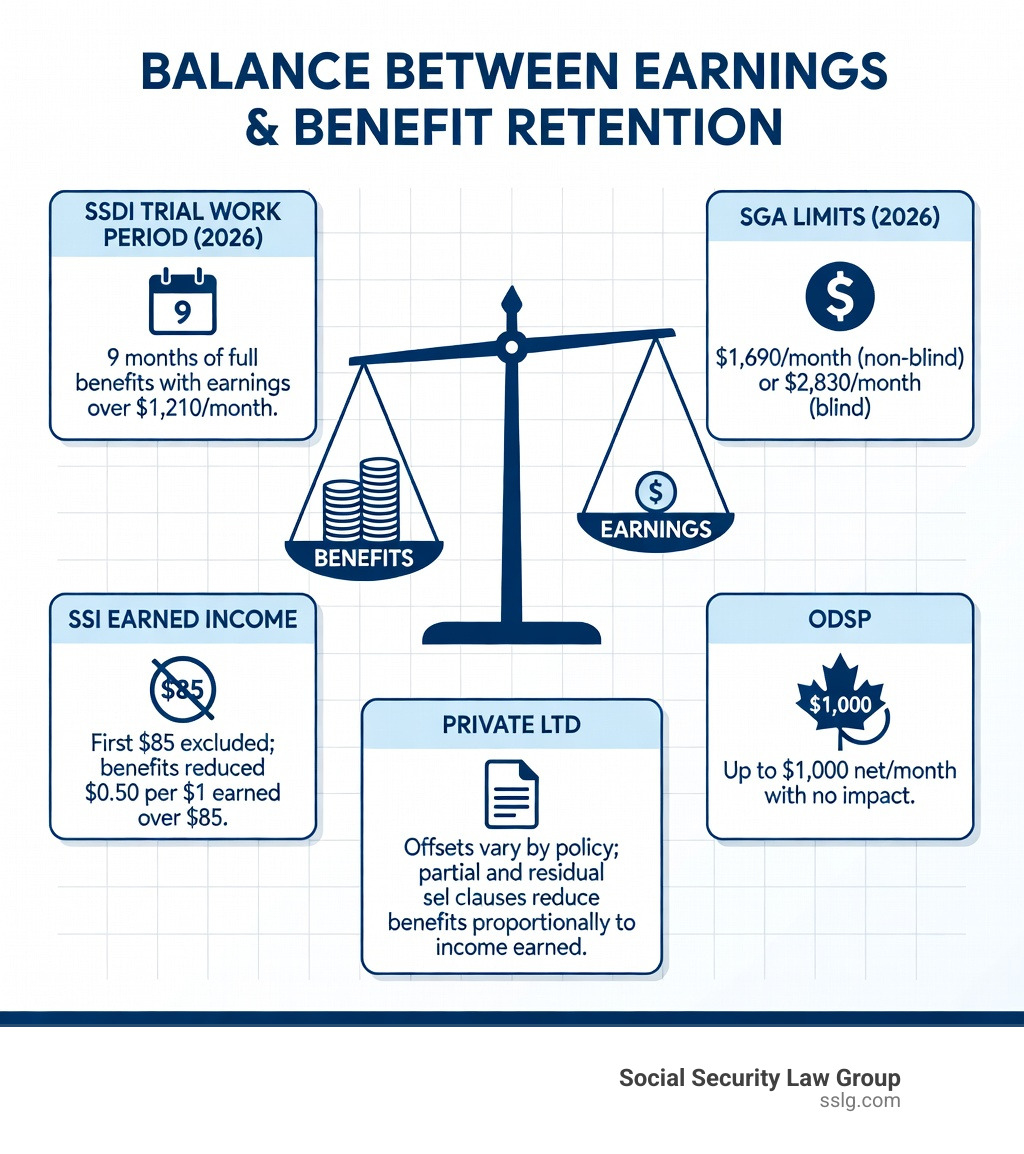
Understanding the Rules to Work While Disabled

Navigating the workforce while managing a disability requires a clear understanding of how the Social Security Administration (SSA) views your activity. At the Social Security Law Group, we often see clients in cities like Boston, Chicago, and Seattle who want to contribute to their communities but worry about the “financial cliff.”
The most important concept to grasp is Substantial Gainful Activity (SGA). Essentially, the SSA uses SGA as a yardstick to determine if your work is “substantial” (involving significant physical or mental activities) and “gainful” (performed for profit).
If you are working while receiving benefits, the SSA looks at your gross income—that is, your pay before taxes are taken out. This is a common point of confusion. You might think you’re safe because your take-home pay is low, but the SSA counts the full amount your employer pays you.
One of the most frequent questions we hear is, “Will I lose my disability if I work part-time?” The answer depends on whether your earnings cross the SGA threshold. To stay in good standing, you must follow strict reporting requirements, informing the SSA of any changes in your work status, hours, or pay.
Defining Substantial Gainful Activity (SGA)
The SGA limit is updated annually to reflect changes in the national average wage index. For 2026, the SGA threshold for non-blind individuals is $1,690 per month.
However, there are blindness exceptions. If you are legally blind, the SGA limit is significantly higher, set at $2,830 per month for 2026. If your gross monthly earnings stay below these amounts, the SSA generally considers you still disabled under their rules. It’s not just about the money, though; the SSA also evaluates your “work capacity.” If you’re working 40 hours a week but earning very little, they may still investigate whether you have regained the ability to work.
Applying for Benefits While Employed
Many people wonder, “Can I apply for SSI disability while working?” While it is technically possible, it carries significant application risks.
If you are earning near the SGA limit when you apply, the SSA may deny your claim immediately, reasoning that you are already capable of gainful employment. To succeed, your medical evidence must clearly show that despite your attempts to work, your condition prevents you from maintaining “substantial” activity. Part-time limitations are often necessary to ensure your health doesn’t deteriorate further while your claim is pending in locations like Atlanta or Dallas.
SSDI Work Incentives: The Trial Work Period and Beyond
The SSA doesn’t want to punish you for trying to return to the workforce. That’s why they created “work incentives.” For those on Social Security Disability Insurance (SSDI), the most powerful tool is the Trial Work Period (TWP). This period allows you to test your ability to work for at least nine months while receiving your full benefit check, regardless of how much you earn.
Once the TWP ends, you enter the Extended Period of Eligibility (EPE), a 36-month window where you can still receive benefits for any month your earnings fall below the SGA limit.
Navigating the Trial Work Period (TWP) to Work While Disabled
The Trial Work Period is a 9-month “safety net.” In 2026, any month where you earn more than $1,210 (or work more than 80 hours if self-employed) counts as a trial work month.
The beauty of the TWP is that these nine months do not have to be consecutive. The SSA looks for nine cumulative months within a rolling 60-month window. During these months, you get your full SSDI check plus your entire paycheck. Whether you’re in North Carolina or Nevada, this guide to the TWP is essential for anyone wanting to work while disabled.
The 36-Month Extended Period of Eligibility (EPE)
After your nine trial months are used up, the EPE begins. This is often called the “re-entitlement period.” During these 36 months:
- If you earn above SGA: Your benefits are suspended for that month.
- If you earn below SGA: You receive your full benefit check.
This allows for a flexible transition. If your condition flares up and you have to reduce your hours, your benefits can kick back in without a new application. Furthermore, if you become unable to work within five years of your benefits ending, you may qualify for Expedited Reinstatement, bypassing much of the initial application stress.
SSI and the Path to Self-Support
Supplemental Security Income (SSI) operates differently than SSDI. Because SSI is a needs-based program, the SSA looks closely at your other income and your total assets.
| Rule Category | SSI Requirement (2026) |
|---|---|
| Individual Asset Limit | $2,000 |
| Couple Asset Limit | $3,000 |
| Income Exclusion | First $85 of gross monthly earnings ignored |
| Benefit Reduction | $0.50 reduction for every $1 earned over $85 |
To help SSI recipients gain independence, the SSA offers the Plan to Achieve Self-Support (PASS).
Using PASS and Ticket to Work While Disabled
A PASS allows you to set aside money for a specific work goal—like tuition, a business startup, or specialized equipment—without that money counting against your SSI resource limits. You must complete Form SSA-545-BK and have it approved by the SSA.
Additionally, the Ticket to Work program connects you with employment networks and vocational rehabilitation agencies. This program is free and voluntary, helping you find career development support in cities from Miami to Detroit.
Student and Specialized Income Rules
If you are a student under age 22, the Student Earned-Income Exclusion (SEIE) is a massive advantage. In 2026, you can exclude up to $2,410 per month (with an annual cap of $9,730) from your countable income.
Other deductions include Impairment-Related Work Expenses (IRWE)—costs for items like wheelchairs or specialized transportation—and Blind Work Expenses (BWE), which can include guide dog expenses or even professional taxes.
Private Insurance and International Benefit Rules
If you are covered by private Long-Term Disability (LTD) insurance, the rules of the SSA do not apply. Instead, you must scrutinize your specific policy. Many modern policies include partial disability or residual clauses, which allow you to work reduced hours. However, your insurer will likely apply income offsets, reducing your benefit by a percentage of what you earn.
Private LTD Policy Pitfalls
The biggest “trap” in private insurance is the shift from Own Occupation to Any Occupation. For the first two years, you might be considered disabled if you can’t do your specific job (e.g., a surgeon with a hand tremor). After two years, the insurer may stop payments if they believe you can do any job (e.g., teaching medical school).
Always document your baseline salary before reducing hours. If you go part-time before filing a claim, the insurer might use your new, lower part-time salary as the basis for your benefits, potentially costing you thousands. Veterans’ disability benefits also have unique rules regarding service-connected injuries.
Practical Steps for a Safe Return to Employment
Before you jump back into the workforce, take these steps to protect your claim:
- Consult Your Physician: Get clear medical clearance. If your doctor’s notes say you can’t stand for more than 10 minutes, but you take a job as a retail clerk, the SSA or your insurer will likely terminate your benefits.
- Understand Self-Employment Rules: If you decide to be a content creator or start a small business, the SSA applies the 80-hour rule. Working more than 80 hours a month can trigger a trial work month, even if you aren’t profitable yet.
Reporting and Documentation Best Practices
Accuracy is your best defense against overpayment notices. Use the Payroll Information Exchange (PIE) if your employer participates, as it automates wage reporting to the SSA. Always keep receipts for work-related expenses and ask your employer about subsidies. For example, if your employer gives you extra breaks or fewer duties because of your disability but pays you a full wage, part of that income is a “subsidy” and shouldn’t count toward your SGA limit.
Frequently Asked Questions about Working on Disability
Can I work part-time without losing my SSDI?
Yes, as long as your gross monthly earnings remain below the SGA limit ($1,690 in 2026 for non-blind). During your Trial Work Period, you can even exceed this limit for nine months without losing any benefits.
What happens if my medical condition worsens after I start working?
If you are within your 36-month Extended Period of Eligibility or the 5-year Expedited Reinstatement window, you can get your benefits back relatively quickly without having to file a brand-new application from scratch.
How does self-employment affect my disability claim?
The SSA looks at both your income and the “worth” of your work. If you are doing significant work that would normally command a high salary, they may consider it SGA even if your business isn’t making a profit yet.
Conclusion
Finding the balance to work while disabled is a journey that requires both courage and caution. Whether you are in Charlotte, Jacksonville, or San Antonio, the Social Security Law Group is here to ensure your rights are protected.
Since 1994, we have maintained a 97% success rate by combining unrivaled legal expertise with modern technology. We operate on a no-win, no-fee structure, meaning you don’t owe us a dime unless we secure your benefits. Don’t let the complexity of the SSA rules keep you from your goals. Contact our experts for help with California disability claims or any claim across our national locations today.