


What You Need to Know About SSI vs SSDI
When it comes to SSI vs SSDI, both programs are run by the Social Security Administration and support people with disabilities. But they work very differently. One is based on your work history. The other is based on your financial need.
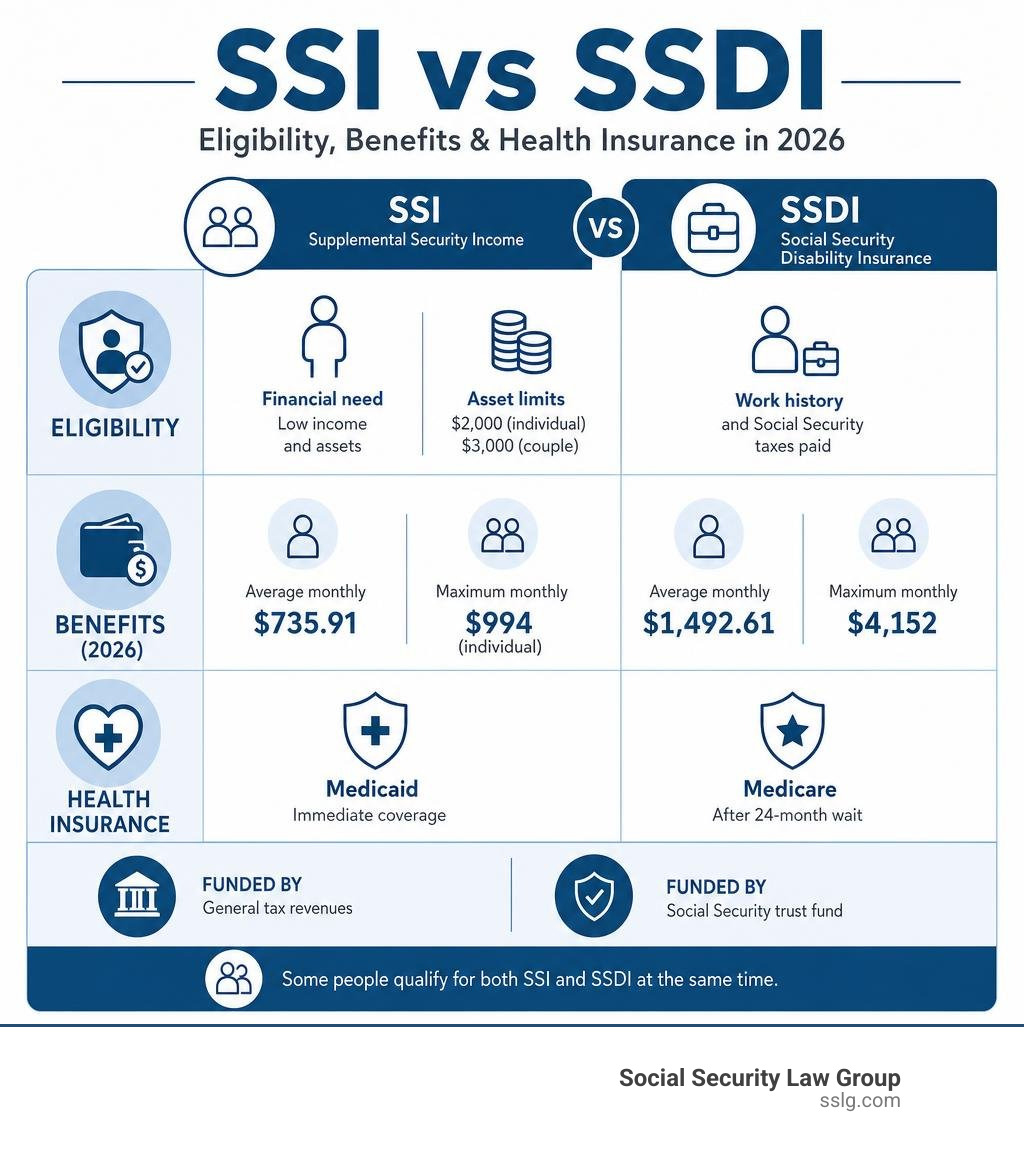
Here is a quick breakdown of the key differences:
| Feature | SSDI | SSI |
|---|---|---|
| Based on | Work history and Social Security taxes paid | Financial need (low income and assets) |
| Work history required | Yes | No |
| Average monthly benefit (2026) | $1,492.61 | $735.91 |
| Maximum monthly benefit (2026) | $4,152 | $994 (individual) |
| Health insurance | Medicare (after 24-month wait) | Medicaid (immediate) |
| Asset limits | None | $2,000 (individual), $3,000 (couple) |
| Funded by | Social Security trust fund | General tax revenues |
If you have worked and paid Social Security taxes for many years, you likely want to look at SSDI first. If you have little income or savings and cannot work, SSI may be your path. Some people qualify for both at the same time.
The process can feel overwhelming, especially when you are already dealing with a serious health condition. Only about 36% of initial SSDI claims are approved, which means most people face at least one denial before getting the help they need.
At Social Security Law Group, we have provided expert legal representation for SSD and SSI claims since 1994. With a 97% success rate and a no-win, no-fee structure, we help our clients understand exactly how work affects their eligibility. We support clients nationwide, from California, Oregon, and Washington, to Texas, Florida, and Massachusetts, using modern technology to ensure your claim is handled with the precision it deserves.
This guide covers everything you need to know about both programs so you can understand your options and take the right next step.
The information provided in this blog article is intended to be general in nature and should not be construed as legal advice. Social Security laws and regulations are subject to, and often change. Please consult the official Social Security Administration (SSA) website or contact SSLG for advice regarding your specific legal matters.
What is the Main Difference Between SSI vs SSDI?
To understand the core comparison of SSI vs SSDI, we must look at how each program is built. While both exist to provide vital financial support to people with disabling conditions, they are governed by entirely different parts of the Social Security Act.
SSDI is authorized under Title II of the Act. It is an insurance program. Just like auto or home insurance, you must pay premiums to remain covered. For SSDI, your premiums are paid in the form of Federal Insurance Contributions Act (FICA) taxes taken directly out of your paychecks. If you have worked long enough and paid these taxes, you are insured.
SSI is authorized under Title XVI of the Act. It is a needs-based public assistance program. It does not look at your work history. Instead, it is designed strictly to help disabled, blind, or elderly individuals who have very limited income and resources.
The funding sources for these programs are also completely separate. SSDI payments are drawn directly from the Social Security Disability Insurance Trust Fund, which is built on the FICA taxes workers pay. SSI is not funded by Social Security taxes at all. Instead, SSI benefits are paid out of the general tax revenues of the United States Treasury.
For a deeper look into how these programs differ structurally, you can read our guide on What is the Difference Between SSI and SSDI?. You can also review the official government breakdown in the Overview of our Disability Programs | The Red Book | SSA.
Eligibility Requirements for SSDI and SSI
To qualify for either program, you must first meet the strict medical definition of disability used by the federal government. According to the Social Security Administration, you must have a medically determinable physical or mental impairment that prevents you from engaging in Substantial Gainful Activity (SGA). This impairment must be expected to last for a continuous period of at least 12 months or result in death.
Under the Comparison of Supplemental Security Income (SSI), the SGA limit for non-blind individuals in 2026 is $1,690 per month. If you are earning more than this amount from working, the government will generally determine that you are not disabled, regardless of your medical diagnosis.
Beyond this shared medical standard, the non-medical eligibility rules for each program diverge significantly.

For a comprehensive review of the specific criteria, you can check our detailed breakdowns on SSDI Eligibility and SSI Qualifications.
How Work Credits Affect SSDI in the SSI vs SSDI Equation
Because SSDI is an insurance program, you must have earned enough work credits through your employment history to qualify. You earn credits when you work and pay FICA taxes. In 2026, you earn one credit for every $1,890 in covered earnings, up to a maximum of four credits per year.
To qualify for SSDI, most workers need to meet two distinct tests:
- The Recent Work Test: You must have worked recently enough. For most applicants over age 31, this means you must have earned at least 20 credits in the 10 years immediately before your disability began (essentially working five out of the last 10 years).
- The Duration of Work Test: You must have worked long enough in total. Most adults need a cumulative total of 40 work credits (equivalent to 10 years of work), though younger workers may qualify with fewer credits.
If you stop working and let many years pass before applying, your insured status can expire. This is why understanding your work history is vital when reviewing SSDI Benefits Overview.
How Income and Asset Limits Define SSI in the SSI vs SSDI Framework
SSI does not care about your work credits. You can qualify even if you have never worked a single day in your life. However, because it is a safety net for those in severe financial need, it has incredibly strict income and asset limits.
To receive SSI, your countable resources (assets) must not exceed:
- $2,000 for an individual
- $3,000 for a married couple
Countable assets include cash, bank accounts, stocks, bonds, and any real estate other than your primary home. The government does exclude certain resources, such as the home you live in, one vehicle used for transportation, and up to $100,000 held in an Achieving a Better Life Experience (ABLE) account.
Your monthly income is also heavily scrutinized. Any money you earn from working, as well as unearned income like pensions, state disability, or even free shelter provided by family, can reduce your monthly SSI payment or disqualify you entirely. You can learn more about these strict rules in our SSI Benefits Overview.
Monthly Benefit Amounts and Health Insurance in 2026
The financial support and health insurance options provided by these programs look very different in 2026.
For SSDI, your monthly payment is calculated based on your lifetime average earnings. If you had a high-paying career before your disability, your monthly benefit will be higher. According to the Overview of our Disability Programs | The Red Book | SSA, the average SSDI monthly benefit for all recipients in 2026 is approximately $1,630, while the maximum possible monthly benefit is $4,152 for a worker retiring at full retirement age.
For SSI, the benefit is a flat rate set by the federal government. In 2026, the maximum Federal Benefit Rate (FBR) is:
- $994 per month for an individual
- $1,491 per month for a couple
Any countable income you receive each month is subtracted from this maximum rate, which is why the actual average monthly SSI payment is closer to $735.91.

Health insurance coverage is another critical area of comparison:
- SSDI and Medicare: If you are approved for SSDI, you will eventually qualify for Medicare. However, under the rules explained in SSI vs SSDI: Disability benefits and Medicare, there is a mandatory 24-month waiting period from your date of entitlement before your Medicare coverage actually begins. The only exceptions to this wait are for individuals diagnosed with Amyotrophic Lateral Sclerosis (ALS) or End-Stage Renal Disease (ESRD).
- SSI and Medicaid: If you are approved for SSI, you generally qualify for Medicaid immediately. In most states, your Medicaid enrollment is automatic as soon as your SSI application is approved, ensuring you have healthcare coverage without a long transition period.
Can You Receive Both SSDI and SSI at the Same Time?
Yes, it is entirely possible to receive concurrent benefits. If you have enough work credits to qualify for SSDI, but your past earnings were very low, your monthly SSDI check might be less than the 2026 SSI individual maximum of $994.
In this scenario, you can apply for both programs. The government will allow SSI to supplement your low SSDI payment, bringing your total monthly benefit up to the SSI limit (plus a small $20 general income exclusion).
Receiving concurrent benefits also means you can get the best of both healthcare worlds: immediate Medicaid coverage to handle your current medical bills, followed by Medicare coverage once your 24-month SSDI waiting period has passed. For an in-depth look at how these calculations work, read our guides on Can You Get SSDI and SSI at the Same Time? and How Much Does SSI and SSDI Pay Together?.
Application Process, Waiting Periods, and Appeals
Applying for disability benefits requires careful preparation and an abundance of patience.
The timeline for these programs is structured differently:
- SSDI Waiting Period: SSDI has a mandatory five-month waiting period from the established onset date of your disability. You will not receive monthly benefit payments for these first five months.
- SSI Waiting Period: SSI has no waiting period. Your benefits can begin in the first full month after you file your application, or the month after you meet all eligibility requirements.
Back pay, or retroactive benefits, is another area where the rules diverge. SSDI allows you to receive retroactive payments for up to 12 months prior to your application date, provided you were disabled during that time. SSI back pay, however, is strictly limited. It only calculates back to the first full month after your application filing date.
To explore these rules further, see our guides on SSI Disability and SSDI Requirements.
The path from application to approval typically follows a multi-step sequence.
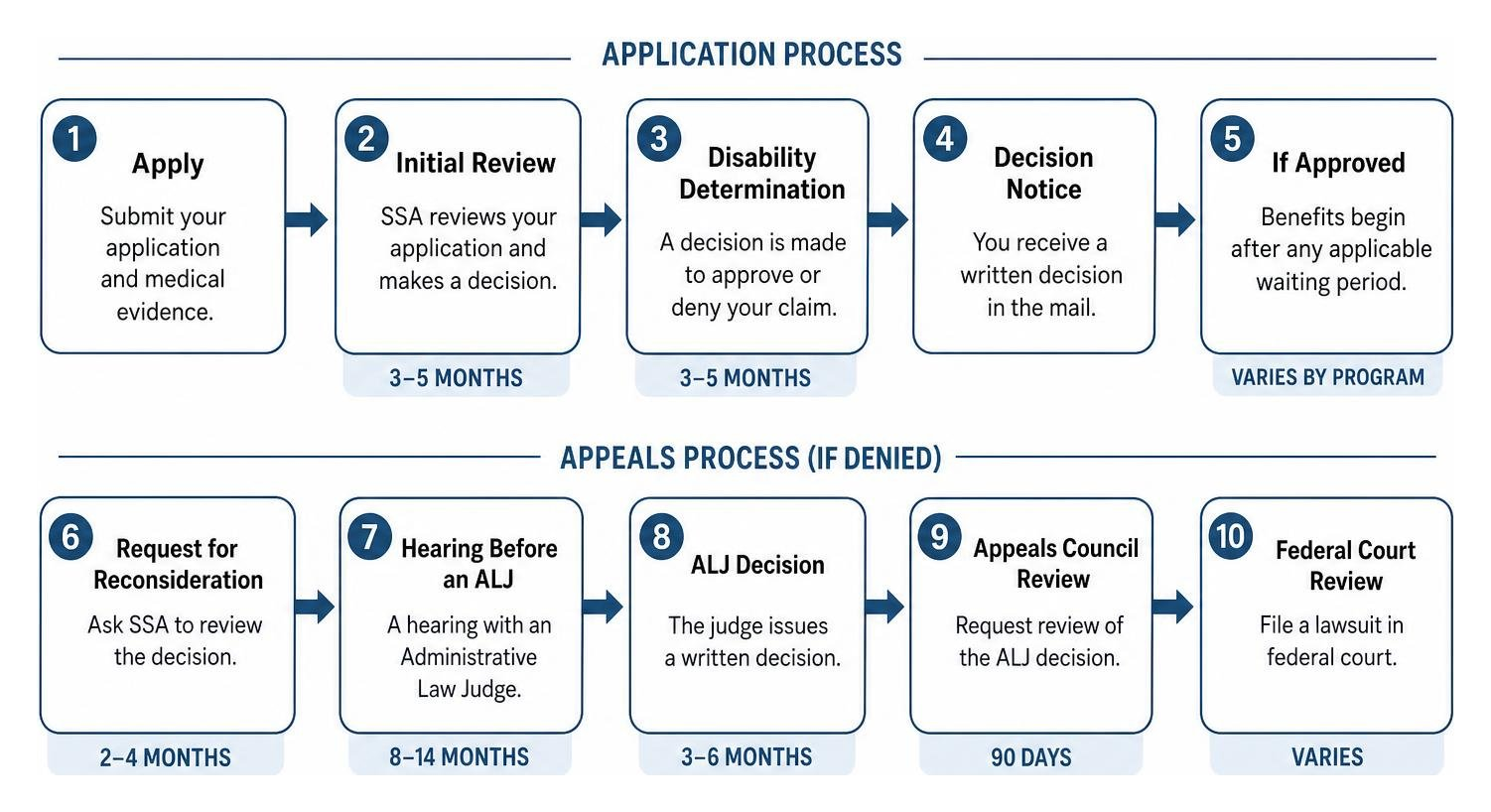
Because the Social Security Administration denies the majority of initial applications, you must be prepared to appeal. The appeals process includes a Request for Reconsideration, followed by a hearing before an Administrative Law Judge (ALJ). Working with an experienced legal team can significantly improve your chances of success during these challenging stages.
Frequently Asked Questions About SSI vs SSDI
What happens to my benefits if I return to work?
If you receive SSDI, the government offers a Trial Work Period (TWP) to help you test your ability to work. Under the Overview of our Disability Programs | The Red Book | SSA, you can work and earn any amount for up to nine months (not necessarily consecutive) within a rolling 60-month window, and still receive your full SSDI check. In 2026, any month where you earn more than $1,210 triggers a trial work month.
For SSI, there is no Trial Work Period. Because SSI is needs-based, any earned income will directly affect your monthly payment. The SSA uses a specific formula to exclude the first $65 of your earned wages (plus an additional $20 of general income), and then reduces your SSI check by $1 for every $2 you earn.
Why are SSDI and SSI claims commonly denied?
The most common reason for a denial is a lack of sufficient medical evidence. The government needs to see consistent, ongoing treatment records from specialists to prove that your condition prevents you from working.
Other common triggers for denial include earning more than the SGA limit of $1,690 per month while applying, or failing to follow your doctor’s prescribed treatment plan. For SSI, exceeding the strict $2,000 asset limit is also a frequent cause for administrative denial. To understand which program has a higher bar for approval, read our analysis: SSI vs SSDI: Which is Harder to Get?.
How do state supplements affect SSI payments?
While the federal government sets the baseline SSI rate ($994 for individuals in 2026), many states offer an optional state supplement to help cover basic living expenses. The availability and administration of these supplements vary widely by geography.
For example, states like Massachusetts and Washington provide significant state-administered supplements that increase the monthly check for SSI recipients. Other states, like Texas and Florida, do not offer a state-funded supplement for individuals living independently, meaning recipients in those areas receive only the federal benefit rate.
Conclusion
Deciding between SSI vs SSDI and navigating the complex application guidelines can feel like an uphill battle. The strict medical requirements, confusing work credit rules, and high initial denial rates leave many applicants feeling discouraged.
At Social Security Law Group, we have dedicated our practice to disability law since 1994. We maintain a 97% success rate and operate on a no-win, no-fee structure, meaning you pay nothing unless we win your case. Our team utilizes modern client technology to provide efficient, high-quality representation to clients nationwide.
Whether you need support from our offices in Boston, Chicago, Detroit, Dallas, Houston, San Antonio, Miami, Orlando, Tampa, Jacksonville, Phoenix, Atlanta, or Seattle, we are here to help you secure the benefits you deserve.
To take the first step toward securing your financial future, explore our Supplemental Security Income Services or contact our legal team today for a free case evaluation.
The information provided in this blog article is intended to be general in nature and should not be construed as legal advice. Social Security laws and regulations are subject to, and often change. Please consult the official Social Security Administration (SSA) website or contact SSLG for advice regarding your specific legal matters.