
What It Means When Dementia Is Classified as a Disability
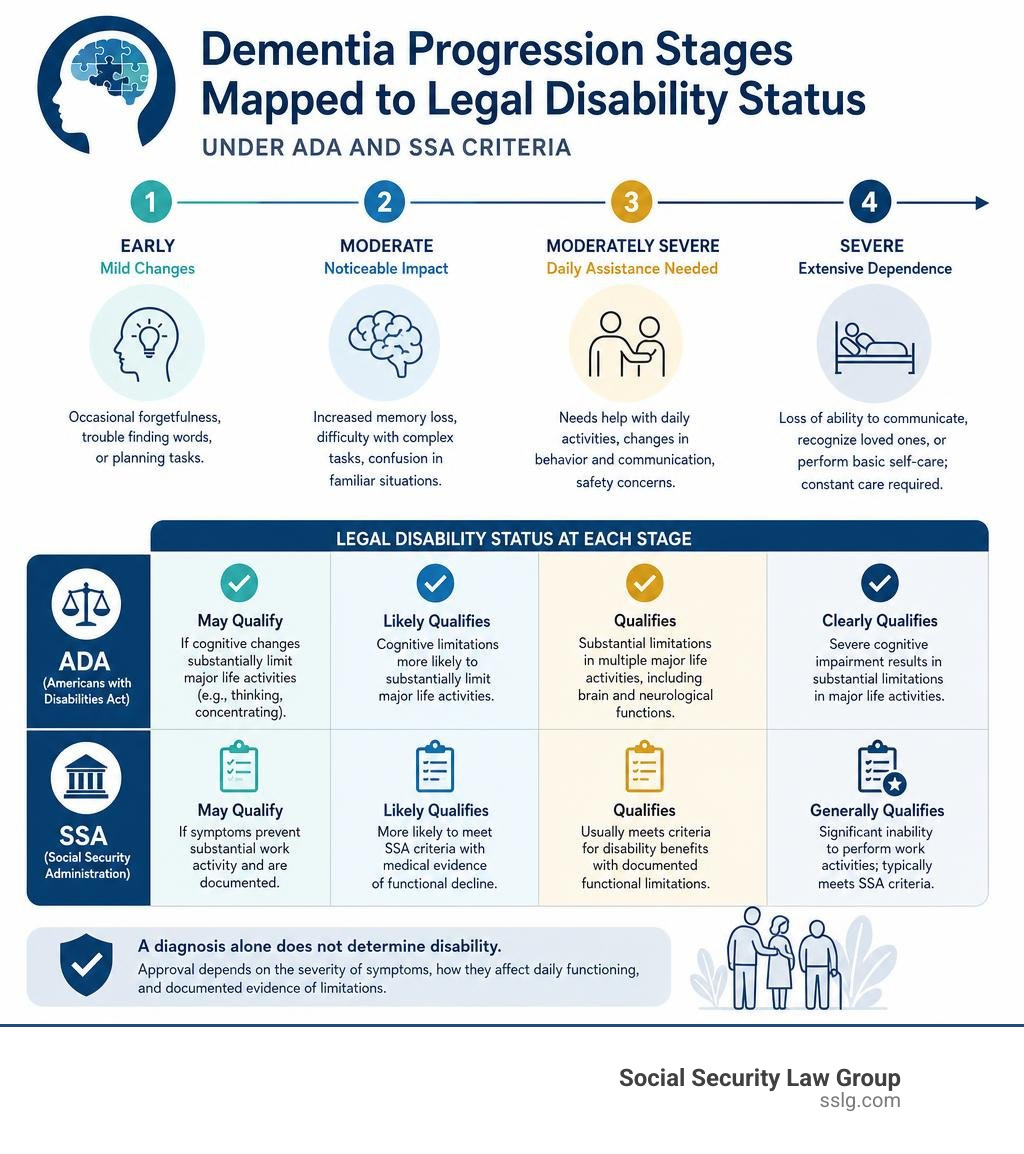
Is dementia a disability? Yes. Under U.S. law, dementia qualifies as a disability when it substantially limits major life activities such as thinking, concentrating, communicating, or caring for oneself.
Here is a quick breakdown:
- Under the ADA: Dementia is a disability if it substantially limits one or more major life activities, including brain and neurological functions. This applies even if symptoms are managed with medication. (42 U.S. Code § 12102)
- Under the SSA: Dementia may qualify for disability benefits if it prevents substantial work activity, is expected to last at least 12 months, and is supported by medical evidence of significant cognitive or functional decline.
- Automatic approval? Not always. Approval depends on the severity of symptoms and how they affect daily functioning, not the diagnosis alone.
- Fast-track option: Certain dementia types, including early-onset Alzheimer’s and Lewy body dementia, may qualify for expedited review through the Social Security Compassionate Allowances program.
In 2026, an estimated 7 million adults in the United States are living with dementia, and that number is expected to nearly double by 2060. More than 80% of people with moderate to severe dementia need help with basic daily tasks like bathing, dressing, or managing medications. For many, the question of disability status is not just legal. It is financial survival.
Navigating the Social Security system while dealing with a dementia diagnosis can feel overwhelming. This guide explains exactly where you stand legally and what steps can help secure the benefits you need.
Other conditions related to is dementia a disability:
Is Dementia a Disability Under U.S. Law?

To answer the question of whether dementia is a disability, we must look at how different federal frameworks define the term. In the United States, the two primary authorities on disability rights and benefits are the Americans with Disabilities Act (ADA) and the Social Security Administration (SSA). Both agencies recognize cognitive impairments, but they apply different standards to determine eligibility for protections and financial assistance.
Under 42 U.S. Code § 12102 – Definition of disability, a disability is defined as a physical or mental impairment that substantially limits one or more major life activities. The law explicitly states that major life activities include cognitive processes such as thinking, concentrating, learning, reading, and communicating. Furthermore, the statute covers the operation of major bodily functions, which directly includes neurological and brain functions.
Because dementia is a progressive neurological condition that directly degrades brain function, it fits squarely within this legal definition. This remains true even if an individual uses medications or coping strategies to temporarily manage their symptoms. According to federal law, the determination of whether an impairment is a disability must be made without considering the positive, ameliorative effects of mitigating measures.
The Americans with Disabilities Act (ADA) and Cognitive Impairments
The Americans with Disabilities Act of 1990, As Amended protects individuals with dementia from discrimination in various settings, including the workplace, public entities, and public accommodations. Under Title I of the ADA, which applies to employers with 15 or more employees, individuals with early-stage dementia are protected from workplace discrimination as long as they can perform the essential duties of their job with or without reasonable accommodations.
Reasonable accommodations for employees experiencing early cognitive decline might include:
- Written checklists and memory aids to track daily tasks.
- Modified work schedules or transition to part-time hours to combat cognitive fatigue.
- A quiet workspace with minimal distractions to aid concentration.
- Job restructuring to reallocate non-essential duties to other team members.
Employers are required to provide these accommodations unless doing so would impose an undue hardship, meaning significant difficulty or expense. Additionally, the ADA requires that all medical records and information related to an employee’s dementia diagnosis be kept strictly confidential and stored in separate medical files.
When Is Dementia a Disability Under SSA Guidelines?
While the ADA focuses on protecting rights and providing workplace accommodations, the SSA has a much stricter standard. To qualify for financial benefits, you must prove that your condition meets the criteria for qualifying disabilities for Social Security. The SSA does not evaluate whether you can work with accommodations. Instead, they determine if your impairment completely prevents you from engaging in substantial gainful activity (SGA) for a period expected to last at least 12 consecutive months.
To make this determination, claims examiners refer to the SSA Blue Book, which lists medical criteria for specific impairments. Dementia is evaluated under two primary categories:
- Section 12.02 (Neurocognitive Disorders): This section is used for cognitive decline that is not primarily physical in nature. To meet this listing, medical documentation must show a significant cognitive decline in areas such as memory, executive function, language, or social cognition, along with a extreme limitation in at least one, or a marked limitation in two, areas of mental functioning. These areas include understanding information, interacting with others, concentrating on tasks, and managing oneself.
- Section 11.00 (Neurological Disorders): If the dementia is caused by a primary neurological disease, such as Huntington’s disease or Parkinson’s disease, the SSA may evaluate the claim under the neurological listings. These listings focus on physical limitations, such as the inability to control movement in two extremities, which results in extreme difficulty in standing up, walking, or using the hands.
Qualifying for Social Security Disability Benefits with Dementia

Securing disability benefits for a dementia diagnosis requires demonstrating that the disease has progressed to a stage where working is no longer possible. Because dementia is progressive, an individual in the very early stages of mild cognitive impairment may not immediately qualify for financial assistance. However, as the disease advances and functional limitations increase, the likelihood of approval rises significantly.
When applying, it helps to understand what conditions automatically qualify you for disability. While a standard diagnosis of late-onset Alzheimer’s disease does not grant automatic approval, the SSA has established pathways to expedite the process for specific, severe types of dementia.
The Compassionate Allowances (CAL) Program for Fast-Tracked Claims
For individuals facing rapidly progressive or early-onset forms of dementia, the standard multi-month disability evaluation process can cause immense financial and emotional strain. To address this, the SSA created the Social Security Compassionate Allowances initiative. This program identifies severe medical conditions that by definition meet the statutory standard for disability, allowing the SSA to fast-track these applications for expedited approval.
Several types of dementia are included on the CAL list:
- Early-Onset Alzheimer’s Disease: Diagnosed in individuals under the age of 65, this condition often progresses rapidly and severely impacts working-age adults.
- Frontotemporal Dementia (FTD): Also known as Pick’s disease, this form of dementia primarily affects the frontal and temporal lobes of the brain, causing profound changes in behavior, personality, and language.
- Lewy Body Dementia: A progressive brain disorder characterized by atypical protein deposits that affect thinking, movement, behavior, and mood.
- Creutzfeldt-Jakob Disease: A rare, degenerative, and invariably fatal brain disorder that progresses extremely rapidly.
If an applicant has a confirmed diagnosis of a condition on the CAL list, the SSA’s software automatically flags the application for expedited processing. This can reduce the wait time for a decision from several months to just a few weeks, provided that the medical evidence is complete and clear.
Differences Between SSDI and SSI for Dementia Patients
When seeking financial support, applicants must understand the distinction between the two main disability programs managed by the SSA. Both programs require the same medical standard of disability, but their financial eligibility rules are entirely different.
To help clarify these differences, we have outlined the core requirements for each program:
| Feature | Social Security Disability Insurance (SSDI) | Supplemental Security Income (SSI) |
|---|---|---|
| Eligibility Basis | Based on work history and Social Security tax contributions. | Based on financial need, limited income, and asset limits. |
| Work Credits | Requires a specific number of work credits based on age at the time of disability. | No work history or work credits required. |
| Asset Limits | No asset or resource limits. | Limited to $2,000 for individuals and $3,000 for couples. |
| Healthcare Link | Qualifies the recipient for Medicare (usually after a 24-month waiting period). | Qualifies the recipient for Medicaid immediately in most states. |
For a deeper look at how these rules apply to cognitive conditions, read our guide on understanding disability eligibility for specific medical conditions.
Medical Evidence and Functional Limitations Required for Approval
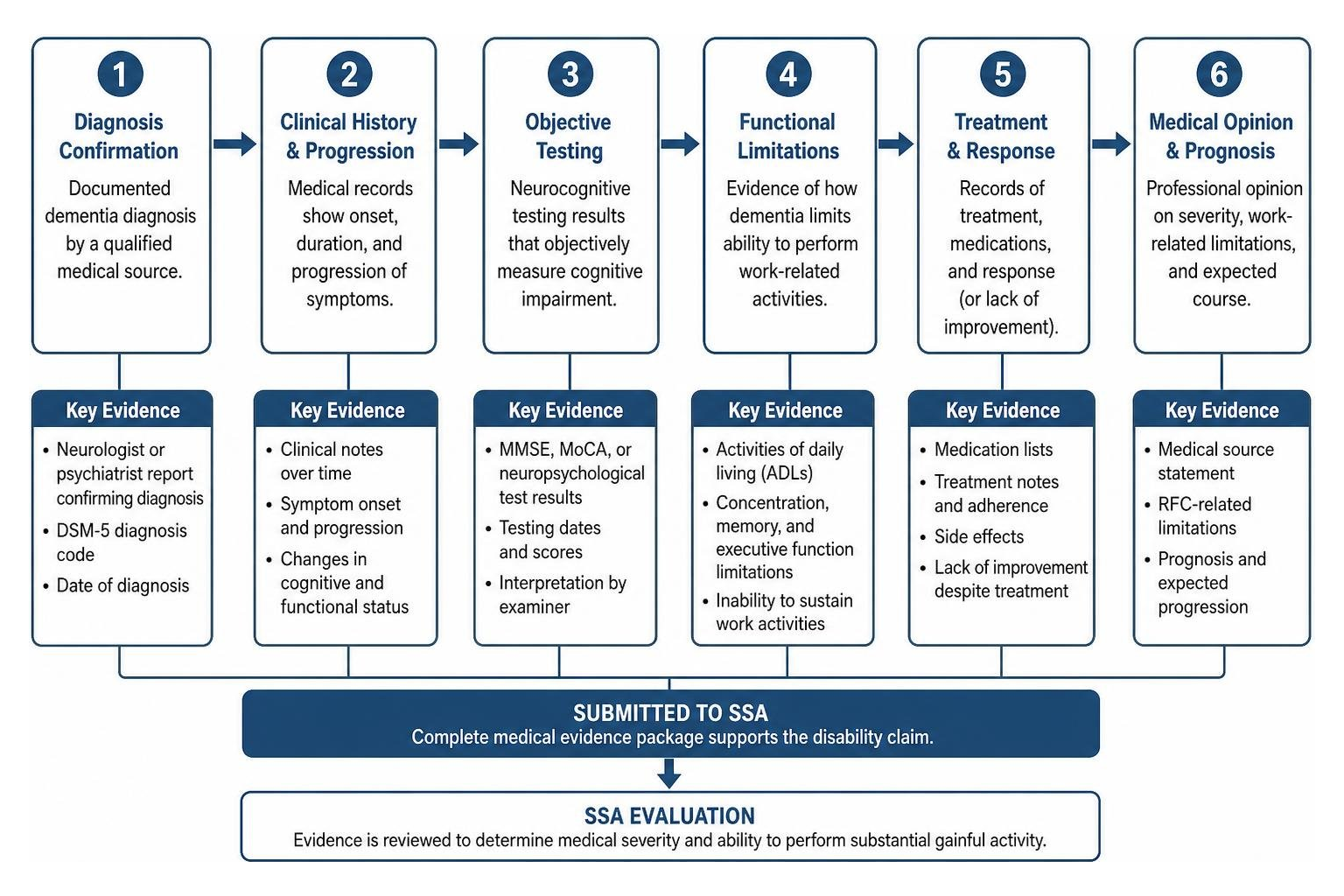
The success of a disability claim for dementia relies heavily on the quality and depth of the medical evidence submitted. The SSA will not approve a claim based solely on a statement from a doctor saying that a patient has dementia. Instead, the agency requires objective clinical findings that prove the diagnosis and document the resulting functional limitations.
To understand the broader requirements, you can review our resource on what medical conditions qualify for Social Security disability. For dementia specifically, the medical record should include:
- Comprehensive Clinical History: Detailed notes from neurologists, psychiatrists, or neuropsychologists tracking the onset and progression of symptoms.
- Neurocognitive Testing: Standardized test results, such as the Mini-Mental State Examination (MMSE), Montreal Cognitive Assessment (MoCA), or detailed neuropsychological testing batteries, which objectively measure memory, attention, and executive function.
- Brain Imaging: Results from MRI, CT, or PET scans that show physical changes in the brain, such as cortical atrophy or amyloid plaques, which support the clinical diagnosis.
- Clinical Dementia Rating (CDR): A standardized scale used by clinicians to stage the severity of cognitive impairment.
- Laboratory Work: Blood tests and other laboratory evaluations used to rule out reversible causes of cognitive decline, such as vitamin deficiencies or thyroid disorders.
Key Functional Limitations for the Disability Determination
To determine whether an applicant can work, the SSA assesses their residual functional capacity (RFC). This assessment looks at how the cognitive and physical limitations caused by dementia restrict the individual’s ability to perform basic work activities. The most critical functional limitations evaluated in dementia claims include:
- Memory Loss: The inability to retain new information, remember simple instructions, or recall routine procedures.
- Concentration and Pace: Extreme difficulty maintaining focus long enough to complete simple, repetitive tasks in a timely manner.
- Communication Barriers: Difficulty expressing thoughts clearly, understanding spoken or written language, or following conversations.
- Impaired Judgment and Safety Risks: Poor decision-making abilities that present safety hazards, such as forgetting to turn off equipment, wandering, or failing to recognize workplace dangers.
- Loss of Activities of Daily Living (ADLs): Requiring assistance or supervision to manage personal hygiene, prepare meals, dress, or take medications safely.
Special Considerations for Early-Onset and Younger-Onset Dementia
Early-onset Alzheimer’s and other younger-onset dementias present unique challenges for disability claims. Because these individuals are diagnosed before the age of 65, they are often still in their peak working years. The sudden loss of income can cause severe financial strain on families who may still be paying off mortgages or supporting children.
From an administrative standpoint, younger applicants are often scrutinized more closely by the SSA because the agency’s vocational rules generally favor older individuals. However, because early-onset conditions often progress rapidly, securing comprehensive medical records early is vital. Documenting the transition from high-functioning employment to cognitive impairment is essential for establishing the onset date of the disability.
Why Is Dementia a Disability for Tax Purposes?
In the United States, a dementia diagnosis also carries significant implications for tax planning. The Internal Revenue Service (IRS) recognizes dementia as a chronic illness, which opens up several tax credits and deductions designed to ease the financial burden on patients and their caregivers.
Available tax relief options include:
- Medical Expense Deductions: Taxpayers can deduct qualified medical expenses that exceed 7.5% of their adjusted gross income (AGI). For those with dementia, qualifying expenses include doctors’ fees, specialized therapies, prescription medications, home modifications for safety, and the cost of long-term care services.
- Child and Dependent Care Credit: If you claim a loved one with dementia as a dependent so that you can continue working, you may qualify for a tax credit that covers up to 35% of caregiving expenses, such as adult day care or in-home care services.
- Long-Term Care Insurance Deductions: Premiums paid for qualified long-term care insurance policies may be tax-deductible as medical expenses, subject to limits based on the taxpayer’s age.
Because tax laws are highly complex and subject to annual adjustments, families navigating these financial decisions should consult a qualified accountant or tax professional.
Frequently Asked Questions About Dementia as a Disability
Is dementia a disability that automatically qualifies for monthly benefits?
No, a diagnosis of dementia does not automatically qualify an individual for monthly Social Security benefits. The SSA evaluates claims based on the severity of the symptoms and how they impact the applicant’s ability to work. To qualify, you must provide comprehensive medical documentation showing that your cognitive decline causes severe functional limitations that prevent you from engaging in substantial gainful activity. The only exception is if your specific diagnosis is listed under the Compassionate Allowances program, which fast-tracks the review process but still requires objective medical proof of the diagnosis.
Can you work while receiving disability benefits for early-stage dementia?
It is possible, but highly restricted. The SSA allows disability beneficiaries to attempt to work through programs like the Trial Work Period, which lets you test your ability to work for up to nine months without losing your benefits. However, if your monthly earnings exceed the limit for Substantial Gainful Activity, which is adjusted annually by the SSA, your benefits may be suspended or terminated. Additionally, under the ADA, you have the right to request reasonable accommodations from your employer to help you continue working in the early stages of the disease.
What is the fastest way to get disability approved for a dementia diagnosis?
The fastest way to secure approval is to ensure your claim is processed under the SSA’s Compassionate Allowances (CAL) program. If your loved one has been diagnosed with early-onset Alzheimer’s, frontotemporal dementia, or Lewy body dementia, make sure your neurologist’s clinical notes clearly state this specific diagnosis. Submitting a complete application that includes all relevant cognitive test results, brain imaging, and detailed medical records right from the start will help the SSA expedite their review and avoid costly delays.
Conclusion
Determining is dementia a disability is the first step toward securing the protections and financial support your family deserves. Under both the ADA and the SSA, cognitive decline is legally recognized as a disabling condition, but navigating the strict medical and vocational requirements of the federal system requires precision, patience, and deep legal expertise.
At Social Security Law Group, we have dedicated our practice to representing clients in Social Security Disability claims since 1994. With a 97% success rate and a no-win, no-fee structure, we provide compassionate, expert legal representation to families facing the challenges of a dementia diagnosis. We utilize modern client technology to streamline the application process, ensuring that your claim is filed accurately and evaluated as quickly as possible.
Whether you are applying from Denver, Boston, Dallas, or Seattle, our team is here to guide you through every step of the process. If you are ready to explore your options and secure the benefits your family needs, contact us today to learn more about applying for SSI disability benefits and scheduling a free consultation.
The information provided in this blog article is intended to be general in nature and should not be construed as legal advice. Social Security laws and regulations are subject to, and often change. Please consult the official Social Security Administration (SSA) website or contact SSLG for advice regarding your specific legal matters.