


When Standing Becomes a Disability: What POTS Patients Need to Know
Is POTS a disability? Yes. POTS (Postural Orthostatic Tachycardia Syndrome) can qualify as a disability under Social Security Administration (SSA) guidelines if your symptoms are severe enough to prevent you from working.
Key Takeaways:
- POTS is not listed in the SSA Blue Book, but it can still qualify for benefits
- The SSA classifies POTS as a nervous system disorder
- You can qualify through a medical-vocational allowance if your symptoms prevent sustained full-time work
- Both SSDI and SSI benefits are available, depending on your work history and income
- In 2026, the maximum SSDI benefit is $4,152/month and SSI is $994/month (SSA, 2026)
- About 25% of people with POTS cannot maintain employment
Living with POTS means your body struggles to regulate basic functions the moment you stand up. Your heart races, your vision blurs, and your mind goes foggy. For many people, this makes holding a job nearly impossible.
The disability application process can feel just as overwhelming as the condition itself. About 75% of initial disability claims are denied, and POTS cases require extra documentation because the condition does not have its own dedicated Blue Book listing.
This guide explains exactly how POTS qualifies as a disability, what evidence you need, and how to protect your rights.
What is Postural Orthostatic Tachycardia Syndrome (POTS)?
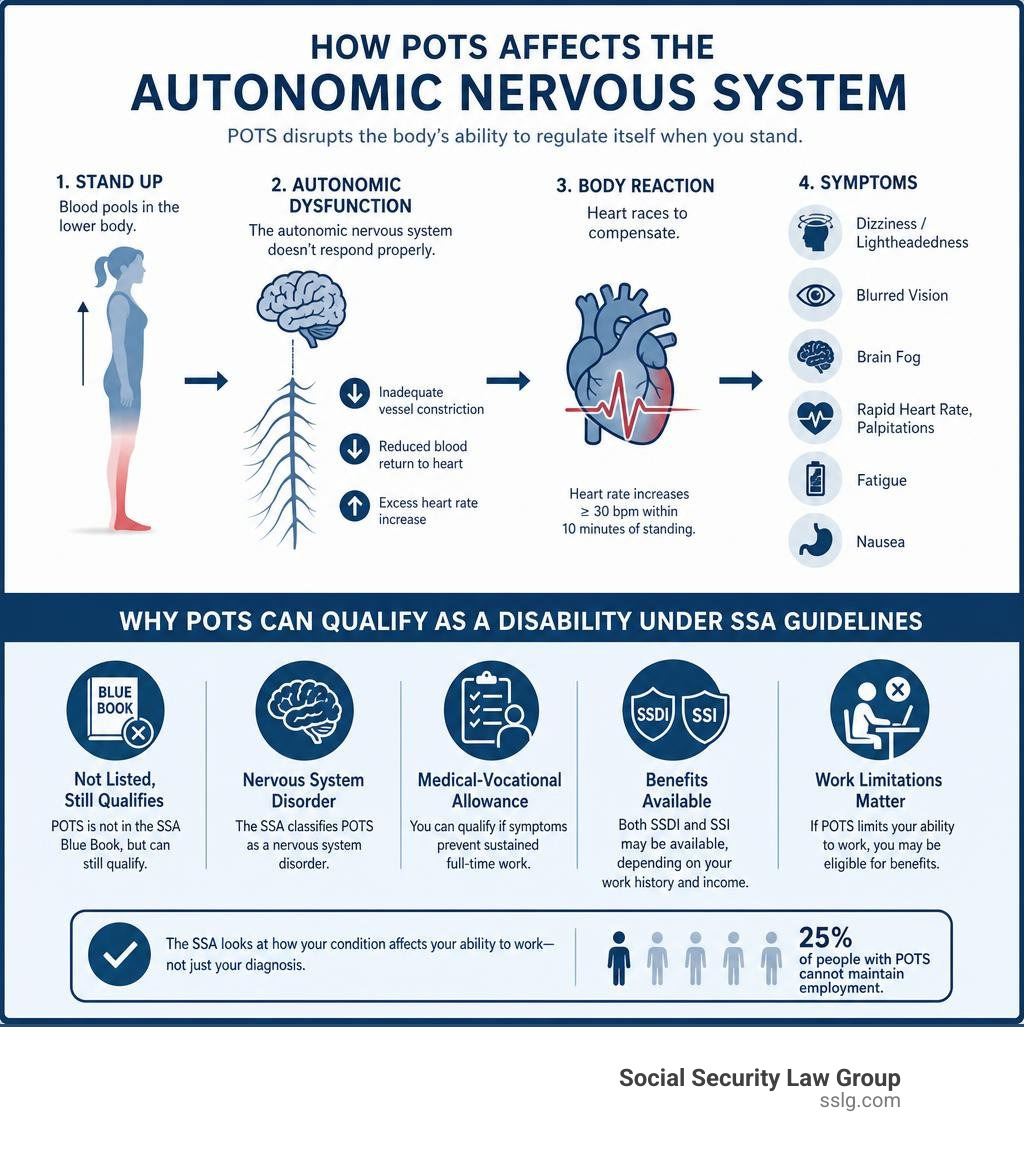
Postural Orthostatic Tachycardia Syndrome (POTS) is a complex, often misunderstood form of dysautonomia. This term refers to a malfunction of the autonomic nervous system, which regulates involuntary bodily functions such as heart rate, blood pressure, digestion, and temperature control.
Under normal circumstances, when a person stands up, the autonomic nervous system coordinates a quick constriction of blood vessels to keep blood flowing steadily to the brain. In individuals with POTS, this coordinate mechanism fails. Blood pools in the lower extremities, causing the heart to beat excessively fast to compensate for the lack of oxygenated blood reaching the upper body. According to the National Institute of Neurological Disorders and Stroke, the hallmark clinical sign of POTS is an abnormal heart rate increase of more than 30 beats per minute (or 40 beats per minute in adolescents) within 10 minutes of standing up, without a corresponding drop in blood pressure.

How POTS Affects Daily Functioning and Employment
POTS is far more than just feeling dizzy upon standing. It is a multi-system, chronic illness that can severely limit basic daily functioning. Simple tasks like showering, cooking, or grocery shopping become monumental challenges. Because gravity is the primary trigger, any activity requiring prolonged standing or sitting upright can provoke a flare-up of symptoms.
This constant orthostatic intolerance makes maintaining traditional employment exceptionally difficult. In approximately 25% of people diagnosed with this condition, the severity of symptoms makes maintaining employment impossible (NINDS, 2026). When a worker cannot reliably stand, walk, or even sit at a desk for a standard workday, applying for Social Security disability benefits becomes a necessary step to secure financial stability.
Common Symptoms That Impair Work Ability
The clinical presentation of POTS varies from person to person, but several primary symptoms regularly impair a person’s ability to work:
- Tachycardia and Heart Palpitations: The rapid, pounding heart rate can cause chest pain, shortness of breath, and severe physical discomfort.
- Brain Fog and Cognitive Impairment: Patients frequently experience difficulty concentrating, memory lapses, and trouble processing information. This makes complex mental tasks, which are common for administrative or professional roles, highly challenging.
- Chronic Fatigue: A profound, systemic exhaustion that is not relieved by sleep can prevent individuals from performing even sedentary job duties.
- Lightheadedness and Syncope: Fainting (syncope) or near-fainting episodes present severe safety hazards in almost any work environment.
- Exercise and Physical Intolerance: Extreme weakness and a lack of physical stamina mean that manual labor or jobs requiring physical exertion are completely out of the question.
Is POTS a Disability Under Social Security Administration Guidelines?
To receive monthly benefits, applicants must understand what medical conditions qualify for Social Security disability. The Social Security Administration (SSA) evaluates claims based on whether a condition prevents an individual from engaging in substantial gainful activity (SGA) for at least 12 consecutive months (SSA, 2026). If your POTS symptoms are severe enough to meet this threshold, the SSA will recognize your condition as a disability.
Navigating the Absence of a Blue Book Listing
The SSA uses a manual called the Blue Book to list conditions that automatically qualify for benefits if specific medical criteria are met. Currently, POTS does not have its own dedicated listing in the Blue Book. However, this does not mean you cannot qualify.
To win a claim, you must demonstrate “medical equivalence.” This means showing that your symptoms and functional limitations are equal in severity to an existing listing. For POTS, we often compare the symptoms to listings in the cardiovascular system (such as recurrent arrhythmias) or the neurological system (such as autonomic neuropathy).
How the SSA Evaluates POTS as a Nervous System Disorder
Because POTS is a form of dysautonomia, the SSA classifies it under diseases of the nervous system. This is a highly common category for disability claims. According to official data, 742,539 workers receive Social Security disability benefits for a disease of the nervous system, which accounts for approximately 10% of all disabled beneficiaries (SSA, 2026).
When evaluating nervous system disorders, the SSA looks closely at how the neurological dysfunction limits your physical and mental capacities. Our legal teams in offices across the country, including Chicago, Boston, Denver, and Seattle, focus on gathering the specific neurological evidence needed to meet these strict administrative standards.
How to Qualify for Social Security Disability Benefits with POTS
To secure disability benefits for POTS, you must navigate the SSA’s strict five-step sequential evaluation process. The primary goal is to prove that you cannot earn more than the monthly SGA limit, which is $1,690 in 2026 for non-blind individuals (SSA, 2026). Additionally, you must show that your disabling symptoms have lasted, or are expected to last, for a continuous period of at least 12 months.
Proving Your Condition Meets the Criteria for POTS as a Disability
Because there is no specific Blue Book listing, most POTS claimants qualify by obtaining a “medical-vocational allowance.” To do this, the SSA will assess your Residual Functional Capacity (RFC).
An RFC assessment determines the maximum amount of work you can still perform despite your medical limitations. For a POTS patient, a typical RFC might show that you:
- Cannot stand or walk for more than 10 minutes at a time
- Require the ability to elevate your legs to heart level throughout the day
- Must avoid extreme temperatures and sudden postural changes
- Have cognitive limitations that prevent you from completing complex or detailed tasks
If your RFC is restricted enough that you cannot perform your past work, and you cannot adjust to any other lighter work in the national economy, the SSA will approve your claim.
Essential Medical Evidence and Diagnostic Testing
The success of your POTS disability claim depends entirely on the strength of your medical record. Subjective complaints of fatigue or dizziness are rarely enough. You must provide objective diagnostic evidence, which should include:
- Tilt Table Test Results: This is the gold standard diagnostic test for POTS. It provides clear, objective proof of your heart rate and blood pressure response to posture changes.
- Detailed Specialist Records: Documentation from cardiologists, neurologists, or autonomic specialists carrying out regular clinical evaluations.
- Functional Capacity Evaluation (FCE): A physical assessment that objectively measures your ability to sit, stand, walk, lift, and carry.
- Symptom Logs: A detailed, daily record showing the frequency of your flare-ups, fainting episodes, and how these symptoms limit your daily activities.
Types of Disability Benefits Available for POTS Patients
If you are unable to work due to POTS, there are different financial assistance programs available depending on your work history and financial situation.
| Benefit Feature | Social Security Disability Insurance (SSDI) | Supplemental Security Income (SSI) |
|---|---|---|
| Primary Eligibility | Based on accumulated work credits and FICA taxes paid | Based on limited income and resources |
| Asset Limits | No asset or resource limits | $2,000 for individuals; $3,000 for couples |
| Average Monthly Check | $1,650 (for nervous system disorders) | Varies by income and living arrangements |
| Maximum Benefit (2026) | $4,152 per month | $994 per month |
Social Security Disability Insurance (SSDI) vs. Supplemental Security Income (SSI)
To qualify for SSDI, you must meet specific SSDI eligibility requirements, which require you to have worked and paid into the Social Security system long enough to accumulate sufficient work credits. For those who qualify, the average monthly check for diseases of the nervous system is approximately $1,650 (SSA, 2026). The absolute maximum SSDI benefit in 2026 is $4,152 per month.
If you do not have enough work credits, you may still qualify under SSI qualifications. SSI is a needs-based program designed for individuals with limited income and assets. In 2026, the maximum monthly SSI benefit is $994 for an individual (SSA, 2026).
Our attorneys in cities like Dallas, Houston, San Antonio, and Miami regularly help clients determine which program fits their specific circumstances.
Private Long-Term Disability Insurance for POTS
If you have a private long-term disability (LTD) insurance policy, either purchased individually or provided through your employer, you may be eligible for monthly benefits. These policies typically pay between 60% and 70% of your pre-disability income.
However, private insurer claims are often governed by complex federal laws known as ERISA (Employee Retirement Income Security Act). Private insurers are notoriously strict when evaluating “invisible” illnesses like POTS. They may use biased medical reviews or surveillance tactics to argue that you are capable of working. Securing detailed statements from your treating physicians regarding your occupational limitations is crucial to winning an LTD claim.
Overcoming Denials and Navigating the Appeals Process
Receiving a denial letter can be incredibly discouraging, but it is a common hurdle in the disability process. Approximately 75% of initial disability applications are denied (SSA, 2026). A denial is not the end of the road; it is simply the signal to begin the appeals process.
Why Insurers and the SSA Deny POTS Claims
POTS claims are frequently denied due to the nature of the condition itself. Common reasons for denial include:
- The “Invisible” Nature of the Illness: Because patients often look healthy on the outside, claims examiners may underestimate the severity of the symptoms.
- Fluctuating Symptoms: POTS symptoms wax and wane. An examiner might point to a “good day” in your medical records to argue that you can work consistently.
- Lack of Objective Testing: If your medical file lacks a tilt table test or autonomic testing, the SSA may claim there is insufficient objective evidence to support your diagnosis.
- Surveillance Tactics: Private insurance companies may hire investigators to film you performing basic tasks, such as driving or carrying groceries, to claim you are not disabled.
Step-by-Step Guide to Appealing a Denied Claim
If your claim is denied, you must act quickly. You have exactly 60 days from the date you receive the denial letter to file an appeal (SSA, 2026).
- Request Reconsideration: This is the first stage of appeal, where a different claims examiner reviews your entire file along with any new evidence you submit.
- Request an Administrative Law Judge (ALJ) Hearing: If the reconsideration is denied, you can request a hearing before an ALJ. This is your best chance of success, as you can present your testimony directly to the judge.
- Cross-Examine the Vocational Expert: During the hearing, a vocational expert will testify about what jobs you can perform. Having experienced legal representation is critical at this stage to cross-examine this expert and prove that no jobs exist for someone with your specific functional limitations.
From our offices in Atlanta, Detroit, Phoenix, and Charlotte, we utilize modern client technology to coordinate appeals efficiently, ensuring no deadlines are missed.
Legal Protections and Accommodations Under the ADA
In addition to federal disability benefits, individuals living with POTS are protected by civil rights laws. The Americans with Disabilities Act (ADA) protects qualified individuals with disabilities from discrimination in the workplace.
Understanding Your Rights to Reasonable Accommodations
Under the ADA, if you work for an employer with 15 or more employees, you have the right to request “reasonable accommodations.” These are modifications to your job duties or work environment that allow you to perform your essential job functions.
For POTS patients, reasonable accommodations might include:
- A flexible work schedule to accommodate morning symptom flare-ups
- An ergonomic chair or stool to minimize prolonged standing
- The option to telecommute or work from home
- Access to climate-controlled workspaces, as heat can worsen symptoms
- Permission to keep fluids, salty snacks, and medications at your workstation
Seeking Accommodations for POTS as a Disability
To secure these accommodations, you must engage in an “interactive process” with your employer. This involves disclosing your diagnosis, explaining how your symptoms limit your work, and providing supporting medical documentation from your doctor. Employers are required to provide these accommodations unless doing so would cause them “undue hardship,” meaning significant difficulty or expense.
Frequently Asked Questions About POTS Disability Claims
Navigating the legal landscape of disability benefits can be confusing. Here are quick answers to some of the most common questions we receive.
Can you get disability for POTS if the symptoms are invisible?
Yes. While POTS is often referred to as an invisible illness, you can qualify for disability if your medical records contain objective diagnostic evidence. A confirmed tilt table test, autonomic testing, and detailed letters from your treating specialists explaining your physical and cognitive limitations are key to overcoming the “invisible” nature of the condition.
What is the maximum monthly benefit for POTS in 2026?
In 2026, the maximum monthly benefit for SSDI is $4,152, and the maximum monthly benefit for SSI is $994 (SSA, 2026). However, the actual amount you receive will depend on your work history and earnings record (for SSDI) or your countable income and resources (for SSI).
How long does the POTS disability application process take?
The timeline varies significantly. An initial decision from the SSA typically takes 3 to 6 months. If your initial application is denied, the appeals process (including reconsideration and waiting for an ALJ hearing) can take an additional 12 to 18 months, depending on the backlog at your local hearing office.
Conclusion
Living with Postural Orthostatic Tachycardia Syndrome is a daily battle. When the physical toll of this condition makes continuing your career impossible, securing disability benefits is essential to protecting your future.
At Social Security Law Group, we have specialized in disability law since 1994. With our 97% success rate and our no-win, no-fee structure, we are committed to helping you secure the SSI disability benefits and SSDI payments you deserve. Whether you are located in Denver, Boston, Dallas, or any of our other nationwide locations, we are here to guide you through every step of this complex process. Contact us today for a free evaluation of your case.
The information provided in this blog article is intended to be general in nature and should not be construed as legal advice. Social Security laws and regulations are subject to, and often change. Please consult the official Social Security Administration (SSA) website or contact SSLG for advice regarding your specific legal matters.