


What You Need to Know Before You Apply for Disability in PA
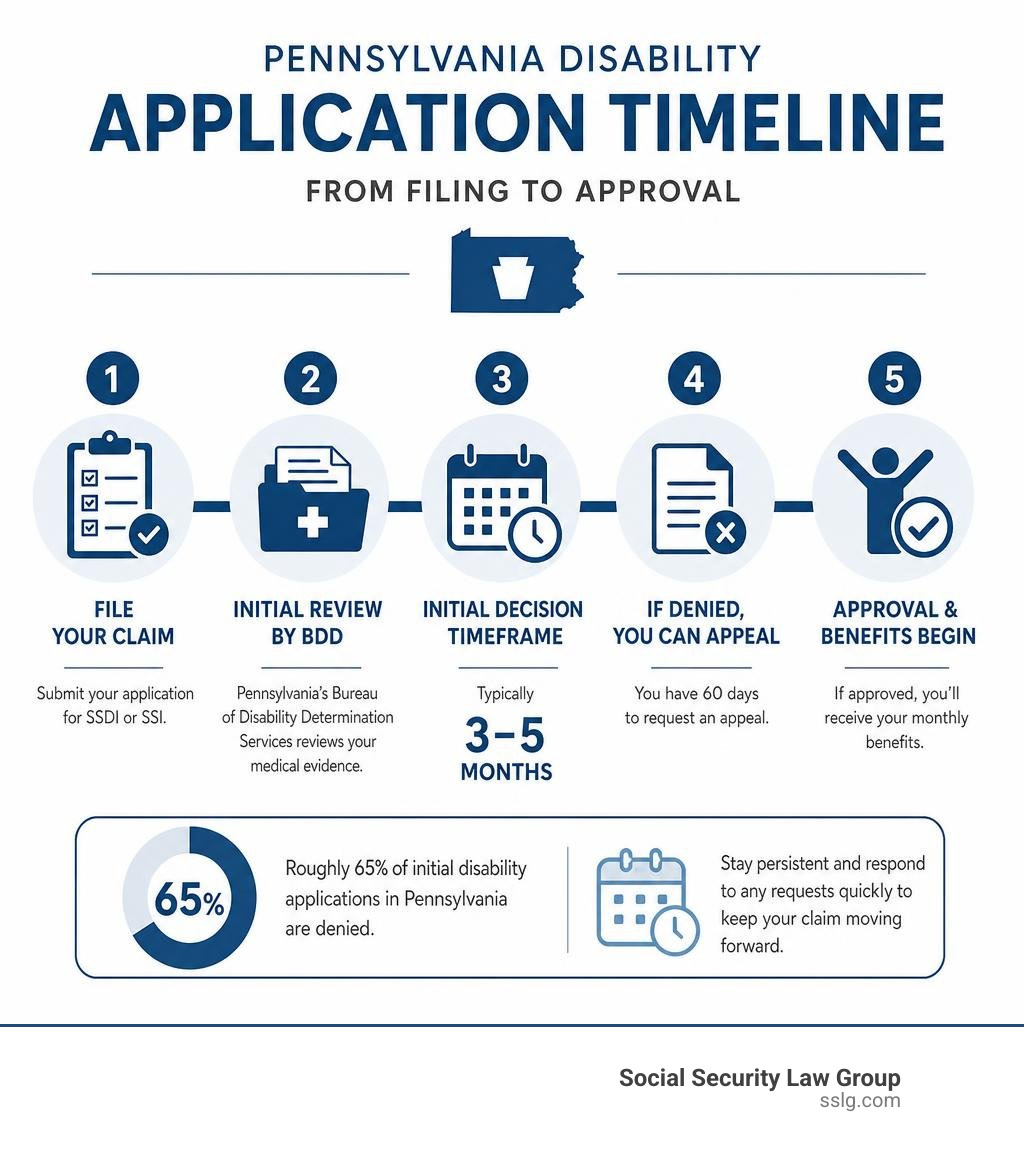
Knowing how to apply for disability in PA can make the difference between getting the financial support you need and facing months of delays or denial. Here is a quick overview of the steps:
- Check your eligibility for SSDI (based on work history) or SSI (based on income and assets).
- Gather your documents, including medical records, work history, and personal identification.
- Submit your application online at ssa.gov, by calling 1-800-772-1213, or in person at a local Social Security office.
- Wait for review by Pennsylvania’s Bureau of Disability Determination Services (BDD), which handles medical eligibility on behalf of the Social Security Administration.
- Appeal if denied, within 60 days, since roughly 65% of initial applications in Pennsylvania are denied.
Pennsylvania has over 1.2 million residents currently receiving disability benefits. But the path to approval is rarely simple. Initial decisions typically take 3 to 5 months. Denials are common. And the rules around medical evidence, work credits, and income limits can be hard to navigate alone.
At Social Security Law Group, we have helped clients across Pennsylvania and nationwide, including in Philadelphia, Pittsburgh, Allentown, Erie, Harrisburg, and Scranton, secure the benefits they deserve since 1994. Our no-win, no-fee structure means you pay nothing unless we win your case.
This guide walks you through every stage of the Pennsylvania disability application process, so you know exactly what to expect and how to give your claim the best chance of success.
Understanding SSDI and SSI Programs in Pennsylvania

The first step in learning how to apply for disability in PA is understanding the two primary federal programs available: Social Security Disability Insurance (SSDI) and Supplemental Security Income (SSI). While both programs are administered by the federal government and evaluated medically by the state of Pennsylvania, they have completely different non-medical eligibility rules.
SSDI acts as an insurance policy for workers. To qualify, you must have worked in jobs covered by Social Security and paid into the system through FICA taxes. SSI, on the other hand, is a needs-based program designed for individuals with limited income and resources, regardless of their work history.
Many applicants wonder if they can qualify for both programs simultaneously. This is known as a concurrent claim, and it occurs when an applicant’s SSDI monthly benefit is very low, allowing them to supplement their income with SSI up to the federal limit. Our legal experts regularly help clients navigate these dual tracks to maximize their monthly income.
Whether you are seeking help locally in Pennsylvania or working with our offices in major hubs like Boston, Chicago, Detroit, or Phoenix, understanding these core programs is vital. For more details on localized resources, you can explore our dedicated Pennsylvania Disability Benefits page.
Financial Eligibility and Work Credit Requirements
To qualify for SSDI, you must have earned enough work credits through your employment history. You can earn up to four credits per year. The exact number of credits you need depends on your age when you became disabled, but most workers need 40 credits, 20 of which must have been earned in the ten years immediately preceding their disability.
For both programs, the Social Security Administration (SSA) enforces strict rules regarding Substantial Gainful Activity (SGA). If you are working and earning more than the monthly SGA limit, the SSA will determine that you are not disabled. The SGA limit is $1,690 monthly for non-blind individuals and $2,830 monthly for blind individuals, as verified by official SSA guidelines.
SSI does not require work credits, but it does enforce rigorous asset and income limits. To qualify for SSI, an individual cannot have more than $2,000 in countable resources, while couples are limited to $3,000. Countable resources include cash, bank accounts, stocks, and secondary real estate, though your primary home and one vehicle are generally excluded. You can find more details about these state-level evaluations through the Apply for a Social Security Disability Determination resource.
| Requirement Type | SSDI Program Details | SSI Program Details |
|---|---|---|
| Work History | Requires sufficient work credits (usually 40 credits) | No work history or credits required |
| Asset Limits | No resource or asset limits | $2,000 limit for individuals; $3,000 for couples |
| SGA Limit | $1,690/month (non-blind); $2,830/month (blind) | $1,690/month (non-blind); $2,830/month (blind) |
| Monthly Benefit | Based on lifetime earnings (up to $4,152 maximum) | Federal Benefit Rate ($994 individual; $1,491 couple) |
Medical Eligibility and the Five Step Evaluation Process
Once you meet the financial and technical requirements, your application is forwarded to the Pennsylvania Bureau of Disability Determination (BDD). The BDD uses a strict five-step sequential evaluation process to determine whether your medical condition qualifies as a disability under federal law.
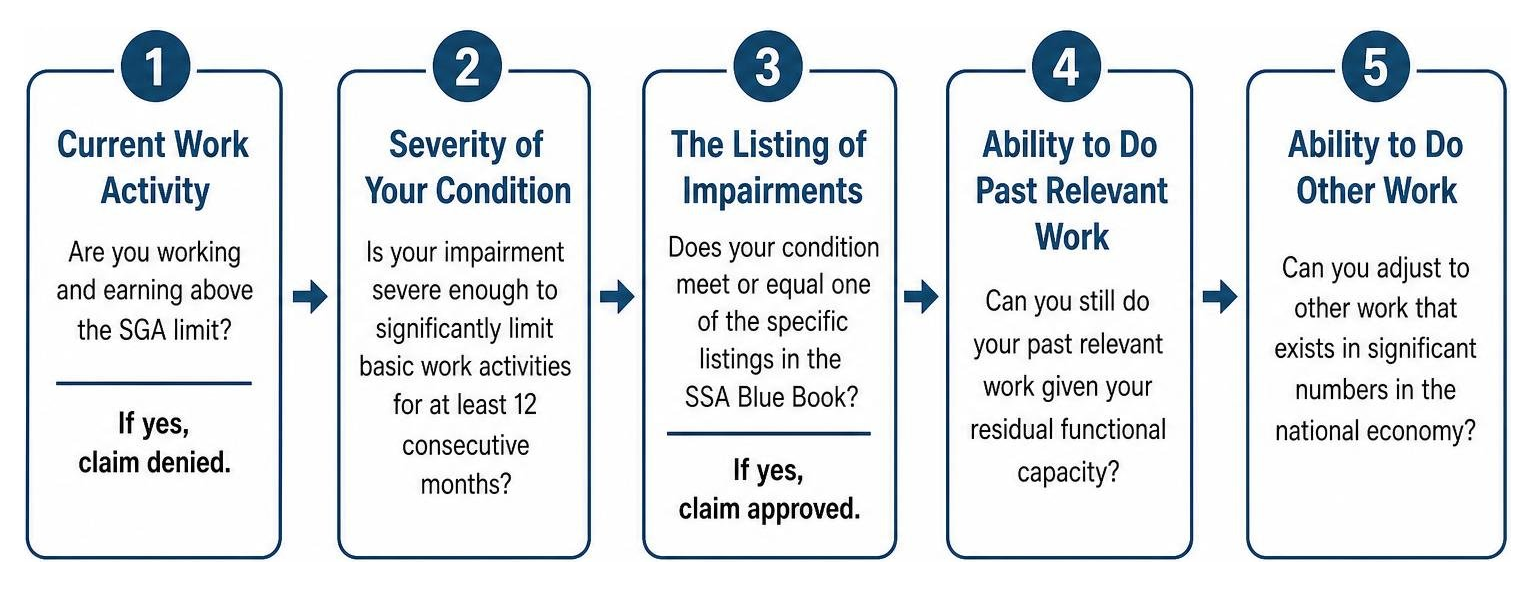
The five steps of this evaluation process include:
- Current Work Activity: Are you currently working and earning above the SGA limit of $1,690 per month? If yes, your claim is denied.
- Severity of Your Condition: Is your physical or mental impairment severe enough to significantly limit your ability to perform basic work activities for at least 12 consecutive months?
- The Listing of Impairments: Does your medical condition meet or equal one of the specific listings in the SSA Blue Book? If it does, you are automatically approved.
- Ability to Perform Past Work: Can you still perform the work you did in the past 15 years despite your medical limitations?
- Ability to Perform Other Work: Can you adjust to other types of work in the national economy, considering your age, education, work experience, and Residual Functional Capacity (RFC)?
Securing positive results during this medical review requires comprehensive medical evidence, including clinical notes, imaging results, and detailed statements from your treating physicians. Preparing these files correctly is essential when submitting your Disability Benefits Application.
How to Apply for Disability in PA: Step by Step

Applying for disability can feel like a daunting task, but breaking the process down into manageable steps can help reduce your stress. Knowing exactly how to apply for disability in PA allows you to navigate the state and federal systems with confidence.
The application process officially begins with the federal Social Security Administration, which handles your initial intake and verifies your technical eligibility. Once those checks are complete, your file is transferred to the Pennsylvania Bureau of Disability Determination (BDD) in Harrisburg, where medical specialists review your clinical records.
Preparing Your Documents: How to Apply for Disability in PA Successfully
The secret to a successful application lies in thorough preparation. Before you begin filling out forms, you should compile a comprehensive folder containing all your personal, professional, and medical details. Missing documents can cause severe delays, sometimes pushing back your decision by several months.
Your preparation checklist should include:
- Your Social Security number and proof of age.
- Names, addresses, and phone numbers of all doctors, hospitals, and clinics that have treated you.
- A complete list of all medications you take, along with dosage information and the prescribing doctor.
- Medical records, laboratory results, and diagnostic imaging reports.
- A detailed summary of your work history for the past 15 years, including job titles and physical duties.
- Your most recent W-2 forms or federal tax returns.
Having these documents organized ahead of time ensures that your Social Security Disability Application is complete, accurate, and ready for rapid evaluation.
Submitting Your Application: How to Apply for Disability in PA Online or by Phone
Once your documents are in order, you can choose how to submit your application. The SSA offers three main pathways: online, by phone, or in person at your local field office.
Filing online is generally the fastest and most convenient option, especially for SSDI applicants. You can pause and resume your application as needed, and you will receive an immediate confirmation of receipt. If you prefer to apply by phone, you can call the SSA toll-free customer service line at 1-800-772-1213 on weekdays between 7 a.m. and 7 p.m. to schedule an appointment.
For state-specific medical assistance programs and supplementary benefits, Pennsylvania residents can also utilize the state’s online portal, COMPASS, or submit paper applications directly to their local County Assistance Office. You can explore these state-level filing methods using the official Apply for Benefits portal.
Navigating the Pennsylvania Bureau of Disability Determination Review
After the SSA confirms that you meet the non-medical, financial requirements, they will route your file to the Pennsylvania Bureau of Disability Determination (BDD). A disability examiner at the BDD will be assigned to your case to gather and evaluate your medical records.
During this review, the examiner may determine that your existing records lack sufficient detail to make a clear decision. If this occurs, they will schedule a Consultative Examination (CE) with an independent medical professional. This exam is paid for by the government and is used solely to assess your current physical or mental limitations. Approximately 40% of Pennsylvania disability cases require a consultative examination, making it a common step in the review process.
Attending this exam is mandatory; failing to show up will result in an immediate denial of your claim. To ensure your file is presented in the best possible light from day one, read our tips on How to Get Approved for Disability the First Time.
State Specific Programs and Medical Assistance in Pennsylvania
While federal SSDI and SSI provide essential monthly cash benefits, Pennsylvania also offers state-specific programs designed to protect disabled residents. These programs focus heavily on medical coverage, ensuring that individuals with physical or mental impairments have access to affordable healthcare while navigating their disability claims.
Pennsylvania’s Department of Human Services manages these programs, which include specialized categories of Medicaid (known locally as Medical Assistance). Understanding how these state programs interact with federal disability benefits is crucial for securing comprehensive support.
Medical Assistance for Workers with Disabilities (MAWD)
One of Pennsylvania’s most progressive initiatives is the Medical Assistance for Workers with Disabilities (MAWD) program. This program is designed specifically for individuals who have a qualifying physical or mental impairment but are still able to engage in some form of paid employment.
Unlike traditional Medicaid programs that enforce extremely low income limits, MAWD allows working individuals with disabilities to protect their healthcare coverage. To qualify for MAWD, you must be between 16 and 64 years of age, be employed and receiving compensation, and meet the SSA definition of disability.
Financially, your countable resources cannot exceed $10,000, and your countable income must be less than 250% of the Federal Poverty Income Guideline. This higher resource limit offers significantly more flexibility than standard SSI limits, allowing working individuals to save money while maintaining vital medical coverage. To apply, you can download and complete the official Application for Medical Assistance for Workers with Disabilities.
For individuals who do not qualify for MAWD but still require state-level support, Pennsylvania also operates the General Assistance-related Medically Needy Only (GA-PD) category. This program provides essential health coverage for disabled individuals who are undergoing medical treatment or awaiting a federal SSI decision. You can read the official state regulations governing this category in the 305.4 GA-Related (PD) Category NMP manual.
Frequently Asked Questions About Pennsylvania Disability Benefits
Navigating the disability application process often brings up many questions. Below are some of the most common questions Pennsylvania applicants ask, along with clear, direct answers based on current regulations.
How long does it take to get a disability decision in Pennsylvania?
On average, it takes 3 to 5 months to receive an initial decision on your disability application in Pennsylvania. However, this timeline can vary significantly depending on how quickly your medical providers submit your records to the Bureau of Disability Determination (BDD). If the BDD needs to schedule a consultative medical examination, the process can take longer.
If your initial application is denied, the appeals process will add several months to your timeline. Filing an appeal moves your case to the reconsideration stage, and if that is denied, you can request a hearing before an Administrative Law Judge (ALJ). Because of the backlogs at local hearing offices in cities like Philadelphia, Pittsburgh, and Allentown, waiting for an ALJ hearing can take an additional 8 to 12 months. You can monitor state-specific processing updates through the Apply for a Social Security Disability Determination portal.
What is the success rate for initial disability applications in PA?
Securing an approval on your first attempt is challenging. Approximately 65% of initial disability applications in Pennsylvania are denied. If you file a reconsideration appeal, the approval rate is historically even lower, hovering around 15% in Pennsylvania.
The good news is that your chances of success increase significantly at the Administrative Law Judge (ALJ) hearing stage. ALJ hearing success rates range from 50% to 60% for applicants who have professional legal representation. Having an experienced attorney from Social Security Law Group by your side ensures that your medical evidence is organized, your vocational limitations are clearly presented, and your rights are protected during the hearing. Find more information on how state agencies evaluate these claims by visiting the Apply for a Social Security Disability Determination page.
Can I work while applying for disability in Pennsylvania?
Yes, you can work while applying for disability, but your monthly earnings must remain strictly below the Substantial Gainful Activity (SGA) limit. For non-blind individuals, this means you cannot earn more than $1,690 per month. For blind individuals, the monthly limit is $2,830.
If your earnings exceed these thresholds, the SSA will automatically deny your application, regardless of your medical condition, because they will determine that you are capable of engaging in substantial gainful work. Additionally, even if you earn less than the SGA limit, the BDD may still consider your part-time work as evidence that you are capable of working full-time. If you plan to work part-time, it is highly recommended to speak with a legal professional to ensure your employment does not negatively impact your claim. You can review additional employment and benefit guidelines on the Apply for Benefits portal.
Conclusion
Securing disability benefits in Pennsylvania is a complex, multi-layered process that requires careful preparation, thorough medical documentation, and a clear understanding of federal and state laws. With initial denial rates sitting at 65%, trying to handle your application alone can lead to unnecessary stress and preventable delays.
At Social Security Law Group, we have spent over three decades helping clients navigate this system. Whether you live in Pennsylvania or are seeking help near our other national offices in locations like Dallas, Houston, Miami, Orlando, St. Louis, or Seattle, our team is ready to support you. We handle every aspect of your claim, from gathering medical records to representing you at an ALJ hearing, all under a no-win, no-fee structure.
Do not let a complicated application stand between you and the financial support you deserve. Contact us today to schedule a free consultation, and let our experienced legal team guide you through every step of How to Apply for Disability.
The information provided in this blog article is intended to be general in nature and should not be construed as legal advice. Social Security laws and regulations are subject to, and often change. Please consult the official Social Security Administration (SSA) website or contact SSLG for advice regarding your specific legal matters.