


Why Was Your Adult SSI Application Denied?
If your adult SSI application has been denied, you are not alone. More than 65% of all disability claims are denied at the initial application level, which means millions of Americans face this exact situation every year. A denial feels devastating, especially when you are already dealing with a serious health condition and financial pressure. But a denial is not the end of the road.
Quick answer: What should you do if your adult SSI application is denied?
- Read your denial letter carefully. It will explain whether the denial was for technical or medical reasons.
- File an appeal within 60 days of receiving your denial notice. The SSA assumes you receive the notice 5 days after it is mailed.
- Request reconsideration first. This is the required first step in the SSI appeal process.
- Gather stronger evidence. Updated medical records and doctor statements can significantly improve your case.
- Consider getting legal help. Applicants who hire a lawyer are three times more likely to succeed than those who go it alone.
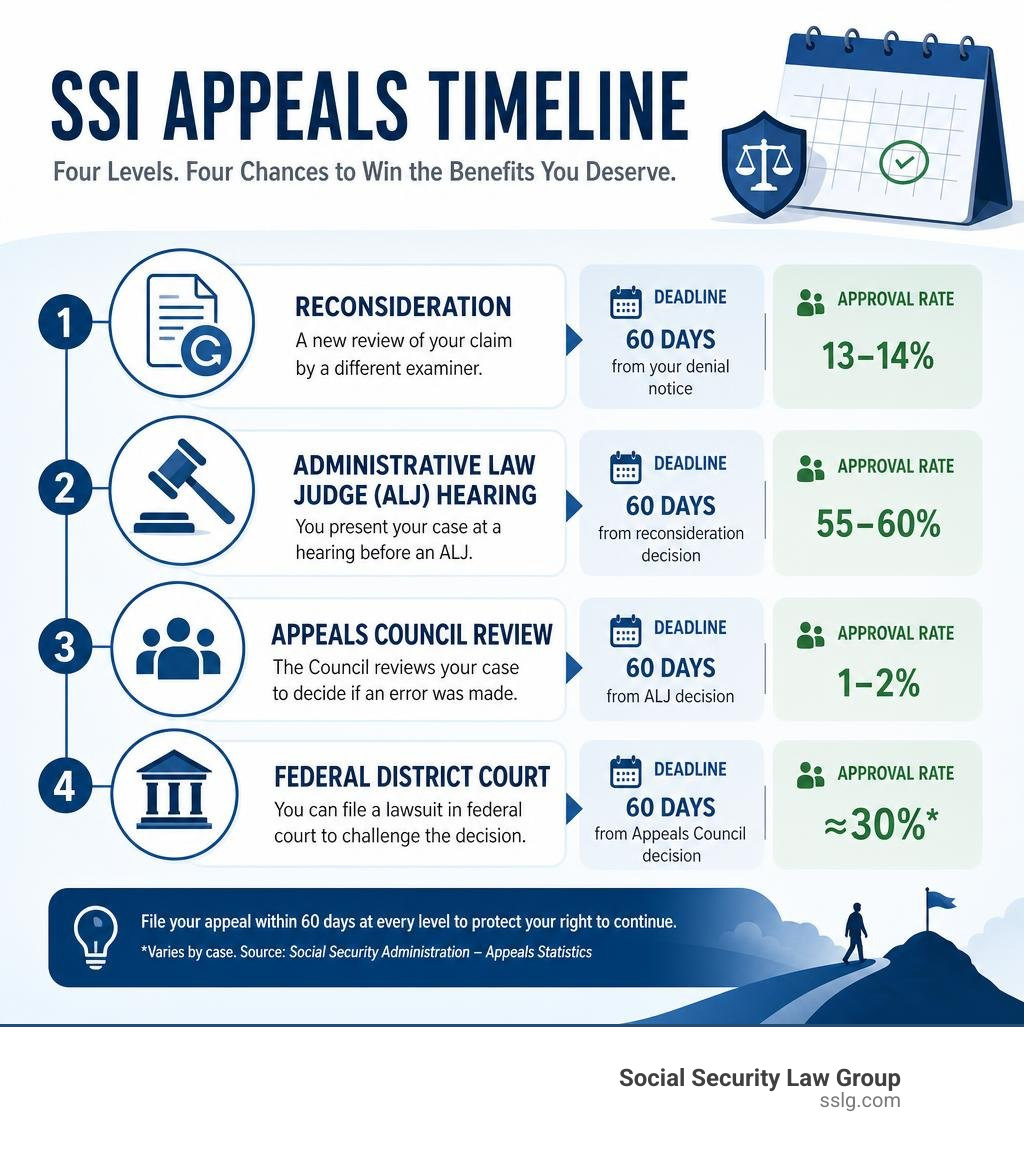
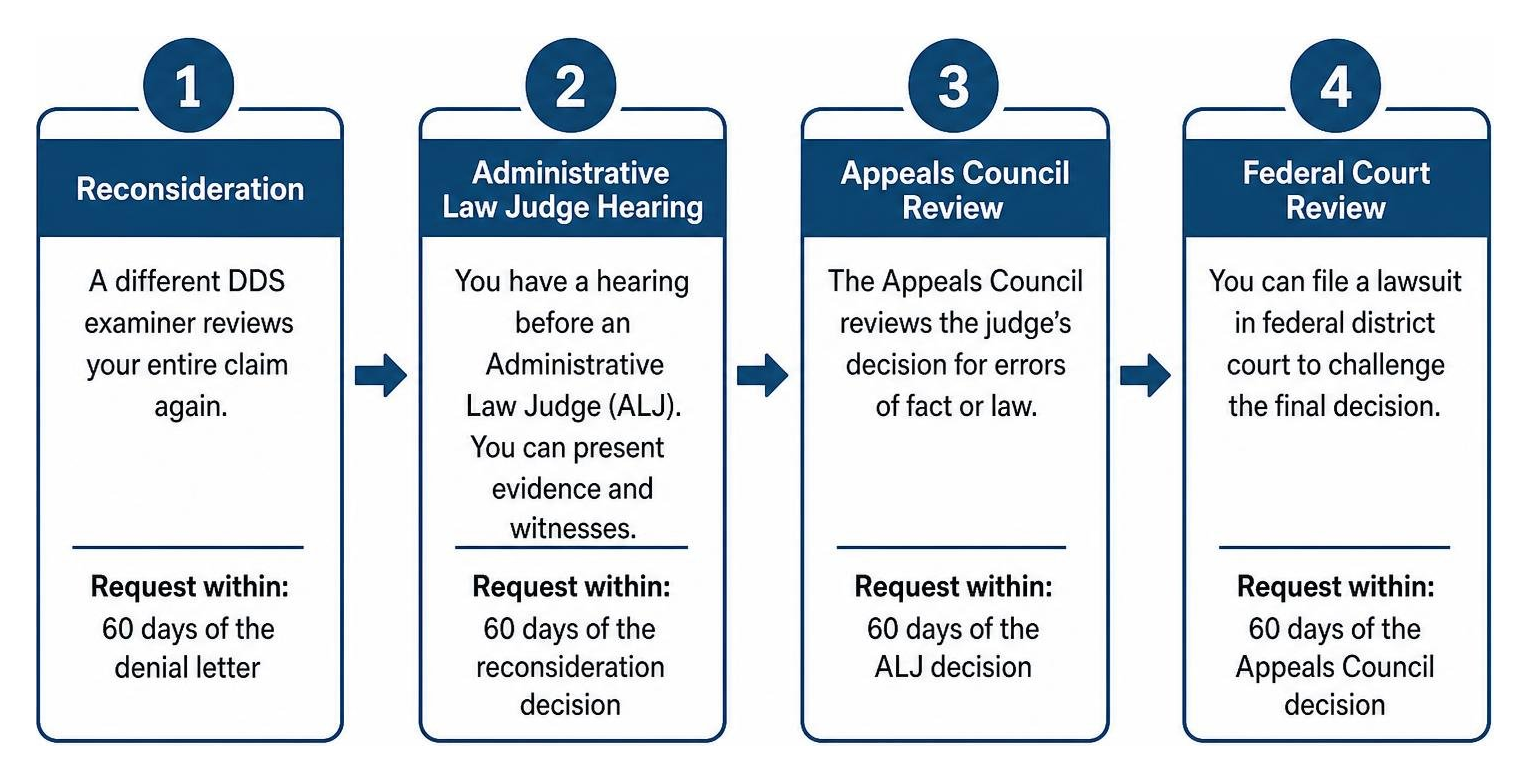
The SSI appeals process has four formal levels: reconsideration, a hearing before an administrative law judge (ALJ), review by the Appeals Council, and finally, federal district court. Each level gives you another chance to fight for the benefits you need.
At Social Security Law Group, we have helped clients navigate denied claims since 1994, with a 97% success rate and no upfront fees. We work with clients nationwide, including in California, Oregon, Washington, Texas, Florida, and Massachusetts.
This guide walks you through every step, from understanding why your claim was delayed to building the strongest possible appeal.
Receiving a letter from the Social Security Administration (SSA) is rarely a stress free experience, especially when the heading indicates your claim was disapproved. To understand why your adult SSI application denied status occurred, you must first look at the type of notice you received.
According to the official SSA – POMS: NL 00802.020 – Initial Denial Notice guidelines, the SSA issues specific notices for nonmedical disapprovals, which explain the exact administrative reasons your claim cannot move forward. Generally, denials are sorted into two main categories: technical denials and medical denials. Knowing which category your denial falls into is crucial because it dictates your entire strategy for the appeal. You can learn more about how the SSA evaluates these claims by reviewing our guide on Supplemental Security Income Eligibility.
Technical Reasons for an Adult SSI Application Denied
A technical denial means the SSA did not even look at your medical records because you failed to meet the basic financial or administrative eligibility requirements. Supplemental Security Income is a strictly needs-based program, which means your finances are heavily scrutinized.
The most common technical denial reasons in 2026 include:
- Excess Countable Income: The SSA evaluates both earned income (like wages) and unearned income (such as pensions, state disability, or even free food and shelter provided by family members). If your countable monthly income exceeds the strict federal benefit rate, your application will be technically denied.
- Excess Countable Resources: For 2026, the resource limit remains incredibly tight. Individual applicants cannot own more than $2,000 in countable assets, while married couples are limited to $3,000. Countable assets include cash, bank accounts, stocks, and secondary vehicles. Your primary home and one primary vehicle generally do not count toward this limit.
- Failure to Apply for Other Benefits: Under federal law, specifically 20 CFR § 416.210 – You do not apply for other benefits, you are legally required to apply for all other potential auxiliary benefits for which you might qualify, such as veterans’ pensions, workers’ compensation, or state unemployment, within 30 days of the SSA notifying you to do so. If you ignore this requirement, your SSI claim will be denied.
If you are unsure whether your asset structure or living arrangements meet the program rules, check out our comprehensive breakdown of SSI Qualifications.
Medical Reasons for an Adult SSI Application Denied
A medical denial means you met the financial requirements, but the state’s Disability Determination Services (DDS) team decided your medical conditions do not meet the legal definition of a disability.
The SSA uses a very strict standard of disability. To qualify, you must show that you have a medically determinable physical or mental impairment that prevents you from engaging in any substantial gainful activity (SGA). Furthermore, this impairment must be expected to last for a continuous period of at least 12 months or result in death, as outlined in the official SSA – How Does Someone Become Eligible? criteria.
Common medical denial reasons include:
- Lack of Sufficient Medical Evidence: This is the single biggest culprit. If you do not have consistent, ongoing medical records, clinical test results, or imaging scans to prove the severity of your diagnosis, the SSA will deny your claim.
- Your Condition is Not Considered Severe: The SSA may agree that you have a medical diagnosis, but they might conclude that it does not limit your ability to perform basic work activities like sitting, standing, walking, or remembering simple instructions.
- You Can Perform Your Past Work or Other Work: The SSA reviews your work history. If they believe you can still do your previous job, or if they decide you can adapt to a lighter, simpler job in the national economy, they will deny your application.
To avoid these common pitfalls during a reapplication or appeal, you can read our detailed instructions on how to Apply for SSI Disability.
The Four Levels of the SSI Appeals Process
If you receive a denial, do not panic. The system is designed with multiple layers of review to catch errors and allow you to present new, stronger evidence. The official policy outlined in SSA – POMS: SI 04010.020 – SSI Appeals Considerations guarantees your right to challenge any initial determination that adversely affects your benefits.
To successfully navigate this journey, you must understand the four distinct levels of the SSI Appeal process.
Requesting Reconsideration After a Denial
The very first step of the appeals process is Reconsideration. This is a complete, top to bottom review of your file by a different claims examiner at the DDS level who had no part in the initial denial.
You must submit your request for reconsideration in writing within 60 days of receiving your denial letter. The SSA assumes you received the letter 5 days after the date printed on it, giving you a functional window of 65 days.
While requesting reconsideration is a necessary step, you should prepare yourself for the reality of the statistics: the SSA denies over 90% of all reconsideration requests. Because the review is conducted by the same state agency that denied you the first time, they rarely reverse their own decisions unless you submit significant, undeniable new medical evidence. To maximize your chances at this stage, read our expert tips on How to Win SSI Appeal.
Presenting Your Case Before an Administrative Law Judge
If your reconsideration is denied, you have 60 days to request a hearing before an Administrative Law Judge (ALJ). This is the stage where your chances of success skyrocket. Historically, the success rate at the ALJ hearing stage is around 50%, making it your best opportunity to secure benefits.
During the hearing, you finally get to step out from behind the paperwork and speak directly to the decision maker. The hearing is relatively informal and is usually held in a small conference room, via video conference, or over the phone.
The judge will ask you questions about your daily limitations, pain levels, and medical treatments. In almost every hearing, the judge will also question a Vocational Expert (VE). The VE is an employment specialist who testifies about what types of jobs exist in the national economy and whether a person with your specific physical and mental limitations can perform them. Having an experienced SSI Appeal Lawyer by your side during this hearing is critical, as an attorney can cross examine the Vocational Expert and object to unfair assumptions about your ability to work.
How to Strengthen Your Appeal with New Evidence
The secret to winning an appeal is simple: you cannot keep submitting the exact same information and expect a different result. You must actively gather and submit fresh, high quality evidence.
Under the strict rules detailed in SSA – POMS: SI 04070.015 – Reopening SSI Determinations, the SSA will only reopen or revise a prior determination if you present “new and material” evidence that was not previously considered.
To build an airtight case, focus on gathering the following documents:
- Recent Medical Records: Obtain copies of every doctor visit, hospital stay, physical therapy session, and prescription change that has occurred since you first applied.
- Diagnostic Test Results: Objective medical evidence is gold to the SSA. Gather recent MRI reports, X rays, CT scans, blood work, or mental health evaluations.
- Detailed Doctor Statements: Ask your treating physicians to fill out a Residual Functional Capacity (RFC) form. A simple note saying “my patient is disabled” will be ignored by the SSA because disability is a legal conclusion reserved for the commissioner. Instead, your doctor must explain, in detail, exactly how many minutes you can stand, how many pounds you can lift, and how often your symptoms would force you to miss work.
Frequently Asked Questions About SSI Denials
Can I continue receiving SSI payments while my appeal is pending?
Yes, but only under very specific circumstances. If you are already receiving SSI benefits and the SSA sends you a notice stating they are cutting off or reduce your payments (often due to a medical improvement finding during a review), you can request a continuation of your benefits.
To keep your checks coming while you fight the decision, you must file your appeal and request the benefit continuation within 10 days of receiving the notice. That if you lose your appeal, you may be required to pay back the benefits you received during the appeal period. You can read more about restoring lost payments in our guide on How to Reinstate SSI Benefits.
What happens if I miss the 60-day deadline to appeal?
If you miss the 60 day deadline, the initial denial becomes legally binding, a concept known as administrative finality. According to SSA – POMS: SI 04070.010 – Title XVI Administrative Finality, once a decision is final, you generally cannot appeal it unless you can establish “good cause” for missing the deadline.
The SSA may find good cause and extend your deadline if you can prove:
- You had serious physical or mental illness that prevented you from filing.
- You did not receive the denial notice due to a move or mail delivery issues.
- You faced severe educational, administrative, or linguistic barriers.
- The SSA gave you incorrect or misleading information.
What are my options if my appeal is denied at every level?
If your claim is denied by the ALJ, the Appeals Council, and the federal district court, you still have options. Your primary route is to file a brand new application.
However, filing a new claim means your potential back pay will only calculate from your new application date, rather than your original filing date. In some cases, if you obtain new medical evidence, we can request to reopen your prior closed claim under the strict time limits allowed by the SSA. If you need to start over, you can read our step by step guide on How to Apply for SSI Disability Online.
Conclusion
A denied SSI claim is incredibly frustrating, but it is a hurdle that can be overcome with patience, thorough medical documentation, and the right legal strategy.
At Social Security Law Group, we specialize exclusively in disability law. Since 1994, we have maintained a 97% success rate by combining deep legal expertise with modern client technology. We operate on a strict no win, no fee structure, which means you pay us absolutely nothing unless we win your case and secure your benefits.
Whether you are located near our offices in Boston, Dallas, Denver, Fort Lauderdale, Miami, Orlando, Sarasota, St. Louis, Wichita, Raleigh, Fayetteville, Clark, Uniondale, San Antonio, Jefferson, Southfield, Las Vegas, Jacksonville, Tampa, Bremerton, Fairhaven, Detroit, Phoenix, Atlanta, Houston, Charlotte, Seattle, or Chicago, our team is ready to stand up to the SSA for you.
If you have received a denial notice or if you are facing an upcoming Continuing Disability Review, do not wait until the clock runs out on your 60 day appeal window. Contact us today for a free, no obligation consultation, and let us help you secure the peace of mind and financial support you deserve.
The information provided in this blog article is intended to be general in nature and should not be construed as legal advice. Social Security laws and regulations are subject to, and often change. Please consult the official Social Security Administration (SSA) website or contact SSLG for advice regarding your specific legal matters.