
How to File for Disability in California: What You Need to Know First
How to file for disability in California depends on which program fits your situation. Although Social Security Law Group (SSLG) maintains primary service hubs in Phoenix, Las Vegas, and Seattle, our specialized legal team utilizes modern technology to serve the entire Golden State, providing the same high-level advocacy we offer in Chicago and Houston.
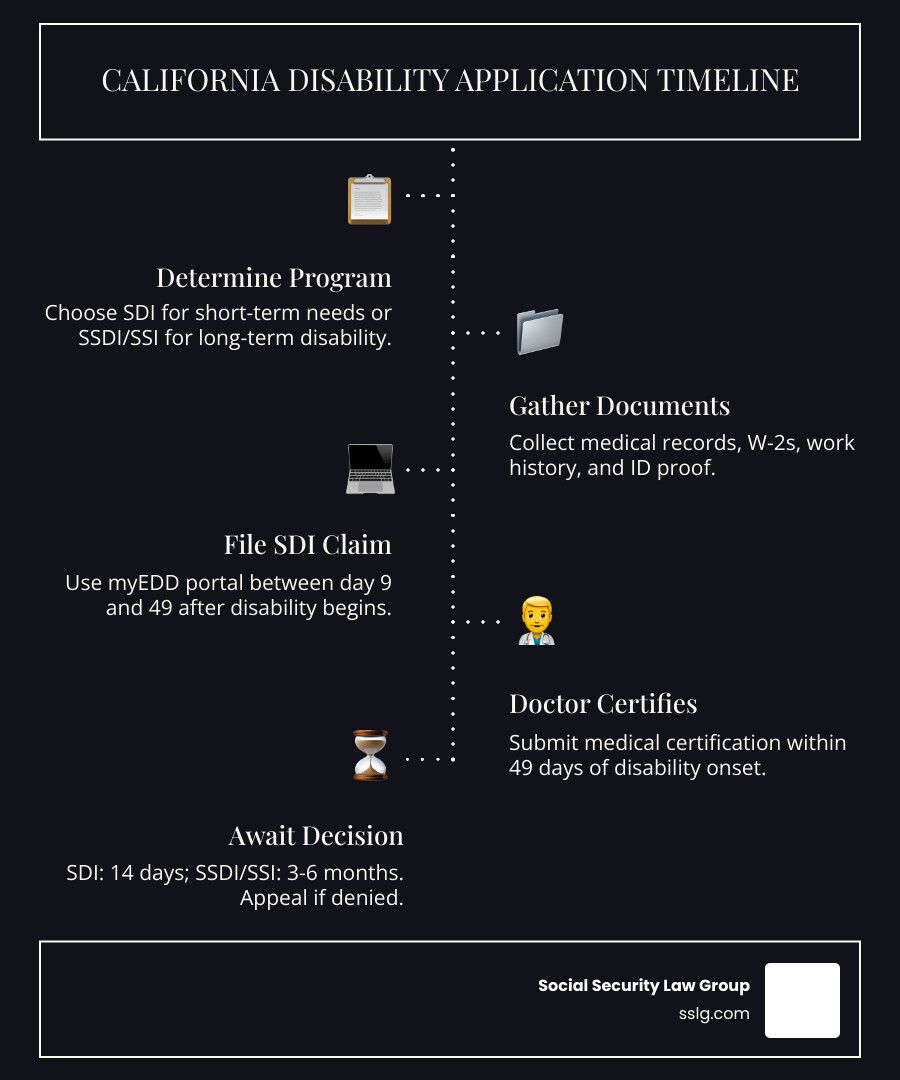
To file for California State Disability Insurance (SDI):
- Wait 9 days after your disability begins
- Create a myEDD account at myedd.edd.ca.gov
- Complete Form DE 2501 Part A online (or by mail)
- Have your doctor complete the medical certification (Part B)
- Submit within 49 days of your disability start date
To file for federal SSDI or SSI:
- Apply online at ssa.gov, call 1-800-772-1213, or visit a local SSA office
- Complete Form SSA-16 with your medical and work history
- Submit supporting documents (medical records, W-2s, birth certificate)
- Wait for a decision (typically 3-6 months)
If you’re dealing with a serious illness or injury that keeps you from working, the financial pressure can feel crushing. And then you discover there isn’t just one disability program — there are several, each with different rules, deadlines, and paperwork.
California residents actually have more options than most Americans. The state runs its own State Disability Insurance (SDI) program through the Employment Development Department (EDD), and federal programs — Social Security Disability Insurance (SSDI) and Supplemental Security Income (SSI) — are also available through the Social Security Administration (SSA).
More than 8 million Californians receive SDI benefits. And over 600,000 receive federal disability benefits. You may qualify for more than one program at the same time.
The catch? Nearly 2 out of 3 applicants are denied SSDI benefits on the first attempt. Knowing how to file correctly — and on time — makes a real difference.
This guide walks you through every step.
Understanding the Types of Disability Benefits in California
When we talk about disability benefits in the Golden State, we are usually looking at three main pillars. Understanding which one you qualify for is the first step in learning how to file for disability in California.
- State Disability Insurance (SDI): This is a short-term program managed by the California Employment Development Department (EDD). It provides partial wage replacement for up to 52 weeks.
- Social Security Disability Insurance (SSDI): This is a federal program for long-term disabilities (expected to last 12 months or more). It is funded by your Social Security taxes and requires a sufficient work history.
- Supplemental Security Income (SSI): Also a federal program, SSI is “needs-based.” It is designed for those with limited income and resources, regardless of their work history.
For a deeper dive into these options, you can explore our California disability overview.
| Feature | SDI (State) | SSDI (Federal) | SSI (Federal) |
|---|---|---|---|
| Duration | Short-term (Up to 52 weeks) | Long-term (1 year+) | Long-term (1 year+) |
| Funding | Payroll taxes (CASDI) | Social Security taxes | General tax revenue |
| Wait Period | 7 days | 5 months | None |
| Max Benefit | $1,765/week (2026) | \~$4,152/month (2026) | $994/month (Individual) |
To learn more about the state-specific program, visit the official State Disability Insurance (SDI) basics page.
State Disability Insurance (SDI) vs. Federal Benefits
The biggest difference is time. SDI is a “sprint,” while SSDI is a “marathon.” California is one of only five states that offers its own short-term disability program. If you look at your paystub and see “CASDI” deductions, you’ve been paying into this system.
SDI typically replaces about 60-70% of your wages earned 5 to 18 months before your claim start date. Because it’s a state program, it moves much faster than the federal government. Most SDI claims are processed within 14 days of the EDD receiving all parts of the application. For more details on payouts, check out our guide on how much disability pays in California.
Eligibility for SSDI and SSI
Federal benefits have stricter medical requirements. To qualify, your condition must be so severe that it prevents you from performing “substantial gainful activity” for at least a year.
- SSDI requires “work credits.” Generally, you need 40 credits, 20 of which must have been earned in the last 10 years ending with the year you become disabled.
- SSI doesn’t care about work history, but it does care about your bank account. In 2026, your countable resources must be under $2,000 for an individual or $3,000 for a couple.
You can start your federal journey by visiting the SSA’s website for disability applications.
How to File for Disability in California: State Disability Insurance (SDI)

If your injury or illness is temporary—like recovering from surgery or a complicated pregnancy—SDI is your primary resource. The EDD uses an online portal called myEDD to manage these claims.
Eligibility Requirements for How to File for Disability in California
Before you hit “submit,” ensure you meet these basic criteria:
- You must be unable to do your regular or customary work for at least eight consecutive days.
- You must have earned at least $300 in wages during your “base period” from which SDI taxes were withheld.
- You must be under the care and treatment of a licensed health professional.
- Your immigration or citizenship status does not affect your eligibility for state SDI.
For a full checklist, see Am I eligible for DI benefits?
Online vs. Mail: How to File for Disability in California SDI Claims
While you can file by mail using a paper Form DE 2501, we highly recommend using the SDI Online portal. It is faster, more secure, and gives you an immediate confirmation number.
The Online Process:
- Register for myEDD: You’ll need to verify your identity through ID.me.
- File Part A: This is the claimant’s statement. You’ll provide your personal info and details about your disability.
- Get a Receipt Number: Once you submit Part A, you’ll get a Form Receipt Number. Give this to your doctor.
- Doctor Files Part B: Your licensed health professional uses your receipt number to submit the medical certification online.
Crucial Timing: Do not file too early! You must wait at least nine days after your disability begins, but you must file no later than 49 days after your disability begins to avoid losing benefits. If you are late, you must provide a written explanation for the delay. You can find more instructions on how to file a DI claim in SDI Online here.
Applying for Federal SSDI and SSI Benefits
If your doctor tells you that you won’t be back to work for a year or more, it’s time to look at federal benefits. The application is long—Form SSA-16—and requires a deep dive into your medical and work history. We suggest using the Adult Disability Starter Kit to organize your thoughts before starting.
Application Methods: Online, Phone, and In-Person
You have three ways to reach the SSA:
- Online: The fastest way for SSDI. (Note: You often cannot complete a full SSI application online).
- Phone: Call 1-800-772-1213 between 8:00 a.m. and 7:00 p.m., Monday through Friday.
- In-Person: You can visit a local office. Whether you are in Los Angeles, San Francisco, San Diego, or Sacramento, there is an office nearby. You can find yours using the Social Security Office Locator. While SSLG’s physical offices are located in hubs like Denver, Dallas, and San Antonio, our ‘virtual-first’ approach ensures California residents receive the same expert representation as our clients in Atlanta or Charlotte.
Strategic Filing for California Residents
One of the best “hacks” for Californians is simultaneous filing. You don’t have to wait for your 52 weeks of state SDI to run out before applying for federal SSDI. In fact, because the federal process can take years if an appeal is needed, we recommend applying for SSDI as soon as you know your condition is long-term.
Additionally, California provides a State Supplemental Payment (SSP) to SSI recipients, which can boost your monthly federal check. For more local resources, see our list of SSA office addresses and phone numbers in California.
Essential Documentation and Medical Evidence
The secret to a successful claim isn’t just being disabled; it’s proving it. Whether you are dealing with the EDD or the SSA, your “paper trail” is your best friend.
What to gather:
- Proof of birth (Birth certificate).
- W-2 forms or self-employment tax returns for the last year.
- A detailed list of medications, dosage, and who prescribed them.
- Medical records from all doctors, hospitals, and clinics you’ve visited.
- A summary of where you worked and what kind of work you did for the last 15 years.
For the SSA’s specific requirements, visit the Required documents for SSA page.
The Role of Licensed Health Professionals
Your doctor is the MVP of your disability claim. For state SDI, they must certify your disability using Part B of the DE 2501. If your disability needs to be extended, they will use Form DE 2525XX.
Under California law, “licensed health professionals” include more than just MDs. Surgeons, podiatrists, dentists, chiropractors, and even nurse practitioners can certify your claim within their scope of practice. You can read more about medical certification requirements on the EDD site.
Managing and Extending Your Benefits
Once you are approved for SDI, the EDD will monitor your status.
- Automatic Payments: If you are on automatic payments, the EDD will send you Form DE 2593 after 10 weeks to certify you are still disabled.
- Non-Automatic: You may need to submit Form DE 2500A every two weeks.
- Returning to Work: If you recover or go back to work earlier than expected, you must notify the EDD immediately via SDI Online or the “Discontinued” section of your forms to avoid overpayment penalties.
Find more on continuing or discontinuing SDI benefits here.
What to Do if Your Claim is Denied
Don’t panic. Roughly 67% of initial Social Security applications are denied. In California, the wait for a hearing can be long—ranging from 9 months in Norwalk to 15 months in Fresno—but the odds shift in your favor at the later stages. Our firm brings the experience of handling thousands of cases in cities like Detroit, St. Louis, Jacksonville, Miami, and Orlando to the California hearing rooms.
The appeals process generally follows these steps:
- Reconsideration: A complete review of your claim by someone who wasn’t involved in the first decision.
- Hearing: This is the “gold mine” of the process. More than 60% of denials are overturned at the Administrative Law Judge (ALJ) hearing stage.
- Appeals Council: If the judge denies you, you can ask the SSA Appeals Council to review the case.
For more state-specific advice, visit our California state disability page.
Common Reasons for Delays and Denials
Why do claims fail? Usually, it’s not because the person isn’t disabled, but because the paperwork didn’t tell the right story.
- Lack of Medical Evidence: If you haven’t seen a doctor recently, the SSA has no “proof” of your current status.
- Income Limits: If you are still working and earning more than the “Substantial Gainful Activity” limit ($1,690/month in 2026), you will be denied automatically.
- Failure to Cooperate: Missing a scheduled medical exam or failing to return forms on time is a quick way to get a denial.
You can learn more about appealing a medical decision directly from the SSA.
Frequently Asked Questions about California Disability
Can I apply for SDI and SSDI at the same time?
Yes! In fact, we often recommend it. SDI provides immediate short-term relief (up to 52 weeks), while SSDI is intended for long-term support. Since SSDI has a five-month waiting period and a long application process, filing both ensures a smoother transition if your disability lasts longer than a year.
How long does it take to get a decision on a disability claim?
For California SDI, you’ll usually hear back within 14 days. For federal SSDI or SSI, the initial decision usually takes 3 to 6 months. If you have to go to a hearing, the entire process can take up to two years.
Do I need a lawyer to file for disability in California?
While you aren’t required to have a lawyer, statistics show that applicants with legal representation are three times more likely to win their benefits. A lawyer helps gather medical records, ensures deadlines aren’t missed, and cross-examines vocational experts during hearings.
Conclusion
Navigating how to file for disability in California can feel like learning a second language while you’re already exhausted and in pain. You don’t have to do it alone.
At Social Security Law Group (SSLG), we’ve been providing expert legal representation for SSD and SSI claims since 1994. With a 97% success rate and a no-win, no-fee structure, our goal is to take the legal burden off your shoulders. With a national presence spanning from Boston, Tampa, and Raleigh to Wichita, Ft. Lauderdale, and Sarasota, we also serve clients near Fayetteville, Clark, Uniondale, Jefferson, Southfield, Bremerton, and Fairhaven.
Whether you are in Los Angeles, San Francisco, or anywhere else in the state, our modern client technology allows us to advocate for you effectively. Ready to secure the benefits you deserve? Start your California disability claim with SSLG today for a free consultation.
The information provided in this blog article is intended to be general in nature and should not be construed as legal advice. Social Security laws and regulations are subject to, and often change. Please consult the official Social Security Administration (SSA) website or contact SSLG for advice regarding your specific legal matters.