
What “How Is Substantial Gainful Activity Calculated” Really Means for Your Benefits
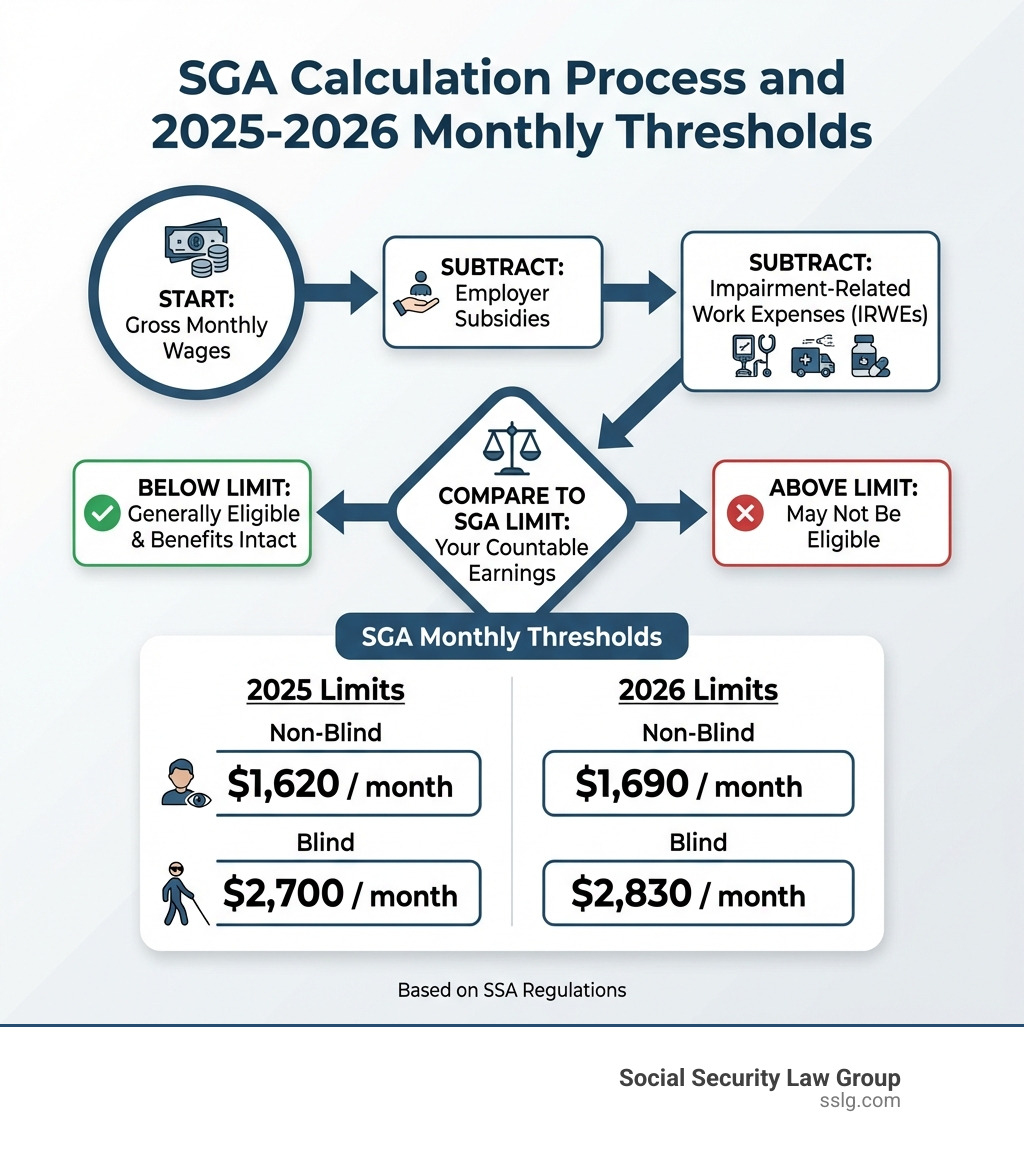
How is substantial gainful activity calculated comes down to a few key steps the Social Security Administration (SSA) follows every time they review your work and earnings.
Here is the short answer:
- Start with your gross monthly wages (before taxes or deductions)
- Subtract any employer subsidies — the portion of your pay that exceeds the real value of your work
- Subtract impairment-related work expenses (IRWEs) — costs you pay out of pocket to work because of your disability
- Compare what’s left to the monthly SGA limit for your situation
| Year | Non-Blind SGA Limit | Blind SGA Limit |
|---|---|---|
| 2024 | $1,550/month | $2,590/month |
| 2025 | $1,620/month | $2,700/month |
| 2026 | $1,690/month | $2,830/month |
If your countable earnings stay below the limit for your category, you are generally not considered to be engaging in SGA — and your disability benefits stay intact.
For most people, the math sounds simple. But the reality is messier. Your hours might vary month to month. You might be self-employed. Your employer might be giving you extra help because of your condition. Each of these situations changes how the SSA counts your income — and getting it wrong can cost you the income you depend on.
This guide walks you through exactly how the SSA calculates SGA, step by step, so you know where you stand.
What is Substantial Gainful Activity (SGA)?

At its core, Substantial Gainful Activity (SGA) is a term the SSA uses to describe a level of work activity and earnings. If you can perform “substantial” work and earn “gainful” income, the SSA may conclude that you are no longer disabled under their strict definition.
- Substantial Work: This involves significant physical or mental activities. Even if you work part-time, your duties might be considered substantial if they require a high level of skill or responsibility.
- Gainful Activity: This refers to work performed for pay or profit. Crucially, it includes work that is intended for profit, even if a profit isn’t realized, and work that is typically paid, even if you are doing it for free (like some types of volunteer work).
The SSA uses SGA as a primary “off-on” switch for benefits. Whether you are applying for benefits in Chicago or already receiving them in Seattle, understanding this threshold is vital. The rules differ slightly depending on whether you are “statutorily blind” or have another disabling condition.
2025 and 2026 Monthly Earnings Limits
The SSA adjusts SGA limits annually based on the national average wage index. We’ve seen these amounts rise steadily over the years to keep up with inflation.
For 2026, the monthly SGA limit is $1,690 for non-blind individuals and $2,830 for statutorily blind individuals. You can always check the Official SGA amounts for the most current data. These increases are tied to the same economic factors that drive the annual cost-of-living adjustments (COLA).
How is Substantial Gainful Activity Calculated for Employees?
If you work for an employer and receive a W-2, the SSA looks primarily at your gross monthly earnings. This is the amount you earn before taxes are taken out. However, the SSA doesn’t just look at your bank deposit; they want to know the “real” value of your work.
To understand the deeper methodology the government uses, you can review the Federal Register SGA methodology. For a practical look at how this applies to your claim, you can consult the SSA’s guide on working while disabled.
Step-by-Step: How is Substantial Gainful Activity Calculated?
The process follows a specific sequence of evaluation:
- Identify Gross Pay: The SSA totals all wages, bonuses, and commissions earned in a calendar month.
- Determine the Month of Performance: Income is counted when it is earned, not necessarily when it is paid. For example, if you are a teacher in Raleigh or Fayetteville and your salary is spread over 12 months but you only work 10, the SSA may re-distribute that income to the months you actually performed the work.
- Evaluate Work Activity: The SSA uses the SSA evaluation guides for employees to see if the work you are doing is truly “substantial.”
Deductions That Lower Your Countable Income
The SSA recognizes that working with a disability often comes with extra costs. They allow you to subtract certain items from your gross pay to reach your “countable income.”
- Impairment-Related Work Expenses (IRWE): These are costs for items or services you need to work because of your impairment. Examples include specialized transportation, attendant care services, or medical devices. To count as an IRWE, you must pay for it yourself and not be reimbursed by insurance or another source.
- Employee Subsidies: Sometimes an employer pays a disabled worker full wages even though the worker is less productive than unimpaired coworkers. This is a “subsidy.” For instance, if you work at a shop in Detroit and your manager gives you extra breaks or fewer tasks but pays you the same as everyone else, the SSA may subtract the “extra” pay from your SGA calculation.
- Special Conditions: If you work in a sheltered workshop or a “supported employment” environment, the SSA often considers your earnings to be subsidized.
You can find a comprehensive list of these deductions in the SSA Red Book on employment supports.
How is Substantial Gainful Activity Calculated for the Self-Employed?
Calculating SGA for business owners in locations like Houston or Phoenix is significantly more complex. The SSA knows that “net profit” doesn’t always reflect the amount of work a person puts in.
Instead of gross wages, the SSA starts with your Net Earnings from Self-Employment (NESE). To account for the employer’s share of FICA taxes, the SSA multiplies your NESE by 0.9235 before starting the evaluation. The SSA provides a deeper look at this in their guide for people who are self-employed.
The Three Tests for Self-Employment SGA
If you have been receiving benefits for more than 24 months, the SSA usually just looks at your income. However, for new applicants or those in the early stages of benefits, the SSA applies three specific tests found in the SSA POMS: Evaluation of self-employment:
- Significant Services and Substantial Income: Does your work contribute significantly to the business, and do you earn a substantial income from it?
- Comparability Test: Is your work activity (in terms of hours, skills, and duties) comparable to that of unimpaired people in your community who are doing the same type of work?
- Worth of Work Test: Even if you aren’t making much money, is your work worth more than the SGA limit to the business? (e.g., if you had to hire someone else to do your job, would you have to pay them more than the SGA limit?)
Calculating Countable Income for Business Owners
Just like employees, self-employed individuals can deduct IRWEs. They can also deduct the value of unpaid help (like a family member helping for free) and business expenses. Soil bank payments or certain passive income are also excluded. For the full legal text on these rules, see the Regulatory guides for the self-employed.
Navigating Work Incentives and Special Circumstances
The SSA doesn’t want to punish you for trying to work. They have created several “safety nets” to help you test your ability to return to the workforce without immediately losing your check. This is where the SSA medical-vocational guidelines become essential for clients in cities like Atlanta or San Antonio.
The Trial Work Period (TWP) and SGA
The Trial Work Period is a powerful tool for SSDI recipients. It allows you to work for at least nine months (not necessarily consecutive) within a 60-month window while receiving your full benefit check, regardless of how much you earn.
In 2026, any month where you earn more than $1,210 (or work more than 80 hours if self-employed) counts as a “Trial Work Month.” During this time, the SGA limits basically don’t apply. For more information, you can review the SSA’s detailed explanation of the Trial Work Period. You can also view the Current TWP monthly thresholds online.
SSDI vs. SSI: Calculation Differences
While the SGA limit is usually the same for both programs, the way income affects your monthly payment varies:
- SSDI (Title II): This is an “all or nothing” program. If you are over the SGA limit (after the TWP), you usually get $0. If you are under, you get your full check.
- SSI (Title XVI): This is a needs-based program. The SSA applies a $20 general income exclusion and a $65 earned income exclusion. After that, they reduce your SSI check by $1 for every $2 you earn.
The SSA Handbook on earnings significance provides more technical detail on these distinctions.
Frequently Asked Questions about SGA Calculations
Does volunteer work count as SGA?
Generally, no. Since you aren’t being paid, it isn’t “gainful.” However, the SSA can look at the nature of the work. If you are performing significant mental or physical duties that someone would normally be paid for, the SSA might use that as evidence that you could work a paid job. If you’re volunteering 40 hours a week at a non-profit in Dallas or Miami, the SSA might question your disability status. For more on this, see the SSA POMS on work activity.
What happens if I exceed the SGA limit?
If you are an applicant, your claim will likely be denied. If you are already receiving benefits and have finished your Trial Work Period, your benefits will enter a “grace period” (usually three months) and then stop. However, you may be eligible for Expedited Reinstatement (EXR) if you have to stop working again within five years. We always recommend reporting your work through your mySocialSecurity reporting portal to avoid overpayments.
How does the SSA handle variable monthly income?
If your income fluctuates—perhaps you work at a seasonal business in Orlando or a retail job in Las Vegas—the SSA may average your earnings over the period you worked. However, they won’t average across periods where the SGA limits changed. You can read more about these SSA averaging guidelines to see how they might apply to your specific work pattern.
Conclusion
Understanding how is substantial gainful activity calculated is the best way to protect your financial future while pursuing independence. Whether you are navigating a new application in St. Louis or managing a return to work in Seattle, the rules are complex and the stakes are high.
At Social Security Law Group, we have been providing unrivaled legal representation since 1994. With a no-win, no-fee structure, we are dedicated to helping you understand your rights. If you are worried about how your paycheck might affect your benefits, don’t guess—get the facts. Consult the official Social Security website today, and let the available resources help you navigate the path forward.