
Why Substantial Gainful Activity Exceptions Can Make or Break Your Disability Claim
Substantial gainful activity exceptions are specific rules that allow the Social Security Administration (SSA) to exclude certain types of work, income, or activities when deciding if you qualify for disability benefits.
Here is a quick overview of the main exceptions:
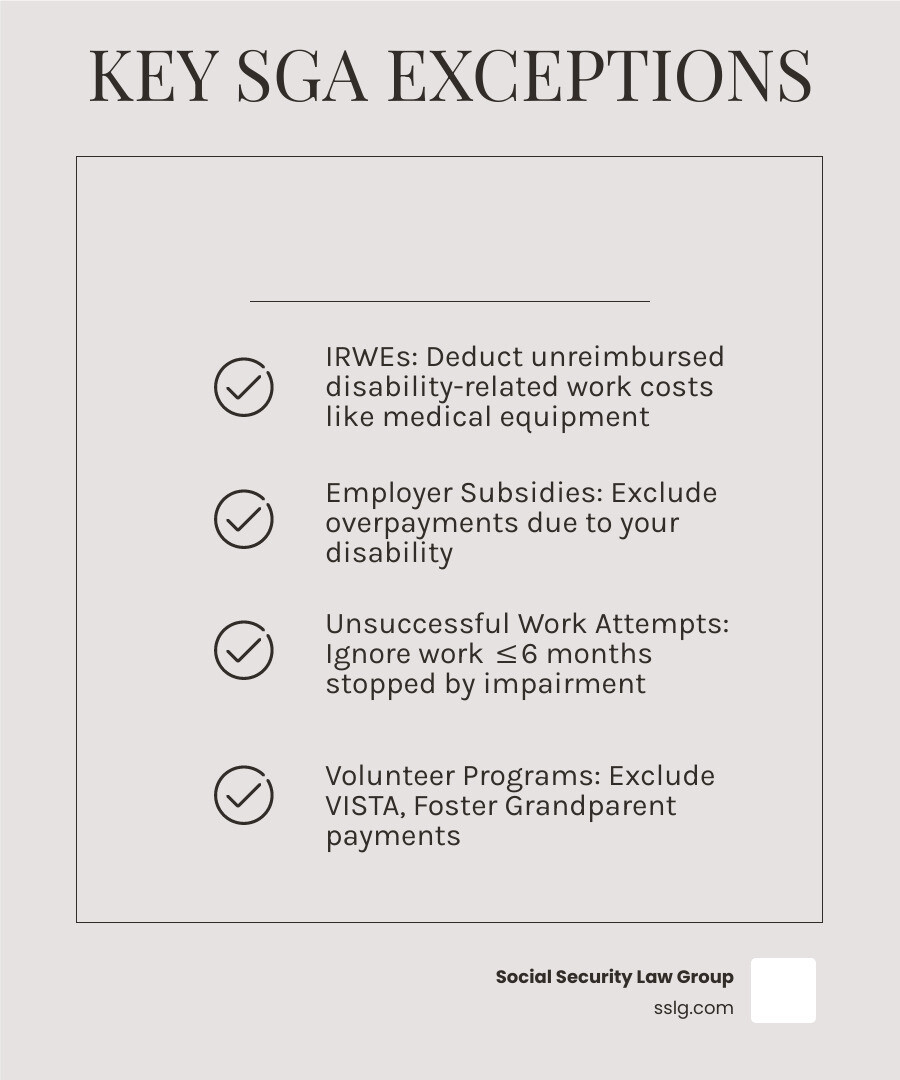
- Impairment-Related Work Expenses (IRWEs): Unreimbursed costs you pay to work because of your disability, such as medical equipment or transportation, are deducted from your countable earnings.
- Employer subsidies: If your employer pays you more than your work is actually worth due to your disability, the excess is not counted toward SGA.
- Unsuccessful work attempts: Work lasting six months or less that you had to stop or reduce because of your impairment does not count as SGA.
- Income averaging: If your earnings fluctuate month to month, the SSA can average them across the months you worked.
- Volunteer and federal program exceptions: Payments from programs like VISTA and the Foster Grandparent Program under the Domestic Volunteer Service Act are excluded entirely.
- Federal Advisory Committee Act (FACA) payments: Compensation for serving on FACA committees is disregarded for SGA purposes.
- Daily personal activities: Getting dressed, cooking, doing household chores, attending therapy, or going to school do not count as SGA.
In 2026, the SSA’s standard SGA monthly earnings limit is $1,690 for non-blind individuals and $2,830 for blind individuals. If your countable income stays below those numbers, or if a valid exception applies, you may still qualify for benefits even if you are doing some form of work.
This matters because the SSA checks SGA first, before it ever looks at your medical records. A misunderstanding at this step can lead to a fast denial, even if your health condition is severe. Knowing which exceptions apply to your situation is one of the most practical things you can do to protect your claim.
At Social Security Law Group, we have helped clients across California, Oregon, Washington, Texas, Florida, Massachusetts, and nationwide navigate exactly these kinds of rules since 1994. Our attorneys understand how to apply SGA exceptions correctly so your claim reflects the full picture of your situation.
Substantial gainful activity exceptions basics:
Understanding Substantial Gainful Activity Exceptions and 2026 Limits

At Social Security Law Group, we often meet applicants in places like Boston, Seattle, or Houston who are worried that any amount of work will automatically disqualify them. This is where understanding the “SGA” threshold becomes vital. Substantial Gainful Activity (SGA) is the yardstick the SSA uses to determine if you are working enough to support yourself.
For the 2026 calendar year, the monthly SGA limits have been adjusted to reflect the national wage index. If you are non-blind, you can generally earn up to $1,690 per month. If you meet the legal definition of blindness, that threshold is significantly higher at $2,830 per month. These figures represent “countable” income, which is not always the same as your gross pay.
| Category | 2023 Monthly Limit | 2026 Monthly Limit |
|---|---|---|
| Non-Blind Individuals | $1,470 | $1,690 |
| Statutorily Blind Individuals | $2,460 | $2,830 |
It is important to remember that the SSA defines “substantial” as work involving significant physical or mental activities, even if you are doing less or being paid less than you were in previous roles. “Gainful” simply means work usually done for pay or profit. To dive deeper into these definitions, you can read our guide on Beyond the Buzzword: Understanding Substantial Gainful Activity.
Volunteer and Advisory Committee Substantial Gainful Activity Exceptions
Not all work that looks like a job is treated like a job by the SSA. One of the most powerful substantial gainful activity exceptions involves specific federal volunteer programs. If you are volunteering through programs authorized under the Domestic Volunteer Service Act of 1973, the SSA is legally required to ignore any stipends, supportive services, or reimbursements you receive.
Exempt programs include:
- Volunteers in Service to America (VISTA)
- University Year for ACTION
- Special Volunteer Programs
- Retired Senior Volunteer Program (RSVP)
- Foster Grandparent Program
- Senior Companion Program
Additionally, if you serve on a committee under the Federal Advisory Committee Act (FACA), any payments or services you receive for that work are fully excluded from SGA considerations. According to the SSA Handbook § 620, these activities are disregarded regardless of the amount of compensation, ensuring that your civic engagement does not jeopardize your disability status.
Navigating the Trial Work Period and Substantial Gainful Activity Exceptions
For those already receiving Social Security Disability Insurance (SSDI) benefits in cities like Phoenix or Chicago, the SSA offers a “Trial Work Period” (TWP). This is a nine month window (not necessarily consecutive) within a rolling 60 month period where you can earn any amount of money without losing your benefits.
In 2026, any month where you earn more than the TWP threshold (which is lower than the SGA limit) or work more than 80 hours in self-employment counts as one of your nine months. Once the TWP is over, you enter an “Extended Period of Eligibility” (EPE) that lasts for 36 months. During the EPE, you can still receive a benefit check for any month your earnings fall below the SGA limit. You can learn more about managing these phases by checking our TWP resources.
Deductions That Lower Your Countable Income
One of the most common ways we help our clients in Detroit, Atlanta, and beyond is by identifying deductions that lower their “countable” income. Even if your gross paycheck is $1,800 (which is over the 2026 non-blind SGA limit), you might still be eligible if your countable income is lower.
Impairment-Related Work Expenses (IRWE)
If you must pay for items or services because of your disability to enable you to work, the SSA may deduct those costs from your gross earnings. These are known as Impairment-Related Work Expenses (IRWE). To qualify, the expense must be:
- Related to your impairment.
- Necessary for you to work.
- Paid for by you (not reimbursed by insurance or an employer).
- Paid in a month you were working.
Examples include specialized transportation, attendant care services, or medical devices like braces or pacemakers. Under 20 C.F.R. § 404.1572 (a), the SSA recognizes that these costs represent a barrier to “gainful” activity that non-disabled workers do not face.
Employer Subsidies and Special Conditions
Sometimes an employer provides “subsidies” by paying a disabled employee the same wage as non-disabled coworkers, even though the disabled employee produces less or requires more supervision. For instance, if you work in a sheltered workshop or a business owned by a relative in San Antonio or Las Vegas, you might receive extra help that has a specific monetary value. The SSA will subtract the value of that extra help from your gross earnings. For a more detailed look at how this works, see our article on Working While Disabled: Understanding Substantial Gainful Activity.
Specific Work Scenarios and Evaluation Guides
The SSA does not just look at a single month’s pay stub and make a final decision. They use several evaluation guides to see if your work truly represents a sustained ability to engage in SGA.
The Unsuccessful Work Attempt (UWA)
If you try to return to work but find that your disability forces you to stop or reduce your earnings below the SGA limit within six months, the SSA may classify this as an “Unsuccessful Work Attempt.” According to SSA POMS: DI 10505.001, a UWA does not count as SGA. This rule is designed to encourage people to try working without the fear that a failed attempt will result in a permanent loss of benefits.
Income Averaging
If your income fluctuates (perhaps you work more hours some weeks than others in a retail job in Miami or Orlando), the SSA may use “income averaging.” They take your total earnings over a period of work and divide it by the number of months in that period. As noted in SSA POMS: DI 10505.015, this helps prevent a single “busy” month from disqualifying an applicant whose average work effort is still below the substantial gainful activity line.
Self-Employment and SSI-Specific Rules
Self-employment is handled differently than traditional W-2 employment. If you are running a small business in Charlotte or Seattle, the SSA uses “Three Tests” to evaluate your work:
- Significant Services and Substantial Income: Are you providing services vital to the operation and earning a healthy profit?
- Comparability Test: Is your work similar to what a non-disabled person does in a similar business in your community?
- Worth of Work Test: Is your work worth more than the SGA limit, even if you aren’t currently drawing that much in profit?
For those on Supplemental Security Income (SSI), the rules are even more specific. Under Code of Federal Regulations § 416.974, the SSA excludes the first $20 of unearned income and the first $65 of earned income, plus half of the remaining earnings.
We also highly recommend looking into the Plan to Achieve Self-Support (PASS). A PASS allows you to set aside money for a specific work goal (like starting a business or getting a degree) without that money counting toward your SSI resource or income limits. This is a great way to transition back to the workforce while maintaining your safety net. If you are still wondering “what is it?”, check out our page on what is substantial gainful activity.
Frequently Asked Questions about SGA Exceptions
What daily activities are excluded from SGA?
Many people worry that being active at home will look like “work” to the SSA. However, 20 C.F.R. § 404.1572 (b) clarifies that daily personal activities, such as taking care of yourself, doing household chores, or engaging in hobbies, are not considered SGA. While these activities might be used to evaluate your physical or mental “functional capacity,” they do not count as “gainful” because they are not the type of work people are usually paid to do.
Can I work while my disability application is pending?
Technically, yes, but it is risky. If you earn over the SGA limit while your application is being reviewed, the SSA may issue a technical denial without even looking at your medical evidence. If you must work part-time in a city like Dallas or Denver while waiting, it is essential to keep your earnings well below the 2026 limits and document any accommodations you receive. For more official answers, you can visit the SSA Frequent Questions page.
How do I document my SGA exceptions?
Documentation is the key to success. If you have IRWEs, keep every receipt. If your employer provides a subsidy, ask them for a written statement describing the extra help or reduced productivity. When the SSA asks for a Work Activity Report (Form SSA-821-BK), be thorough in explaining why your pay does not reflect a full work capacity. You can find more details on reporting responsibilities to the SSA on their website.
Conclusion
Navigating substantial gainful activity exceptions doesn’t have to be a solo journey. At Social Security Law Group, we pride ourselves on a 97 percent success rate and a commitment to our “no-win, no-fee” structure. Whether you are in California, Oregon, Washington, Texas, Florida, or Massachusetts, our modern client technology allows us to provide top-tier legal representation regardless of your location.
If you are ready to explore how these exceptions apply to your specific case, contact us today. We are here to ensure that your effort to stay active and productive doesn’t stand in the way of the benefits you have earned. To learn more about how we can help, visit our comprehensive guide on Substantial Gainful Activity.
The information provided in this blog article is intended to be general in nature and should not be construed as legal advice. Social Security laws and regulations are subject to, and often change. Please consult the official Social Security Administration (SSA) website or contact SSLG for advice regarding your specific legal matters.