


What You Need to Know About SSDI Payment Dates in 2026
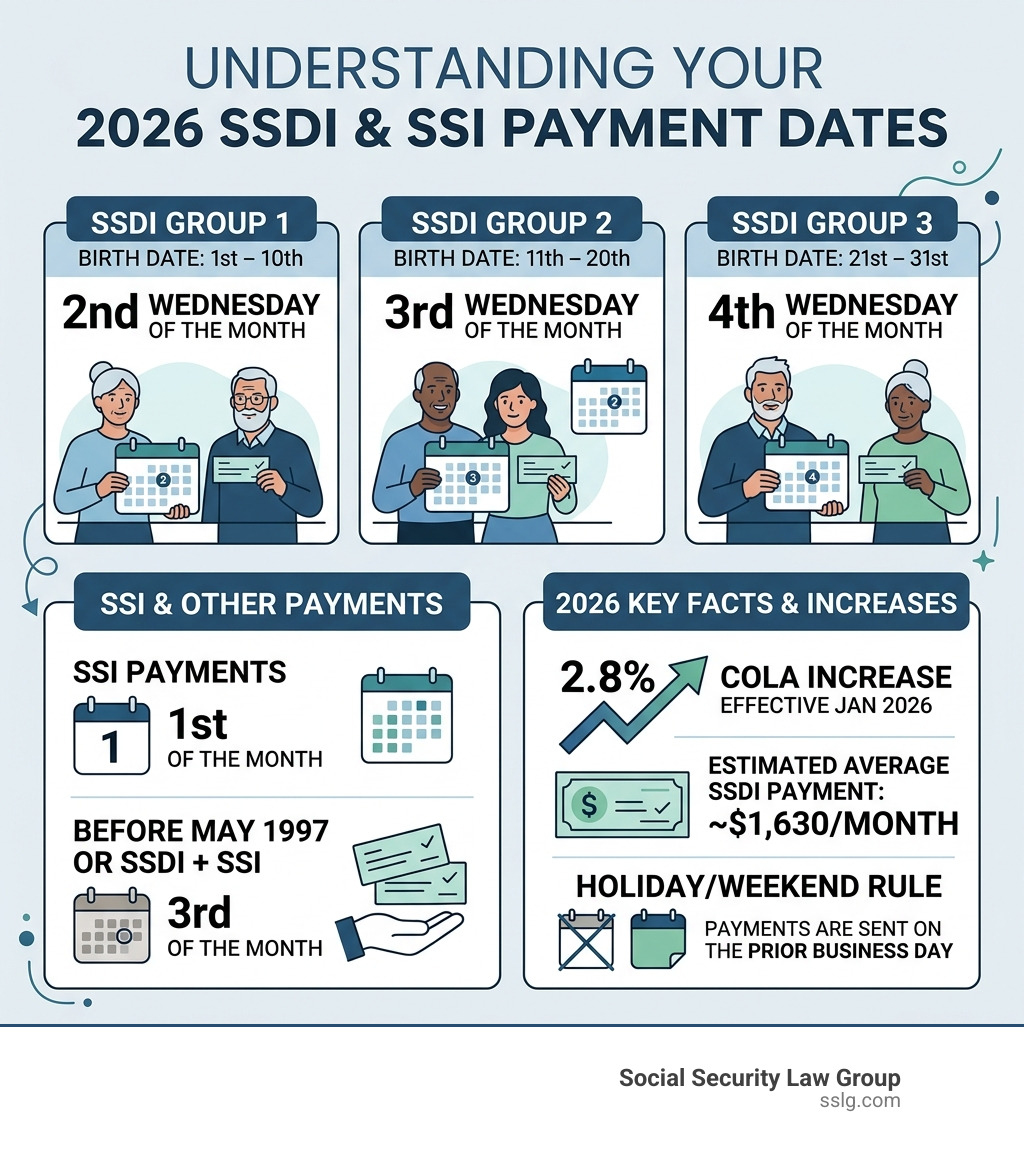
SSDI payment dates are set by the Social Security Administration (SSA) based on your birth date. Here is a quick summary of when you can expect your payment each month:
| Birth Date Range | Payment Day |
|---|---|
| 1st – 10th | 2nd Wednesday of the month |
| 11th – 20th | 3rd Wednesday of the month |
| 21st – 31st | 4th Wednesday of the month |
| Before May 1997 or receiving both SSDI and SSI | 3rd of the month |
Key facts for 2026:
- The average SSDI payment is approximately $1,630 per month, up from $1,586 in 2025
- A 2.8% Cost-of-Living Adjustment (COLA) took effect in January 2026
- If your payment date falls on a federal holiday or weekend, SSA sends it on the prior business day
- SSI payments arrive on the 1st of each month (with the same holiday/weekend rule)
Waiting on a disability check when bills are due is one of the most stressful parts of living with a serious health condition. For the more than 74 million Americans who rely on Social Security and SSI benefits, knowing exactly when money will arrive is not just helpful, it is essential for covering rent, groceries, and medical costs.
The good news is that the SSA follows a very predictable schedule. Once you know your birth date group and benefit type, you can plan your finances around the same payment window every single month.
This guide walks you through everything you need to know about the 2026 SSDI payment calendar, including exceptions, holiday adjustments, and what to do if your payment does not show up on time.
How Birth Dates Determine Your SSDI Payment Dates

If you are new to the disability system, you might wonder why your neighbor gets their check a week before you do. Since May 1997, the SSA has used a staggered system to distribute payments. This helps prevent banks from being overwhelmed by millions of transactions on a single day.
The primary factor determining your SSDI payment dates is the day of the month you were born. The SSA splits beneficiaries into three distinct Wednesday cycles.
Birth Date Ranges and Wednesday Cycles
The schedule is strictly mathematical. Here is how it breaks down for 2026:
- Birthdays 1st through 10th: You will receive your benefits on the second Wednesday of every month.
- Birthdays 11th through 20th: Your payment arrives on the third Wednesday of every month.
- Birthdays 21st through 31st: You are scheduled for the fourth Wednesday of every month.
| Birth Date Group | 2026 Payment Wednesday |
|---|---|
| 1st – 10th | 2nd Wednesday |
| 11th – 20th | 3rd Wednesday |
| 21st – 31st | 4th Wednesday |
It is important to remember that Social Security payments are made “in arrears.” This means the payment you receive in March is actually for the month of February. You can view the official Schedule of Social Security Benefit Payments 2026 for a month by month view of these dates. For more details on how these cycles work, you can explore more info about social security payment.
The 2026 SSDI Payment Schedule and COLA Increases
For 2026, there is some positive news regarding your monthly check amount. More than 74 million beneficiaries saw their payments increase by 2.8% due to the annual Cost-of-Living Adjustment (COLA). This adjustment is designed to help your benefits keep pace with the rising cost of living, from healthcare to housing.
According to the Social Security Benefit Amounts 2026 fact sheet, the average SSDI payment has risen to approximately $1,630 per month. This is an average increase of about $44 per month compared to 2025. While it might not seem like a fortune, that extra $528 per year can make a significant difference in maintaining your purchasing power against inflation.
Understanding the Social Security COLA for 2026 is vital for budgeting. If you are still in the application phase and wondering how much is social security disability, your specific amount is based on your lifetime earnings record and the amount of Social Security taxes you paid while working.
Exceptions to the Standard SSDI Payment Dates Schedule
While the Wednesday birth date schedule covers most people, there are significant exceptions. Not everyone follows the “Wednesday rule.” If you fall into one of these categories, your SSDI payment dates will look different.
The most common exception involves those who receive Social Security disability payments alongside Supplemental Security Income (SSI).
Understanding SSDI Payment Dates for Pre-1997 Recipients
If you started receiving benefits before May 1997, you are likely on a “legacy” or grandfathered schedule. For these beneficiaries, the SSA typically issues payments on the 3rd of each month. This provides a high level of consistency, as the date does not shift based on your birthday. To learn more about how these fixed dates are calculated, see our disability benefit amount a guide to your monthly check.
Coordinating SSDI and SSI Payment Dates in 2026
For those who qualify for both programs, the SSA coordinates the SSI payment schedule with your SSDI check. Usually, SSI is paid on the 1st of the month, and the SSDI portion is paid on the 3rd.
In 2026, the maximum federal SSI amounts have also increased by 2.8%. For individuals, the limit is $994 per month, while eligible couples can receive up to $1,491. If you are curious about how much does SSI and SSDI pay together, it is important to check the 2026 SSI payment schedule to see how these dates align, especially during months where the 1st or 3rd falls on a weekend.
Impact of Holidays and Weekends on Your Benefits
The SSA never wants you to be without funds on a holiday or weekend. Therefore, if your scheduled payment date falls on a Saturday, Sunday, or a federal holiday, your payment will be moved to the preceding business day.
For example, in 2026, the Social Security Payment Schedule 2026 shows several shifts:
- January 1, 2026 (New Year’s Day): Since this is a holiday, the SSI payment for January is actually issued on December 31, 2025.
- November 2026: Because Veterans Day (November 11) falls on a Wednesday, recipients who usually get paid on the second Wednesday will see their funds arrive on Tuesday, November 10.
While the SSA sends the money early, your individual bank’s processing times may vary. If you use direct deposit, which we strongly recommend, you will likely see the funds available immediately on that earlier date. For a deeper look at these shifts, read Decoding Your SSI Payments: A Comprehensive Date Guide.
Troubleshooting Late or Missing SSDI Payments
If your Wednesday comes and goes without a deposit, do not panic immediately. The SSA suggests a “three day mailing rule.” If you still receive a paper check in the mail, you should wait three additional mailing days before contacting the SSA.
However, most people now use direct deposit or the Direct Express card. If your electronic payment is missing, start by contacting your bank or financial institution. Sometimes there are internal processing delays that have nothing to do with the SSA.
Steps to Take if Your SSDI Payment Dates Pass Without Deposit
If your bank confirms no deposit is pending, follow these steps:
- Check your my Social Security account: Log in to my Social Security to see if there are any alerts or notices regarding your eligibility.
- Verify your info: Ensure you haven’t recently changed banks or addresses without notifying the SSA.
- Call the SSA: You can reach them at 800-772-1213.
- Local Office: If you live in areas like San Antonio, Houston, or Seattle, you can visit a local field office for assistance.
Whether you are looking for how much is disability in Texas or how much does disability pay in California, the process for reporting a missing payment is the same nationwide.
Frequently Asked Questions about SSDI Payment Dates
Why did I receive two SSI payments in one month?
This is one of the most common questions we hear. You are not getting “extra” money; it is simply a calendar adjustment. If the 1st of the next month falls on a weekend or holiday, the SSA pays that benefit on the Friday before. This results in some months having two payments and other months (like March 2026) having zero payments. Rest assured, you still receive exactly 12 payments per year. You can check the SSI amounts for 2024 and 2026 to see how these amounts are calculated.
How do I check my personal payment status online?
The fastest way is through the official SSA portal. By creating an account, you can see your payment history and upcoming dates. If you are unsure how much does SSDI or SSI pay in your specific case, your “Benefit Verification Letter” available in the portal will show your exact 2026 amount.
Will a government shutdown delay my SSDI check?
No. Social Security and SSDI payments are considered “permanent appropriations.” This means the money is already set aside and does not require a new act of Congress to be sent out. Even during a government shutdown, the SSA continues to issue checks on the scheduled SSDI payment dates.
Conclusion
Navigating disability benefits can be overwhelming, but understanding your payment schedule should not be. At Social Security Law Group, we have been helping clients from Boston and Chicago to Miami and Las Vegas secure the benefits they deserve since 1994.
With our 97% success rate and no-win, no-fee structure, we take the stress out of the legal process so you can focus on your health. Whether you are in California, Texas, Florida, Massachusetts, Washington, or Oregon, our team is ready to provide the unrivaled expertise you need.
If you are ready to start your journey or have questions about your claim, apply for SSDI benefits with us today.
The information provided in this article is intended to be general in nature and should not be construed as legal advice. Social Security laws and regulations are subject to change without notice. Please consult the official Social Security Administration (SSA) website or contact SSLG for advice regarding your specific legal matters.