
What Are Child Disability Benefits and Who Can Get Them?
Child disability benefits are government programs that provide monthly financial support to families raising children with serious physical or mental health conditions. If your child has a qualifying disability, you may be able to get help paying for their care, medical needs, and daily living costs.
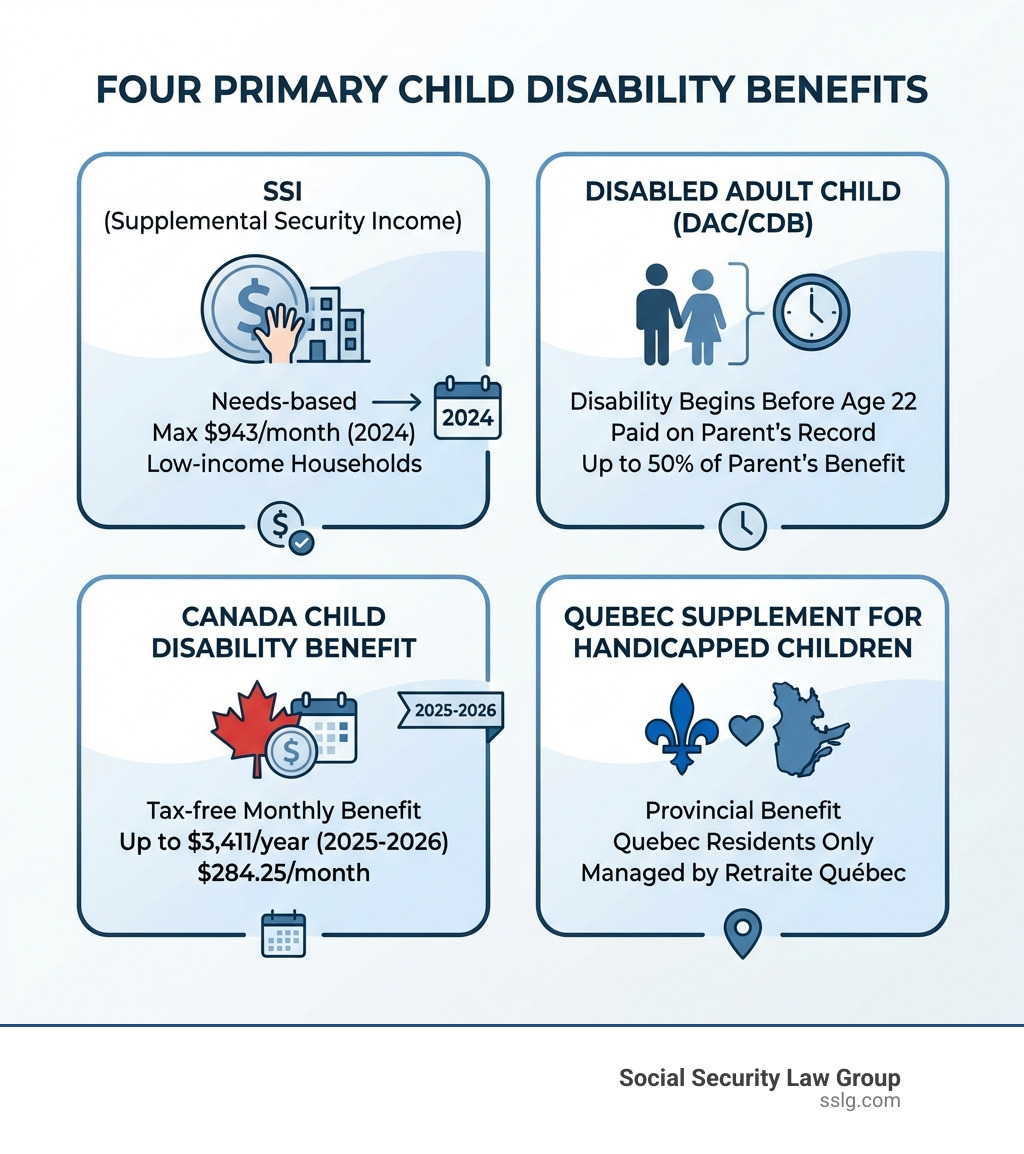
Here is a quick overview of the main types:
- Supplemental Security Income (SSI): A needs-based program from the Social Security Administration (SSA) for children with disabilities in low-income households. The maximum payment is $943 per month in 2024.
- Disabled Adult Child (DAC) / Childhood Disability Benefits (CDB): For adults whose disability began before age 22, paid on a parent’s earnings record. Can be up to 50% of the parent’s benefit.
- Canada Child Disability Benefit (CDB): A tax-free monthly benefit for Canadian families. For July 2025 to June 2026, families can receive up to $3,411 per year ($284.25/month) per eligible child.
- Quebec Supplement for Handicapped Children: A separate provincial benefit for Quebec residents, managed by Retraite Québec.
Getting these benefits is not always easy. Between 70% and 80% of first-time applicants are denied, and the application process can feel overwhelming. This guide breaks down everything you need to know, from eligibility and medical requirements to what happens when your child turns 18.
Eligibility Criteria for Child Disability Benefits

When we look at eligibility for Child disability benefits, specifically Supplemental Security Income (SSI) in the United States, the Social Security Administration (SSA) uses a two pronged approach. First, the child must meet strict medical criteria. Second, the household must meet financial requirements. Because children do not usually have their own income, the SSA “deems” a portion of the parents’ income and resources as being available to the child.
Medical necessity is the foundation of any claim. The SSA defines disability for a child as a physical or mental impairment that results in marked and severe functional limitations. This condition must be expected to last at least 12 months or result in death. We often see families in cities like Boston or Seattle struggle with the technicalities of these definitions, but having a clear medical trail is vital.
It is also important to consider family structure. For instance, many parents ask, are stepchildren eligible for benefits? The answer is often yes, provided the stepchild was dependent on the disabled or retired stepparent.
| Feature | Supplemental Security Income (SSI) | Social Security Disability Insurance (SSDI) |
|---|---|---|
| Basis | Financial Need (Low Income/Assets) | Work History of Parent |
| Medical Requirement | Marked/Severe Functional Limitations | Disability onset before age 22 (for DAC) |
| Monthly Max (2024) | $943 | Varies (Up to 50% of parent’s PIA) |
| Health Coverage | Medicaid (usually automatic) | Medicare (after 24 months) |
Qualifying Medical Conditions and Child Disability Benefits
The SSA maintains a “Blue Book” of impairments. This is a technical manual that lists specific medical criteria for various conditions. If a child’s condition meets or medically equals a listing in the SSA Blue Book listings, they are considered disabled.
Common qualifying conditions include:
- Autism Spectrum Disorder (ASD): To qualify, a child must show significant deficits in social communication and social interaction, along with restricted, repetitive patterns of behavior. We specialize in helping families secure SSI benefits for autism by documenting how these traits limit the child’s ability to function at an age appropriate level.
- ADHD: While more common, ADHD only qualifies if it is severe enough to cause marked limitations in two areas of functioning (such as learning or interacting with others) or an extreme limitation in one.
- Intellectual Disabilities: Measured through standardized IQ testing and functional assessments.
- Physical Impairments: Such as cerebral palsy, cystic fibrosis, or severe musculoskeletal disorders.
For conditions like autism, the autism disability criteria focus heavily on functional reports from teachers and therapists, not just a doctor’s diagnosis.
Income Limits and Deeming Rules
Even if a child is medically disabled, they can be disqualified if the family earns too much. This process is called “deeming.” The SSA looks at the “adjusted family net income” and total resources. Generally, for a single parent household, the income limit is roughly $35,000, and for a two parent household, it is around $45,000, though these numbers fluctuate based on how many other non disabled children are in the home.
The resource limit is also strict. Parents can generally have up to $2,000 in countable assets (or $3,000 for couples). However, the SSA does not count the home you live in or one vehicle used for transportation. According to SSA.gov, the maximum SSI payment for a child is $943 per month in 2024, but this amount can be reduced if the family’s income is near the threshold.
Navigating the Application Process and Medical Requirements
The application process is a marathon, not a sprint. Whether you are applying in Dallas, Houston, or Chicago, the requirements for medical evidence are exhaustive. You cannot simply tell the SSA that your child is struggling; you must prove it with “objective medical evidence.”
In Canada, this often involves Form T2201, which requires a medical practitioner to certify a severe and prolonged impairment. In the U.S., while there is no single form like the T2201, the SSA application portal requires you to list every doctor, hospital, and clinic your child has visited.
How to Apply for Child Disability Benefits
You can start the process for SSI online, but you will typically need to complete a follow up interview over the phone or at a local office in cities like Atlanta or Phoenix. You will need:
- The child’s Social Security Number and birth certificate.
- Proof of household income and resources (bank statements, pay stubs).
- A detailed medical history, including medications and treatment plans.
- School records, including Individualized Education Programs (IEPs) or 504 plans.
The Social Security application checklist is a helpful tool to ensure you have everything ready. Be prepared for a wait; the initial decision usually takes three to five months. Unfortunately, industry statistics show that 70% to 80% of applicants are denied on their first attempt. This is why many families in places like Detroit or Las Vegas choose to work with us from the beginning.
Proving Severity and Duration
To win a case for Child disability benefits, you must satisfy the “Twelve Month Rule.” This means the disability must have lasted, or be expected to last, for at least one continuous year.
The SSA also looks for “marked” or “extreme” limitations in six domains of functioning:
- Acquiring and using information.
- Attending and completing tasks.
- Interacting and relating with others.
- Moving about and manipulating objects.
- Caring for yourself.
- Health and physical well being.
A “marked” limitation means the impairment interferes seriously with the child’s ability to independently initiate, sustain, or complete activities. An “extreme” limitation is even more severe. Detailed medical evidence requirements specify that statements from teachers and social workers are often just as important as those from doctors in proving these limitations.
Comparing Federal, Provincial, and International Programs
If you live near the border or have family in Canada, you might notice that the systems differ significantly. The U.S. system is largely based on financial need (SSI) or parental work history (SSDI/DAC). The Canadian system, however, offers a tax free monthly payment that is less tied to strict “poverty” levels than U.S. SSI.
Differences Between US and Canadian Benefits
The Child Disability Benefit overview provided by the Canadian government highlights that their benefit is a tax free payment for families who care for a child under 18 with a severe impairment.
Key differences include:
- Payment Amounts: The maximum Canadian benefit is $3,411 per year for the 2025 to 2026 period. In the U.S., the maximum SSI is $943 per month, which totals over $11,000 annually, though it is much harder to qualify for the full amount due to income deeming.
- Income Thresholds: In Canada, the benefit starts to reduce only when the adjusted family net income (AFNI) exceeds $81,222.
- Regional Supplements: Quebec offers the Supplement for Handicapped Children, which is a provincial addition. Similarly, parents must already be receiving the Family Allowance in Quebec to qualify.
State Specific Programs and Supplements
In the United States, many states provide extra money on top of the federal SSI payment. Furthermore, children who qualify for SSI are usually automatically eligible for Medicaid.
Some states have unique programs:
- Colorado: The Colorado Health First Program allows families with disabled children to “buy in” to Medicaid coverage even if their income is too high for traditional SSI.
- Missouri: The Missouri Disability Portal provides a centralized hub for state specific grants and assistive technology programs.
- Massachusetts: Families can access Boston legal resources that specialize in helping children through the Children’s Disability Project.
Transitioning to Adult Benefits at Age 18
The day a child turns 18 is a major milestone for Child disability benefits. At this age, the SSA performs an “age 18 redetermination.” They stop looking at the parents’ income and instead evaluate the young adult based on adult disability standards. This is often a “sink or swim” moment for benefits.
Because adult rules focus on the “ability to work” rather than “functional domains,” some children who received SSI may lose it at 18 if the SSA decides they can perform simple jobs. However, if the disability is severe, they may transition to Disabled Adult Child (DAC) benefits.
According to the SSA Handbook Section 518, a person can receive DAC benefits if:
- They are over 18.
- They have a disability that started before age 22.
- A parent is deceased or receiving Social Security retirement or disability benefits.
Re-entitlement and Work History
The rules for “re entitlement” are also crucial. If a disabled adult child tries to work but their disability forces them to stop, they may be able to get back on benefits without a brand new application. The SSA policy on re-entitlement allows for this within certain timeframes, specifically if the previous entitlement ended due to substantial gainful activity.
Additionally, if a parent passes away, the child may be eligible for survivor benefits for children. These benefits are vital for long term financial stability. The Requirements for Entitlement to Childhood Disability Benefits state that as long as the disability began before 22, the “child” can be any age when they claim on a parent’s record.
Frequently Asked Questions
What happens if my application is denied?
Do not panic. Most applications are denied initially. You have 60 days to file a Request for Reconsideration. If that is denied, you can request a hearing before an Administrative Law Judge. This is where having legal representation is most effective, as judges look closely at the medical evidence and vocational factors.
Can my child receive benefits for ADHD?
Yes, but it is difficult. You must prove that the ADHD is so severe that it causes “marked” limitations in at least two areas of functioning. This usually requires extensive documentation from psychiatrists and school specialized education departments showing that the child cannot function in a standard classroom setting even with medication.
How does family income affect the monthly payment?
The SSA uses a formula to “deem” parental income. After certain deductions for living expenses and other children in the home, the remaining income reduces the child’s SSI payment dollar for dollar. If the deemed income is high enough, the payment may drop to zero, even if the child is medically qualified.
Conclusion
Navigating Child disability benefits is one of the most challenging tasks a parent can face. Whether you are dealing with the complexities of the SSA Blue Book or trying to understand how your income affects your child’s SSI, you do not have to do it alone.
At Social Security Law Group, we have been providing expert legal representation since 1994. With a 97% success rate and a no win, no fee structure, we are committed to helping families in cities like Boston, Dallas, Miami, and Charlotte secure the support they deserve.
While SSLG represents individuals who attain the age of 18 and are being reviewed by SSA to determine whether they meet the adult rules for disability benefits, we do not provide assistance with childhood disability claims.
If you are ready to start the journey or need to appeal a denial, contact a disability benefits lawyer today for a consultation. We are here to help you turn a “no” into a “yes.”