


What You Need to Know About Stroke Disability Benefits
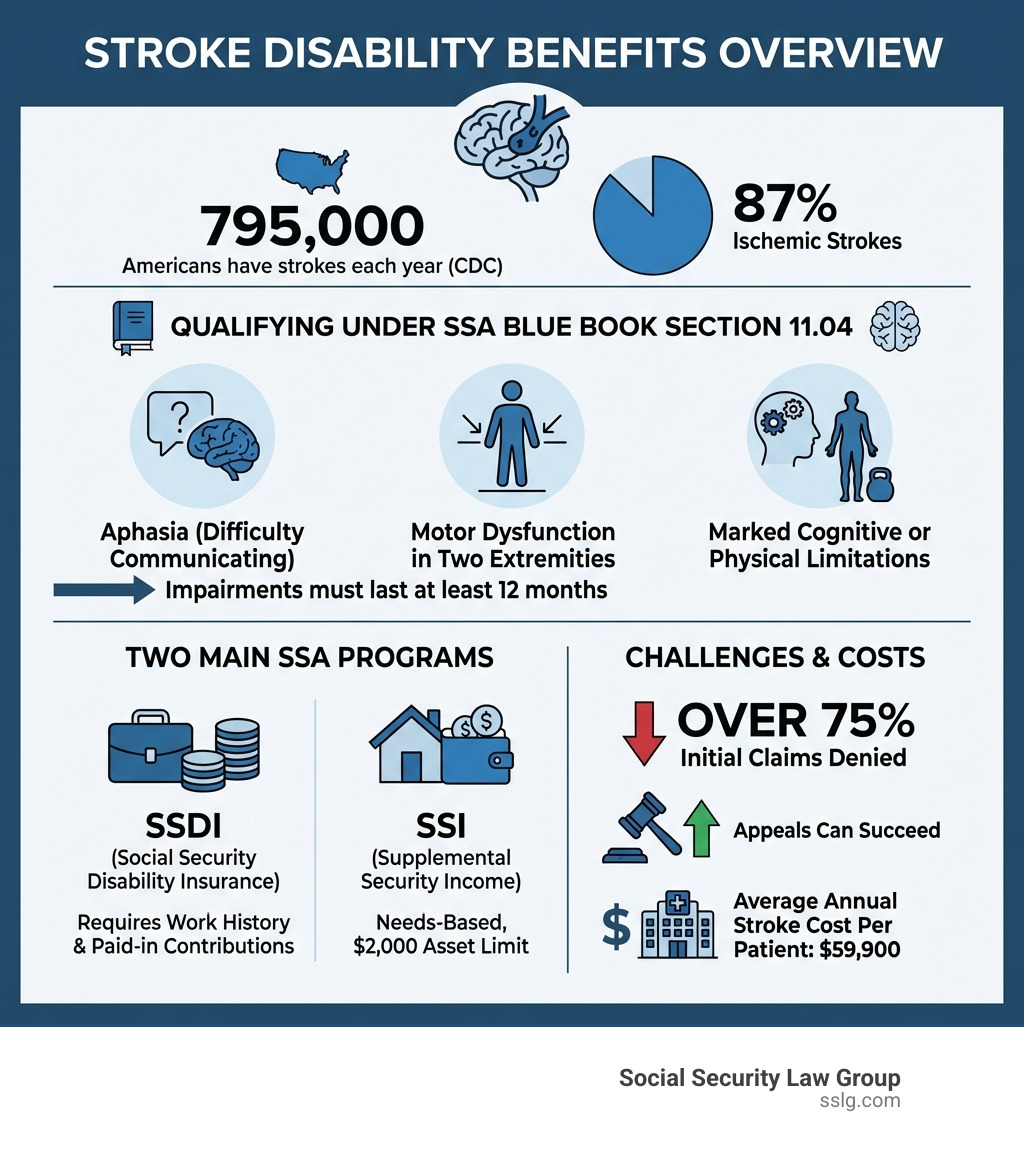
Stroke disability benefits are monthly payments from the Social Security Administration (SSA) for people whose stroke prevents them from working for at least 12 months.
Here is a quick overview of how eligibility works:
- Who qualifies: People whose stroke causes lasting impairments like paralysis, aphasia, or cognitive problems that stop them from working
- Main programs: Social Security Disability Insurance (SSDI) for workers with a paid-in work history, and Supplemental Security Income (SSI) for those with limited income and assets
- Key SSA listing: Strokes are evaluated under Blue Book Section 11.04 (Vascular Insult to the Brain)
- Duration rule: Your impairments must last or be expected to last at least 12 months
- When to apply: As soon as possible after your stroke, though SSA typically waits at least 3 months to assess lasting damage
- If denied: You have 60 days to appeal, and most approvals happen at the hearing stage
Every year, about 795,000 Americans suffer a stroke, making it a leading cause of serious long-term disability in the United States. About one in four stroke victims is under age 65, meaning many are working-age adults suddenly unable to earn a paycheck. The financial pressure can be immediate and severe, with average stroke-related costs running nearly $59,900 per patient per year, according to research published by the NCBI.
Despite the clear need, the SSA denies more than 75% of initial disability applications. Many stroke survivors give up after that first rejection, not realizing they have strong grounds to appeal.
This guide walks you through exactly what it takes to qualify, what evidence you need, and how to protect your rights if you are denied.
Understanding Stroke and Its Impact on Work

A stroke, often referred to as a “brain attack,” occurs when the blood supply to part of your brain is interrupted or reduced, preventing brain tissue from getting oxygen and nutrients. According to the Centers for Disease Control and Prevention (CDC), about 87% of all strokes are ischemic strokes, which happen when blood flow through the artery that supplies oxygen rich blood to the brain becomes blocked. Hemorrhagic strokes, on the other hand, occur when an artery in the brain leaks blood or ruptures.
Even a “mini stroke,” known as a Transient Ischemic Attack (TIA), serves as a serious warning. While TIAs may resolve quickly, the CDC reports that they are often precursors to more severe events that lead to permanent work incapacity. For those living in cities like Boston, Massachusetts, or Raleigh, North Carolina, the path to disability benefits eligibility begins with understanding how these medical events translate into functional limitations.
The impact of a stroke on your ability to work is often multifaceted. Common effects include:
- Mobility Reduction: More than half of stroke survivors over age 65 experience reduced mobility, such as difficulty walking or maintaining balance.
- Cognitive Changes: Survivors may struggle with memory, attention, and executive function, making complex workplace tasks impossible.
- Aphasia: This communication disorder affects the ability to express or understand speech and written language.
- Vision Loss: Blurred, double, or blackened vision can occur depending on which part of the brain was affected.
- Personality Shifts: Changes in emotional regulation or temperament can impact professional interactions and workplace stability.
SSA Criteria for Stroke Disability Benefits
The SSA uses a manual called the Blue Book to determine if a medical condition is severe enough to qualify for benefits. To receive stroke disability benefits, your condition must meet specific SSA Blue Book Neurological Listings. Strokes are specifically categorized under Section 11.04, “Vascular Insult to the Brain.”
A critical hurdle for many applicants is the 12 month duration rule. The SSA does not pay for short term or partial disability. You must prove that your impairments have lasted, or are expected to last, for at least one full year. Because many survivors see significant improvement in the first few weeks, the SSA typically waits at least 3 months post stroke before making a final determination on the severity of the “vascular insult.” You can find more info about the SSA Blue Book on our dedicated resources page.
Qualifying via Listing 11.04 for Stroke Disability Benefits
To meet the requirements of Listing 11.04, you must demonstrate one of the following persisting for at least 3 consecutive months after the stroke:
- Sensory or Motor Aphasia: This must result in “ineffective speech or communication.” If you cannot be understood by others or cannot understand what is being said to you despite using assistive devices, you may qualify under this criteria.
- Disorganization of Motor Function: This requires “extreme limitation” in the ability to stand up from a seated position, balance while standing or walking, or use your upper extremities (arms and hands). This must affect at least two extremities, such as both legs, both arms, or one arm and one leg.
- Marked Physical and Mental Limitations: If your physical limitations are “marked” (serious but not extreme) and you also have a “marked” limitation in mental functioning (such as remembering information, interacting with others, or concentrating), you may satisfy the listing.
For those experiencing related issues like vision or hearing loss, the SSA may also refer to the SSA guide to sensory disorders to evaluate the claim.
How the RFC Supports Stroke Disability Benefits
Not every survivor fits perfectly into the 11.04 listing, but that does not mean you are ineligible. If you do not meet the Blue Book criteria, the SSA will perform a Residual Functional Capacity (RFC) assessment. This evaluation determines the most you can still do in a work setting despite your stroke related limitations.
The RFC considers both physical and mental restrictions. For example, if a stroke left you with weakness on one side of your body, your RFC might limit you to “sedentary work” that does not require standing or carrying heavy objects. If you also have cognitive “brain fog,” your RFC might state you can only perform “simple, routine tasks.” When the SSA determines your RFC makes it impossible to return to your past work or adjust to any other type of work, they may grant a Medical Vocational Allowance. This is a common path for applicants in locations like Detroit, Michigan, or Houston, Texas, who may have physically demanding work histories. Detailed SSA Residual Functional Capacity criteria help adjudicators make these complex decisions.
Navigating the Five-Step Evaluation for Stroke Disability Benefits
The SSA uses a sequential five step process to decide every disability claim. Understanding these steps can help you prepare a stronger application.
| Step | Question Asked by SSA | What It Means for Stroke Survivors |
|---|---|---|
| Step 1 | Are you working? | You cannot earn more than the Substantial Gainful Activity (SGA) limit, which is $1,690 per month in 2026. |
| Step 2 | Is your condition “severe”? | Your stroke must significantly limit your ability to do basic work activities like walking, lifting, or remembering. |
| Step 3 | Does it meet a “Listing”? | The SSA checks if your medical evidence matches Listing 11.04 in the Blue Book. |
| Step 4 | Can you do past work? | If you don’t meet a listing, the SSA asks if you can still perform the jobs you’ve held in the last 15 years. |
| Step 5 | Can you do other work? | The SSA looks at your age, education, and skills to see if you can transition to a different, less demanding job. |
This process emphasizes that stroke disability benefits are not just about a diagnosis; they are about how that diagnosis prevents work. For those over age 50, the SSA often applies “Grid Rules” that recognize it is harder to transition to new careers later in life, making it slightly easier to qualify. You can learn more about qualifying disabilities for Social Security on our website.
Financial Lifelines: SSDI, SSI, and Beyond
There are two primary federal programs that provide stroke disability benefits, and the one you apply for depends on your work history and financial situation.
Social Security Disability Insurance (SSDI) SSDI is an insurance program funded by payroll taxes. To qualify, you must have worked and paid into the system for a sufficient number of years (usually five out of the last ten years before your stroke). SSDI is not based on your current assets. Once approved, you are eligible for Medicare after a 24 month waiting period.
Supplemental Security Income (SSI) SSI is a needs based program for those who have not worked enough to qualify for SSDI or who have very low monthly income. To be eligible, you must have less than $2,000 in countable resources ($3,000 for couples). SSI provides a smaller monthly check but often comes with immediate access to Medicaid in most states, including Florida and Illinois.
The financial burden of a stroke is high. A study published by the NCBI estimates total stroke related costs in the U.S. reached nearly $53 billion between 2017 and 2018. Securing these benefits is often the only way for families in cities like Dallas, Texas, or Atlanta, Georgia, to stay afloat. In rare, extremely severe cases where a survivor is in a persistent vegetative state, they may look into what conditions automatically qualify you for disability under the Compassionate Allowances program.
Overcoming Denials and the Appeals Process
If your initial application is rejected, you are in the majority. The SSA denies approximately 75% of initial claims. However, this is not the end of the road. You have 60 days from the date you receive your denial letter to file an appeal.
The appeals process generally follows these stages:
- Reconsideration: A complete review of your file by someone who was not involved in the first decision.
- Hearing: An appearance before an Administrative Law Judge (ALJ). This is often the best chance for success, as you can present testimony and vocational experts can explain why your stroke prevents you from working.
- Appeals Council: A request for the SSA to review the ALJ’s decision.
- Federal Court: Filing a lawsuit in federal district court.
To win an appeal, medical evidence is paramount. You must provide hospital records, MRI results, CT scans, and detailed notes from your neurologists and physical therapists. At Social Security Law Group, we help clients in locations from Seattle, Washington, to Miami, Florida, organize this evidence to show what medical conditions qualify for social security disability.
Frequently Asked Questions about Stroke Disability Benefits
How long after a stroke can I apply for benefits?
You can apply for stroke disability benefits immediately after your stroke occurs. However, be aware that the SSA typically waits at least 3 months to see how much you recover through rehabilitation. Applying early establishes your “onset date,” which can maximize your back pay once you are eventually approved.
Can I get disability if my stroke was minor but I have cognitive issues?
Yes. The SSA looks at the functional impact of the stroke, not just the physical visible damage. If a “minor” stroke left you with severe memory loss, inability to concentrate, or emotional instability that prevents you from holding a job, you can still qualify through an RFC assessment and a Medical Vocational Allowance.
What if I have not worked enough years to qualify for SSDI?
If your work history is limited, you should apply for Supplemental Security Income (SSI). This program does not require work credits but does have strict limits on your income and assets. We represent clients in both programs to ensure they receive the maximum support available.
Conclusion
Navigating stroke disability benefits while recovering from a major medical event is a daunting task. The rules are complex, the paperwork is exhaustive, and the risk of denial is high. At Social Security Law Group, we have dedicated ourselves to expert advocacy since 1994. With a 97% success rate, our team provides the legal representation you need to secure your future.
We operate on a no win, no fee structure, meaning you pay nothing unless we win your case. Whether you need Massachusetts legal support in Boston, Florida application assistance in Tampa or Orlando, or Colorado disability claims help in Denver, our modern client technology allows us to serve you effectively regardless of your location. From Chicago to Charlotte and Las Vegas to Little Rock, we are here to help you rebuild your financial life after a stroke.
If you or a loved one are struggling with work incapacity after a stroke, do not wait until your savings are exhausted. Contact us for disability benefits today for a consultation and let us put our decades of experience to work for you.
The information provided in this blog article is intended to be general in nature and should not be construed as legal advice. Social Security laws and regulations are subject to, and often change. Please consult the official Social Security Administration (SSA) website or contact SSLG for advice regarding your specific legal matters.