
When You Need SSI Money Now: What the SSA Can Actually Do
One-time emergency payment SSI options exist to help people who cannot wait weeks or months for their first regular benefit check. If you are facing a crisis right now, here is what you need to know fast:
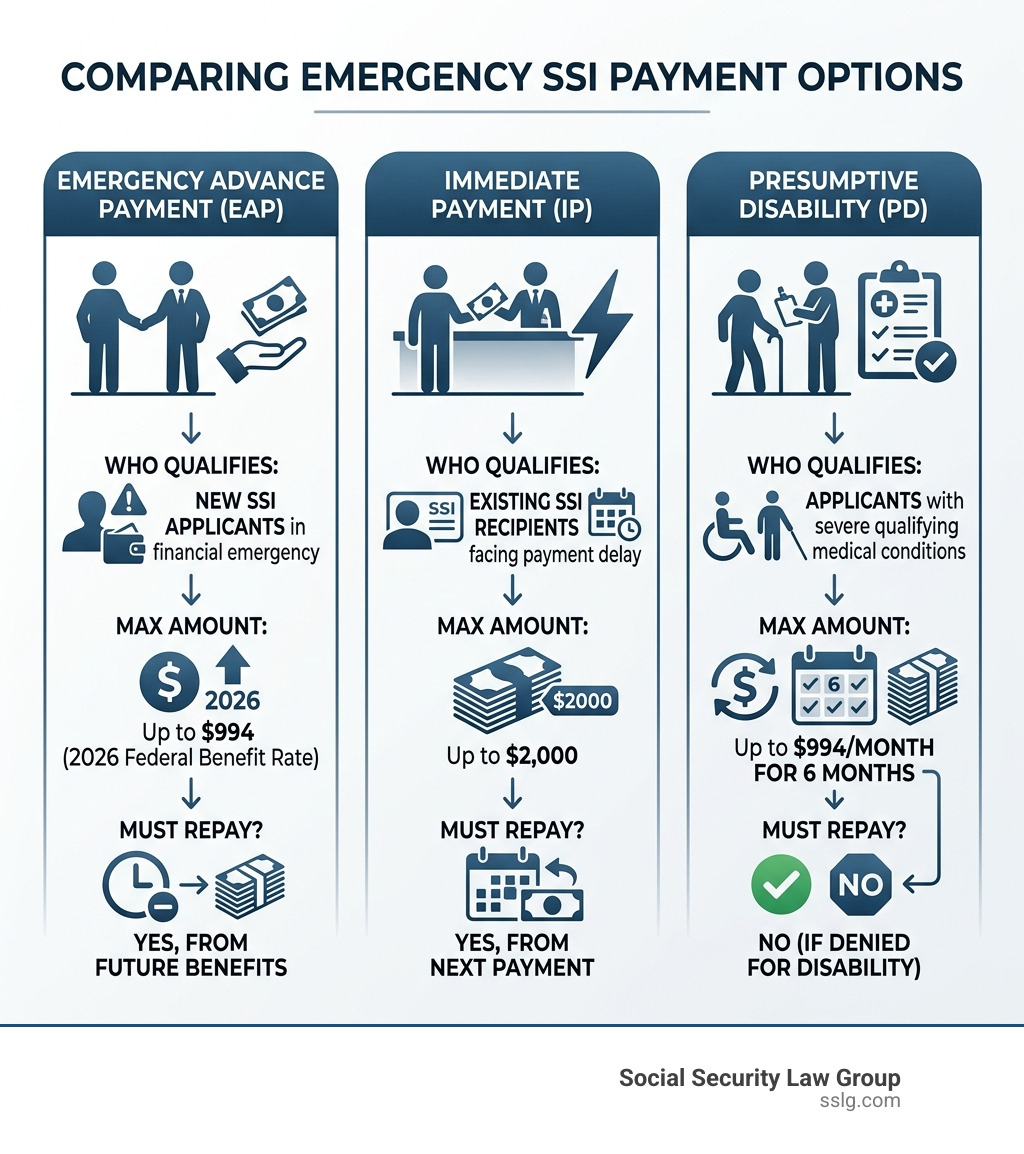
Your main options for emergency SSI payments in 2026:
| Payment Type | Who Qualifies | Max Amount | Must Repay? |
|---|---|---|---|
| Emergency Advance Payment (EAP) | New SSI applicants with a financial emergency | Up to $994 (2026 Federal Benefit Rate) | Yes, from future benefits |
| Immediate Payment (IP) | SSI recipients with a payment delay | Up to $2,000 | Yes, from next payment |
| Presumptive Disability (PD) | Applicants with severe qualifying conditions | Up to $994/month for 6 months | No (if denied for disability) |
The Social Security Administration (SSA) recognizes that disability decisions can take months or even years. Only about 20% of initial applications are approved, which means most people wait a long time with little or no income. That gap can be dangerous.
These emergency programs were created for exactly that situation. But the rules are strict, and not everyone qualifies.
At Social Security Law Group, we have helped SSI and SSDI clients navigate these programs since 1994, serving people nationwide from California and Texas to Florida, Oregon, Washington, and Massachusetts. Understanding which option fits your situation is the first step.
Understanding the One-Time Emergency Payment SSI Options

When we talk about a one-time emergency payment SSI benefit, we are actually looking at a few different technical programs. The SSA uses specific names for these, and knowing the right term can help you when you walk into a field office in cities like Boston, Dallas, or Seattle.
According to SSA Handbook § 2187, the Social Security Administration has the authority to issue direct field office payments. These are not meant to be long term solutions, but rather a bridge to get you through a temporary crisis.
The first option is the Emergency Advance Payment (EAP). This is specifically for people who are applying for SSI for the first time or are reapplying after a previous termination. To get this, you must be facing a financial emergency and appear to be eligible for benefits. We often help clients understand their SSI Benefits to see if they meet these high bars.
The second option is the Immediate Payment (IP). This is available for both new applicants and those who are already receiving benefits but have run into a payment delay. If the SSA has already determined you are eligible, but the money has not arrived, an IP might be the answer.
Finally, there is Presumptive Disability (PD). This is not technically a “one-time” payment, but it functions as an emergency measure. If your medical condition is so severe that it is highly likely you will be approved, the SSA can start paying you for up to six months while they finish your medical review. This is vital for maintaining SSI Income during the long wait for a final decision.
Defining a Financial Emergency for a One-Time Emergency Payment SSI
What exactly counts as an emergency? The SSA does not just take your word for it; they follow the Code of Federal Regulations § 416.520. A financial emergency is defined as a situation where you have insufficient income or resources to meet an immediate threat to your health or safety.
Common examples of a qualifying emergency include:
- Lack of food or groceries.
- Lack of clothing.
- Imminent eviction or homelessness (lack of shelter).
- Inability to pay for essential medical care or prescriptions.
If you are in a city like Chicago or Houston and facing utility shut-offs or an eviction notice, these documents serve as critical evidence. We emphasize to our clients that Understanding SSI Qualifications involves proving not just your disability, but the immediate nature of your financial peril.
Eligibility Criteria for the One-Time Emergency Payment SSI
To qualify for an EAP, you must be in the process of an initial application. You cannot get an EAP if you are already receiving regular monthly checks. According to SSA – POMS: SI 02004.001, you must provide strong evidence that you will likely meet all eligibility requirements. This includes:
- Income and Resource Limits: You must show that your assets are below the $2,000 limit ($3,000 for couples).
- Categorical Eligibility: You must be aged, blind, or disabled.
- Technical Eligibility: You must meet citizenship or residency requirements.
For an Immediate Payment, the criteria are slightly different. The SSA must have already established that you are eligible for benefits, but there must be a delay in the system that they cannot fix right away. This is often used when a check is lost or a system error stops your payment.
Payment Amounts and Recovery Processes for 2026
As of 2026, the maximum Federal Benefit Rate (FBR) for an individual is $994. This number is the baseline for most emergency payments. However, the amount you actually receive depends on which program you use and where you live.
| Payment Feature | Emergency Advance Payment (EAP) | Immediate Payment (IP) |
|---|---|---|
| Max Individual Amount | $994 (plus state supplement) | $2,000 |
| Max Couple Amount | $1,491 (plus state supplement) | $4,000 |
| Timing | Initial application only | Initial or post-eligibility |
| Authority | Statutory (Law) | Commissioner’s Discretion |
In California, for example, the state provides a supplement that can increase the total EAP amount. If you are in Florida or Texas, state supplements are different or may not apply to the EAP calculation in the same way. The SSA will always pay the smallest of these three amounts: the FBR plus supplement, the amount of your expected first month’s benefit, or the specific amount you requested to cover your emergency.
You can find more details on these limits at the Official Expedited Payments Page. It is also helpful to compare these to the SSI Amounts for 2026 to see how the cost of living adjustments have increased your potential emergency funds.
How the SSA Recovers Emergency Funds
It is important to remember that these are advances, not “free” extra money. The SSA will want the money back. According to SSA – POMS: SI 02004.130, the recovery process is usually automatic.
If you are due retroactive benefits (back pay), the SSA will simply subtract the emergency payment from that lump sum before you ever see it. If you do not have enough back pay to cover the advance, they will withhold the money from your future monthly checks. They usually spread this out over six months to ensure you still have enough to live on.
We recommend tracking your SSI Payment Schedule closely. If you receive an emergency payment in January, don’t be surprised if your checks from February through July are slightly smaller than expected.
Expedited SSI via Presumptive Disability and Blindness
Sometimes, the medical evidence is so clear that the SSA does not need to wait for a full review from the Disability Determination Services (DDS). This is known as Presumptive Disability (PD) or Presumptive Blindness (PB).
If you have one of the following conditions, you might be able to start receiving payments immediately:
- Amputation of a leg at the hip.
- Total deafness (no sound perception).
- Total blindness.
- Bed confinement due to a long term condition.
- Terminal illness with a life expectancy of six months or less.
- Low birth weight in infants (specific gram thresholds apply).
The benefit of PD payments is that even if the SSA eventually denies your claim for medical reasons, you typically do not have to pay the money back. This is a huge relief for many of our clients who are struggling with SSI Disability claims.
Frequently Asked Questions about SSI Emergency Payments
Navigating the SSA field offices in places like Atlanta, Phoenix, or Detroit can be intimidating. Here are the most common questions we hear at Social Security Law Group.
Can SSDI recipients get emergency payments?
Yes, but the rules are different. While SSDI recipients do not qualify for the SSI Emergency Advance Payment, they can qualify for an Immediate Payment. According to SSA – POMS: RS 02801.010, the limit for an SSDI Immediate Payment is much higher, up to $5,000.
This is reserved for cases where the SSA has clearly established you are entitled to benefits, but a delay is causing a financial emergency. If you are wondering, “Can I Apply for SSI Disability Online?” the answer is yes, but for these specific emergency payments, you almost always have to speak with someone at a local office.
What happens if my SSI claim is denied after an advance?
If you received an Emergency Advance Payment (EAP) and your claim is later denied, the SSA will view that payment as an overpayment. You will likely receive a notice asking for the money back.
However, if you were paid under the Presumptive Disability rules, you are in a better position. As noted in the Official Expedited Payments Page, PD payments are generally not recoverable if the denial was based on medical reasons. If the denial was because you had too much income or too many resources, you might still have to repay it.
How do I apply for an emergency payment in person?
To apply for a one-time emergency payment SSI benefit, you should visit your local field office. You cannot usually do this through the national 800 number or the website.
According to SSA – POMS: SI 02004.130, the process involves:
- Verification: A staff member will verify your financial emergency. Bring your eviction notices or past-due medical bills.
- Manager Approval: A field office manager must sign off on the payment.
- Same Day Processing: If approved, the office can often issue a “Third Party Draft” or a same day electronic transfer.
Conclusion
Facing a financial crisis while waiting for disability benefits is one of the most stressful experiences a person can go through. At Social Security Law Group, we understand that a one-time emergency payment SSI can be the difference between keeping your home and facing the streets.
Whether you are in Denver, Miami, or Charlotte, our team is dedicated to helping you secure the benefits you deserve. With our 97% success rate and no-win, no-fee structure, we take the risk out of the legal process so you can focus on your health.
If your claim has been delayed or you need help with an SSI Appeal, don’t wait until the emergency becomes a catastrophe. Contact an SSI Appeal Lawyer at SSLG today to discuss your options for Social Security Hardship Payments. We are here to help you navigate the system with the precision and expertise you need.
The information provided in this blog article is intended to be general in nature and should not be construed as legal advice. Social Security laws and regulations are subject to, and often change. Please consult the official Social Security Administration (SSA) website or contact SSLG for advice regarding your specific legal matters.