
What Are Widow Disability Benefits and Who Qualifies?
Widow disability benefits are monthly Social Security payments available to surviving spouses who are disabled and between the ages of 50 and 59. They are part of a broader set of survivor protections administered by the Social Security Administration (SSA).
Here is a quick overview of who qualifies:
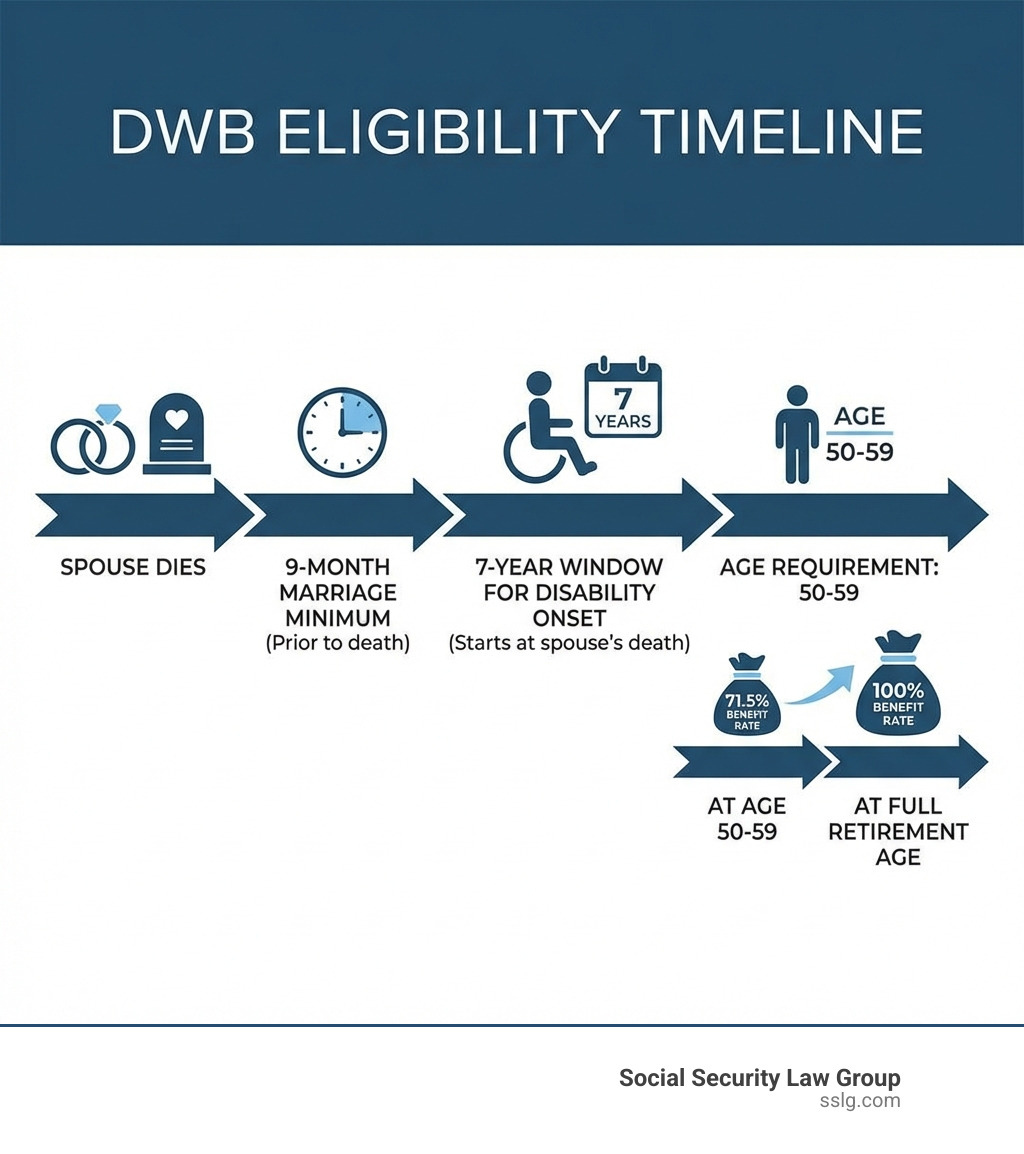
- Age: You must be between 50 and 59 and disabled, or 60 or older (non-disabled widows qualify separately)
- Disability timing: Your disability must have started before your spouse’s death or within 7 years after
- Marriage duration: You must have been married to the deceased for at least 9 months (with some exceptions)
- Remarriage: You cannot have remarried before age 50
- Spouse’s work history: Your deceased spouse must have earned enough Social Security work credits
- Benefit amount: Disabled widows aged 50 to 59 receive 71.5% of the deceased spouse’s benefit
Losing a spouse is devastating. When you are also dealing with a disability and financial pressure, it can feel impossible to know where to turn. The Social Security system does provide real support for surviving spouses in this situation, but the rules are strict and the process is complex.
This guide explains everything you need to know about widow disability benefits, from eligibility to how to apply and what to do if you are denied.
Understanding Disabled Widow(er) Benefits (DWB)
When we talk about Widow disability benefits, we are specifically referring to a program called Disabled Widow(er)’s Benefits (DWB). This is a subset of the Retirement, Survivors, and Disability Insurance (RSDI) program. Unlike Supplemental Security Income (SSI), which is a needs based program for those with limited resources, DWB is an earned benefit. It is funded by the Federal Insurance Contributions Act (FICA) payroll taxes that your spouse paid while they were working.
Essentially, the Social Security system treats the deceased worker’s earnings as a form of insurance for their family. If you live in cities like Denver, Boston, or Dallas, you know that the cost of living can be high. Having access to these earned benefits can be the difference between financial stability and significant hardship. According to the Official SSA overview of survivor benefits, these payments are intended to provide for the basic needs of family members who lost their primary source of income.
You can learn more about how these differ from standard disability payments by reading our More info about SSDI survivor benefits page.
Eligibility Requirements for Widow Disability Benefits
To qualify for DWB, you must meet the Social Security Administration’s strict definition of disability. This means you must have a physical or mental impairment that is expected to last at least 12 months or result in death. Furthermore, your condition must be so severe that you cannot perform “Substantial Gainful Activity” (SGA).
For 2024, the SSA generally considers anyone earning more than $1,550 per month from work to be engaging in SGA, as noted in the SSA disability qualification criteria. If you are blind, this earnings limit is higher. We often see clients in Seattle or Chicago who are struggling to work through chronic pain or illness, only to be told they “earn too much” to qualify. It is a delicate balance, and understanding these thresholds is key to a successful claim.
The Seven Year Rule for Widow Disability Benefits
One of the most confusing aspects of Widow disability benefits is the “prescribed period,” commonly known as the seven year rule. To be eligible for DWB between the ages of 50 and 59, your disability must have started within a specific window of time.
This window, or 84 month window, begins with the latest of the following:
- The month your spouse died.
- The last month you were entitled to survivors benefits on their record because you had a child in your care.
- The last month your previous entitlement to DWB ended because your disability had ceased.
If your disability begins after this seven year period has expired, you may have to wait until age 60 to apply for regular widow’s benefits, which do not require a disability. This timing is strictly enforced under the Legal code on entitlement timing. If you are unsure when your “onset date” occurred, we recommend looking at your medical records to see when your doctor first documented your inability to work.
Marriage and Work History Qualifications
To receive benefits on a deceased spouse’s record, the SSA needs to verify your relationship. Generally, you must have been married for at least nine months before your spouse passed away. This rule exists to prevent people from marrying solely to gain access to Social Security benefits.
However, life is unpredictable, and there are several important exceptions to this nine month requirement:
- Accidental Death: If your spouse’s death was accidental (and not a suicide), the marriage duration requirement may be waived.
- Military Service: If your spouse died in the line of duty while serving on active duty.
- Children: If you and your spouse are the natural or adoptive parents of a child.
These nuances are detailed in the SSA Handbook on widow entitlement. For more general information on how marriage affects your record, you can visit our page with More info about spousal benefits.
Impact of Remarriage on Widow Disability Benefits
Remarriage is a common point of concern for our clients in places like Ft. Lauderdale or Miami. The rules for Widow disability benefits are different than those for regular retirement benefits.
If you are a disabled widow(er) aged 50 to 59:
- If you remarry before age 50, you generally cannot claim benefits on your deceased spouse’s record unless the subsequent marriage ends by death, divorce, or annulment.
- If you remarry after age 50, your eligibility for DWB is preserved. You can continue to receive benefits based on your deceased spouse’s record even while married to someone else.
This is a significant protection for disabled survivors. The SSA recognizes that a new marriage does not suddenly “cure” a disability or replace the insurance protection earned by the first spouse. You can find more details in the SSA policy on remarriage and benefits.
Deceased Spouse Work Credits and Family Maximums
Your benefits are based on how much your spouse worked and paid into the system. To be “fully insured,” a worker typically needs 40 quarters of coverage, which equates to 10 years of work. However, if your spouse died young, they might have needed fewer credits.
There is also a “family maximum” to consider. The SSA limits the total amount that can be paid out on a single worker’s record. This limit usually falls between 150% and 188% of the worker’s primary insurance amount. If a surviving spouse and multiple children are all claiming benefits, each person’s check might be reduced proportionally to stay under this cap. You can see the math behind this at the Formula for family maximum benefits.
Benefit Amounts and Medicare Integration
How much will you actually receive? The amount of Widow disability benefits is a percentage of the deceased worker’s primary insurance amount.
| Age of Surviving Spouse | Percentage of Deceased Worker’s Benefit |
|---|---|
| Full Retirement Age (FRA) | 100% |
| Age 60 to FRA | 71.5% to 99% |
| Disabled Widow (Age 50-59) | 71.5% |
| Spouse caring for child under 16 | 75% |
As you can see, a disabled widow aged 50 to 59 receives a fixed rate of 71.5%. While this is lower than the 100% you would receive at full retirement age, it provides vital income years earlier than you would otherwise be eligible. For those with very low income, you might also look into More info about SSI survivor benefits to see if you qualify for supplemental help. You can also view the Table of payment percentages directly on the SSA website.
Medicare Eligibility for Disabled Widows
One of the most valuable aspects of winning a DWB claim is the health insurance. Normally, you have to wait until age 65 to get Medicare. However, if you are receiving Widow disability benefits, you become eligible for Medicare after a 24 month waiting period.
The SSA uses a concept called “deemed entitlement.” This means that the months you were disabled before you actually started receiving checks might count toward your waiting period. If you were previously on your own SSDI and then switched to DWB, your previous months of entitlement carry over. This ensures that disabled survivors in cities like Orlando or Sarasota can access doctors and treatments without waiting until their mid sixties. Detailed rules on this are found in the Medicare for disabled widowers section of the SSA manual.
Divorced Spouse Qualifications
Can you claim Widow disability benefits if you were divorced? Yes, provided you meet specific criteria. The most important rule is that your marriage must have lasted at least 10 years.
To qualify as a disabled surviving divorced spouse, you must:
- Be at least 50 years old (and under 60).
- Meet the SSA’s definition of disability.
- Have a disability that started within the seven year “prescribed period.”
- Be unmarried (unless you remarried after age 50).
The best part about divorced spouse benefits is that they do not affect the benefits of the current widow or any other family members. You are “independently entitled.” If you are living in St. Louis or Wichita and trying to navigate an ex-spouse’s record, check the SSA guide to divorced spouse benefits for more guidance.
How to Apply and Common Denial Reasons
Applying for Widow disability benefits is not something you can typically do entirely online. Because the SSA needs to verify marriage certificates, death certificates, and complex medical evidence, you usually need to speak with a representative.
You will need to fill out Form SSA-10 (Application for Widow’s or Widower’s Insurance Benefits). We recommend having the following documents ready:
- Proof of death (usually from the funeral home).
- Your birth certificate.
- Your marriage certificate (and divorce papers, if applicable).
- Social Security numbers for you and your deceased spouse.
- A detailed list of your medical conditions, doctors, and medications.
You can find a checklist of the Information needed for application to help you prepare. For a step by step walkthrough of the logistics, see our More info about how to apply for survivor benefits guide.
Navigating the Appeals Process
Do not be discouraged if your initial application is denied. In fact, roughly 80% of initial disability applications are rejected by the SSA. This is often because the medical evidence provided was not specific enough to prove you cannot work.
If you are denied, you have 60 days to file a “Request for Reconsideration.” If that is also denied, the next step is a hearing before an Administrative Law Judge (ALJ). This is often where we see the most success for our clients in Raleigh or Charlotte. According to the SSA’s own data on Success rates at the hearing stage, nearly half of all applicants who reach the hearing stage are eventually approved. If you find yourself in this boat, we have More info about survivor benefits denied to help you plan your next move.
VA DIC and the PACT Act
If your deceased spouse was a veteran, you might be eligible for a different type of benefit called Dependency and Indemnity Compensation (DIC) through the Department of Veterans Affairs (VA). This is a tax free benefit for survivors of service members who died in the line of duty or from a service connected injury.
The PACT Act, signed in 2022, significantly expanded the list of “presumptive conditions” related to toxic exposures like burn pits. This means it is now easier for many widows to prove their spouse’s death was service connected. If you are in Fayetteville or San Antonio (both major military hubs), this is a critical resource. You can use the VA QuickSubmit for claims to upload your evidence directly to the VA.
Frequently Asked Questions about Widow Disability Benefits
Can I receive my own SSDI and widow benefits at the same time?
The SSA does not allow “double dipping” in the sense of receiving two full checks. Instead, they follow the “higher benefit rule.” If you are eligible for both your own Social Security Disability Insurance (SSDI) and Widow disability benefits, the SSA will pay your own benefit first. If the widow’s benefit is higher, they will add an extra amount to your check to make up the difference.
Many people choose to Switch from survivor to retirement benefits later in life. For example, you might take the survivor benefit at age 60 and let your own retirement benefit grow until age 70, when it reaches its maximum value.
What is the lump sum death payment?
In addition to monthly checks, the SSA provides a one time payment of $255 to help with funeral costs or immediate expenses. This is only available to a surviving spouse who was living in the same household as the deceased, or a child who is eligible for benefits on the record. You must apply for this within two years of the date of death. You can find the Lump sum death benefit form online to get started.
How do earnings or work affect DWB payments?
Can you work while receiving Widow disability benefits? Yes, but there are limits. If you are under full retirement age, the SSA applies an “earnings test.” For 2024, if you earn more than $22,320, the SSA will deduct $1 from your benefits for every $2 you earn over that limit.
However, if you are receiving benefits because you are disabled, working too much might also trigger a “Continuing Disability Review.” If the SSA sees you are capable of working at a substantial level, they may decide you are no longer disabled. We suggest checking the SSA guide to working while receiving benefits before accepting a new job.
Conclusion
Navigating Widow disability benefits is rarely easy, especially when you are grieving and managing a health condition. Whether you are in Las Vegas, Jacksonville, or Tampa, the rules remain the same, but the local medical evidence and legal support you gather can make all the difference.
At Social Security Law Group, we have been providing expert legal representation for disability claims since 1994. We understand the nuances of the “seven year rule” and the complexities of “deemed entitlement” for Medicare. With a 97% success rate and a no win, no fee structure, our goal is to take the administrative burden off your shoulders so you can focus on your health.
We serve clients across the country, including residents of:
- Waco, TX and Temple, TX
- Detroit, MI and Southfield, MI
- Seattle, WA and Bremerton, WA
- Phoenix, AZ and Atlanta, GA
- Houston, TX and Chicago, IL
If you are ready to explore your options or need help appealing a denial, we are here to help. You can Apply for disability benefits through our modern client portal or call us for a consultation. Let us help you secure the support your spouse worked so hard to provide.