
Is Your Condition on the List? What Medical Conditions Qualify for Long-Term Disability in California
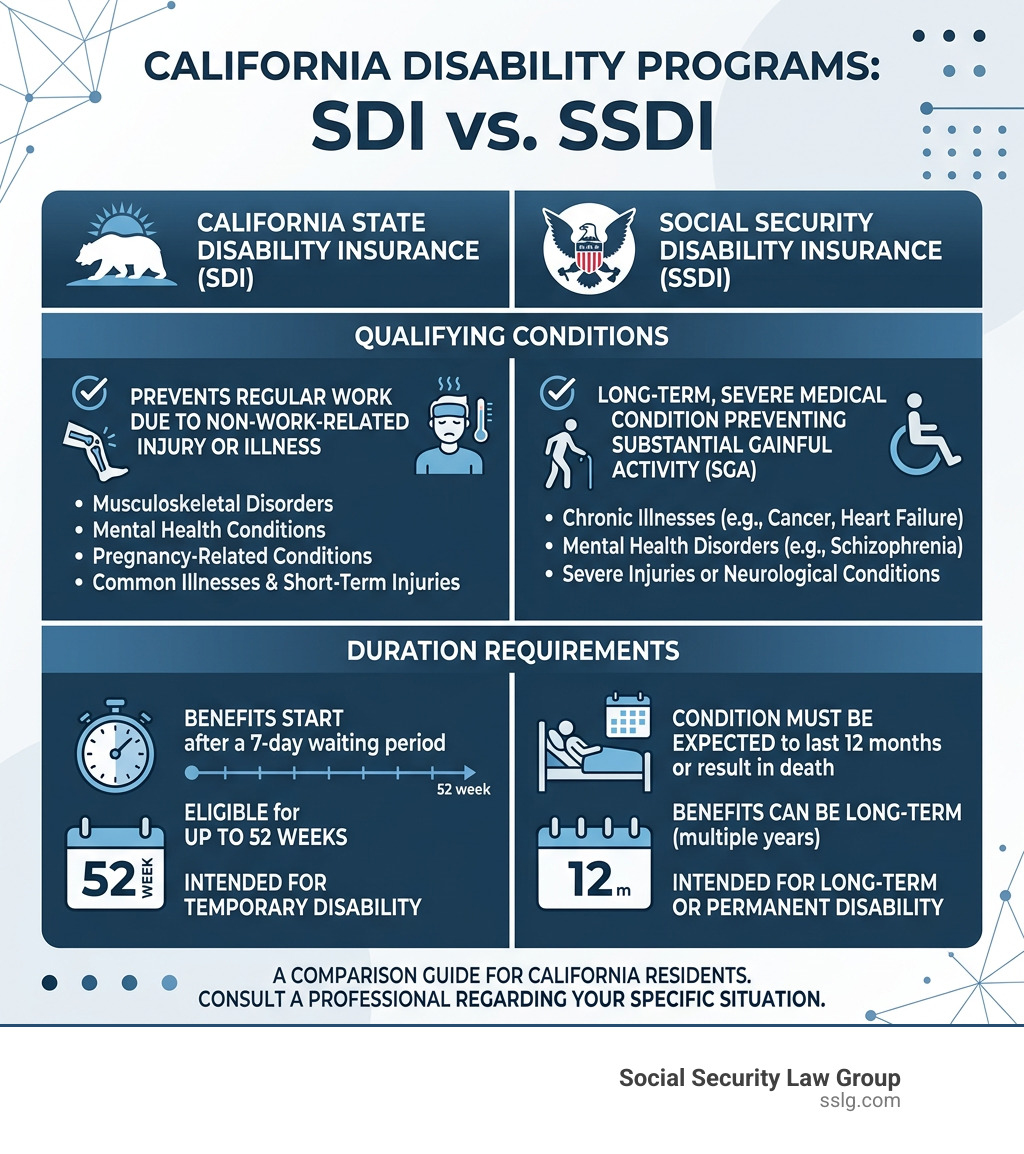
What medical conditions qualify for long-term disability in California depends on which program you are applying for. Here is a quick overview of the most common qualifying conditions:
- Musculoskeletal disorders (back injuries, degenerative disc disease, joint dysfunction)
- Mental health conditions (depression, anxiety, PTSD, bipolar disorder, schizophrenia)
- Neurological disorders (epilepsy, multiple sclerosis, ALS, stroke)
- Cardiovascular conditions (heart failure, coronary artery disease)
- Respiratory disorders (COPD, asthma, cystic fibrosis)
- Cancer (malignant neoplastic diseases, listed under SSA Category 13.00)
- Immune system disorders (lupus, HIV/AIDS)
- Chronic illnesses (chronic kidney disease, diabetes with complications)
California residents can access several programs, including federal Social Security Disability Insurance (SSDI), California’s own State Disability Insurance (SDI), and workers’ compensation. Each program has its own rules about which conditions qualify and for how long.
For most long-term programs like SSDI, your condition must prevent you from working for at least 12 months. For California SDI, your condition only needs to prevent you from doing your regular job for at least 8 days, with benefits available for up to 52 weeks.
If you are overwhelmed and unsure where to start, you are not alone. Many Californians are denied benefits on their first application, even with serious health conditions. Understanding the rules upfront can make a real difference.
This article is for general informational purposes only and is not to be construed as tax, legal, or accounting advice. Consult your tax, legal, or accounting professional regarding your individual situation.
Know your what medical conditions qualify for long-term disability in California terms:
Understanding What Medical Conditions Qualify for Long-Term Disability in California

When we talk about long-term disability in the Golden State, we are often looking at two different systems that sometimes overlap. The first is the federal Social Security Administration (SSA) system, which handles Social Security Disability Insurance (SSDI). The second is California’s specific State Disability Insurance (SDI), managed by the Employment Development Department (EDD). While SDI is technically a short-term program lasting up to 52 weeks, many people use it as a bridge while waiting for a long-term SSDI approval.
The definition of “disabled” varies significantly between these two. For California SDI, you are considered disabled if you are unable to do your “regular or customary work” due to a physical or mental illness or injury https://edd.ca.gov/en/disability/Am_I_Eligible_for_DI_Benefits/. However, to qualify for federal long-term benefits, the SSA uses a much stricter “all-work” test. You must prove that your condition is so severe that you cannot perform any substantial gainful activity (SGA) and that the condition has lasted or is expected to last for at least 12 months or result in death (Source: https://www.ssa.gov/foia/resources/proactivedisclosure/2025/FY24%20Workload%20Data-Total.pdf).
In 2026, the SSA continues to use the “Blue Book,” formally known as the Listing of Impairments, to evaluate claims. This book organizes medical conditions into 14 different body systems. If your diagnosis and the severity of your symptoms match a listing exactly, your claim may be approved more quickly. If you don’t match a listing, we must prove that your “residual functional capacity” is so limited that no job in the national economy is suitable for you.
| Feature | California SDI | Federal SSDI |
|---|---|---|
| Duration | Up to 52 weeks | Long-term/Permanent |
| Wait Period | 7 days | 5 months |
| Definition | Cannot do regular job | Cannot do any job |
| Medical Proof | Physician certification | Extensive clinical history |
At Social Security Law Group, we have helped thousands of residents navigate these definitions. Whether you are in Sacramento or San Francisco, understanding that California disability requirements are a mix of medical evidence and work history is the first step toward a successful claim.
Top physical impairments on the California disability list
Physical impairments make up a massive portion of the disability claims processed in California. According to the Centers for Disease Control and Prevention (CDC), mobility disabilities are among the most common types of functional limitations reported by adults https://www.cdc.gov/disability-and-health/about/.
The SSA’s Monthly Statistical Snapshot for August 2025 indicates that hundreds of thousands of Californians receive benefits for physical conditions https://www.ssa.gov/policy/docs/quickfacts/stat_snapshot/. These are not just “minor aches.” To qualify, these conditions must be documented with objective medical evidence like X-rays, MRIs, or lab results.
Musculoskeletal criteria for what medical conditions qualify for long-term disability in California
Musculoskeletal disorders are the leading cause of disability claims in California, accounting for approximately 28.4 percent of all recipients https://www.ssa.gov/disability/professionals/bluebook/AdultListings.htm. If you are living in San Diego or Los Angeles and struggling with a back injury, you know how debilitating these conditions can be.
Common qualifying musculoskeletal conditions include:
- Degenerative Disc Disease: This involves the breakdown of the discs between your vertebrae. To qualify, you usually need to show evidence of nerve root compression or spinal arachnoiditis.
- Osteoarthritis: Severe joint pain and stiffness in the knees, hips, or shoulders that makes it impossible to walk effectively or use your arms for fine and gross movements.
- Amputations: Loss of a limb, particularly if it prevents you from using a prosthetic device effectively to walk or work.
- Sensory Disorders: While categorized separately, severe hearing or vision loss often stems from physical trauma or disease. You can find more details in the SSA guide to sensory disorders.
When we evaluate qualifying disabilities for social security, we look for an “inability to ambulate effectively.” This means you cannot walk a block at a reasonable pace on uneven surfaces or use public transportation without help. If your back injury prevents you from standing for more than 15 minutes or sitting for more than 30, it is vital to have these specific limitations documented by your doctor.
Mental health standards for what medical conditions qualify for long-term disability in California
Mental health issues are the single largest category of disability in California, representing 36.2 percent of all claims https://www.ssa.gov/policy/docs/quickfacts/stat_snapshot/. From San Jose to San Francisco, the stress of modern life and trauma can lead to conditions that are just as disabling as physical ones.
The SSA evaluates mental disorders under Category 12.00 of the Blue Book. They don’t just look at your diagnosis; they look at your “functional criteria.” This means they want to know how well you can:
- Understand, or apply information.
- Interact with others (colleagues, supervisors, the public).
- Concentrate, persist, or maintain pace on tasks.
- Adapt or manage yourself (hygiene, following a schedule).
Common qualifying conditions include:
- Major Depressive Disorder: Persistent low mood that prevents you from getting out of bed or focusing on simple tasks.
- Anxiety Disorders: Severe panic attacks or social phobia that make a workplace environment impossible to navigate.
- Post-Traumatic Stress Disorder (PTSD): Often qualifying for veterans or survivors of trauma, marked by flashbacks and hypervigilance.
- Bipolar Disorder: Extreme mood swings that make consistent employment impossible.
For those in San Jose or other tech hubs, “brain fog” or cognitive decline from neurological issues can also qualify. You can learn more about how the SSA views these in the SSA guide for endocrine disorders if your mental symptoms are linked to hormonal imbalances like thyroid issues. We often recommend a long-term disability social security strategy that includes a detailed Functional Capacity Evaluation (FCE) to prove these invisible symptoms to a judge.
Eligibility requirements beyond your medical diagnosis
Having a diagnosis is only half the battle. To receive a check every month, you must also meet technical and financial requirements.
For SSDI, the most important factor is your “work credits.” You earn credits based on your annual wages or self-employment income. In 2026, you earn one credit for every $1,850 in covered earnings. You can earn a maximum of four credits per year https://www.policygenius.com/disability-insurance/ssi-vs-ssdi/. Generally, you need 40 credits to qualify, 20 of which must have been earned in the last 10 years ending with the year you become disabled.
If you don’t have enough work credits, you might qualify for Supplemental Security Income (SSI), which is a needs-based program for those with limited income and assets.
Other critical requirements include:
- Physician Certification: For California SDI, you must be under the care of a licensed health professional who certifies your disability https://edd.ca.gov/en/disability/AmIEligibleforDI_Benefits/.
- Earnings Limits: To get SSDI, you cannot be earning more than the SGA limit. In 2026, the maximum SSDI benefit for a high earner has risen to approximately $4,018 per month, but the average payment is closer to $1,524 https://www.ssa.gov/policy/docs/quickfacts/stat_snapshot/.
- SDI Base Period: For California’s state program, you must have earned at least $300 in your “base period” (roughly 5 to 18 months before your claim) from which SDI deductions were taken.
Wondering how much does disability pay in California? It varies wildly based on your past earnings. At Social Security Law Group, we offer a free evaluation to help you estimate your potential benefits and ensure you meet these non-medical hurdles.
Frequently Asked Questions about California disability
How long does the application process take in Sacramento?
Patience is a requirement when dealing with the government. In California, the average time for an initial decision on an SSDI claim is about 6.1 months https://www.ssa.gov/foia/resources/proactivedisclosure/2025/FY24%20Workload%20Data-Total.pdf. If your initial claim is denied (which happens to about 70 percent of applicants), you must enter the appeals process.
The wait for a hearing before an Administrative Law Judge in cities like Sacramento or Fresno can take an additional 12 to 18 months. This is why many people ask can you get long-term disability and social security at the same time. While you wait for the federal government, you should definitely apply for California SDI to keep your finances afloat.
Can I receive both SDI and SSDI at the same time?
Yes, but there is a catch. You can apply for both, but the SSA will typically “offset” your SSDI payments if you are receiving other public disability benefits like SDI. The rule is that your total benefits from all sources cannot exceed 80 percent of your average current earnings before you became disabled (Source: https://edd.ca.gov/en/disability/Am_I_Eligible_for_DI_Benefits/).
Understanding how to collect social security disability and long-term disability requires careful timing. SDI usually pays out faster and lasts for one year, providing a vital safety net while the multi-year SSDI process unfolds.
What happens if my initial claim is denied in Fresno?
Don’t panic! A denial is often just the beginning of the journey. In Fresno and throughout California, the majority of successful claims are won at the hearing level, not the initial application.
The appeals process follows these steps:
- Reconsideration: A complete review of your claim by someone who did not participate in the first decision.
- Hearing: An opportunity to present your case and witnesses before an Administrative Law Judge https://www.ssa.gov/foia/resources/proactivedisclosure/2025/FY24%20Workload%20Data-Total.pdf.
- Appeals Council: A request for the SSA to review the judge’s decision.
If your disability is the result of a workplace injury, you might also be dealing with a long-term disability after workers’ comp settlement. These cases are particularly complex because the settlement amounts can affect your Social Security payments for years to come.
Conclusion
Navigating the list of what medical conditions qualify for long-term disability in California is a daunting task, but you don’t have to do it alone. Whether you are dealing with a musculoskeletal injury, a mental health struggle, or a chronic illness, the evidence you provide is the key to your independence.
At Social Security Law Group, we have provided unrivaled expertise since 1994. With a 97 percent success rate and a no-win, no-fee structure, our goal is to take the legal burden off your shoulders so you can focus on your health. We leverage modern client technology to make the process as smooth as possible, whether you are in our backyard or across the state.
If you are ready to fight for the benefits you deserve, visit our California disability page to start your free evaluation today. We have locations ready to serve you in cities like Seattle, Phoenix, Chicago, and Dallas, bringing our national experience to your local claim.
Mandatory Legal Disclaimer: This content is for informational purposes only and does not constitute legal, tax, or accounting advice. Every disability claim is unique, and outcomes depend on individual medical evidence and work history. Social Security Law Group (SSLG) provides legal representation for Social Security Disability (SSD & SSI) claims. We operate on a contingency fee basis, meaning we only get paid if you win your case. Our past success rate of 97% does not guarantee future results. Please consult with a qualified professional to discuss your specific situation.
Consult your tax, legal, or accounting professional regarding your individual situation.