
Learning how to win a disability appeal without a lawyer is more achievable than most people think, if you follow the right steps.
Here is a quick overview of the 5-step strategy this article covers:
- File your reconsideration request within 60 days of your denial letter
- Gather strong medical evidence including objective test results and RFC forms from your doctor
- Organize and submit your case file at least 5 business days before your hearing
- Prepare for the ALJ hearing and understand how to respond to vocational expert testimony
- Describe your worst days clearly using specific, functional language
About 67% of first-time disability claims are rejected by the Social Security Administration. That means denial is not the end; it is often just the beginning of a process that most people eventually get through. Roughly 65% of applicants who appeal do succeed in the end.
The process is long. It takes an average of 18 months from appeal to approval. And it is complicated, especially in high-volume states like California, Texas, and Florida, where hearing wait times can stretch even longer.
People can win without legal representation, but strong medical records and careful preparation matter.
At Social Security Law Group, we have provided expert legal representation for SSD and SSI claims since 1994. With a 97% success rate and a no-win, no-fee structure, we help our clients understand exactly how work affects their eligibility. We support clients nationwide, from California, Oregon, and Washington, to Texas, Florida, and Massachusetts, using modern technology to ensure your claim is handled with the precision it deserves.
Related articles to how to win a disability appeal without a lawyer:
- Fibromyalgia as a Disability
- Social Security Disability Review After Age 50
- How to Apply for Social Security Disability
How to Win a Disability Appeal Without a Lawyer: The 5-Step Strategy
If you decide to pursue a pro se strategy (representing yourself), you must prepare for a marathon. In 2026, the national average wait time to get to a hearing and receive a decision is roughly 18 months, as documented in the SSA Hearing Wait Times Report. This timeline varies depending on where you live. For instance, claimants working through offices in Seattle, Bremerton, or Boston may experience different regional backlogs than those filing in Dallas, Houston, or Phoenix.
While you wait, you must pay close attention to financial rules. The most critical threshold is Substantial Gainful Activity (SGA). For 2026, the non-blind SGA limit is $1,690 per month, according to the SSA SGA Limits Page. If you earn more than this amount, the SSA will automatically deny your appeal on financial grounds, regardless of your physical or mental limitations.
To give yourself the best chance of success across Washington, Oregon, Massachusetts, and beyond, follow this structured five-step strategy.
Step 1: File the Reconsideration Request and Avoid Common Denial Pitfalls
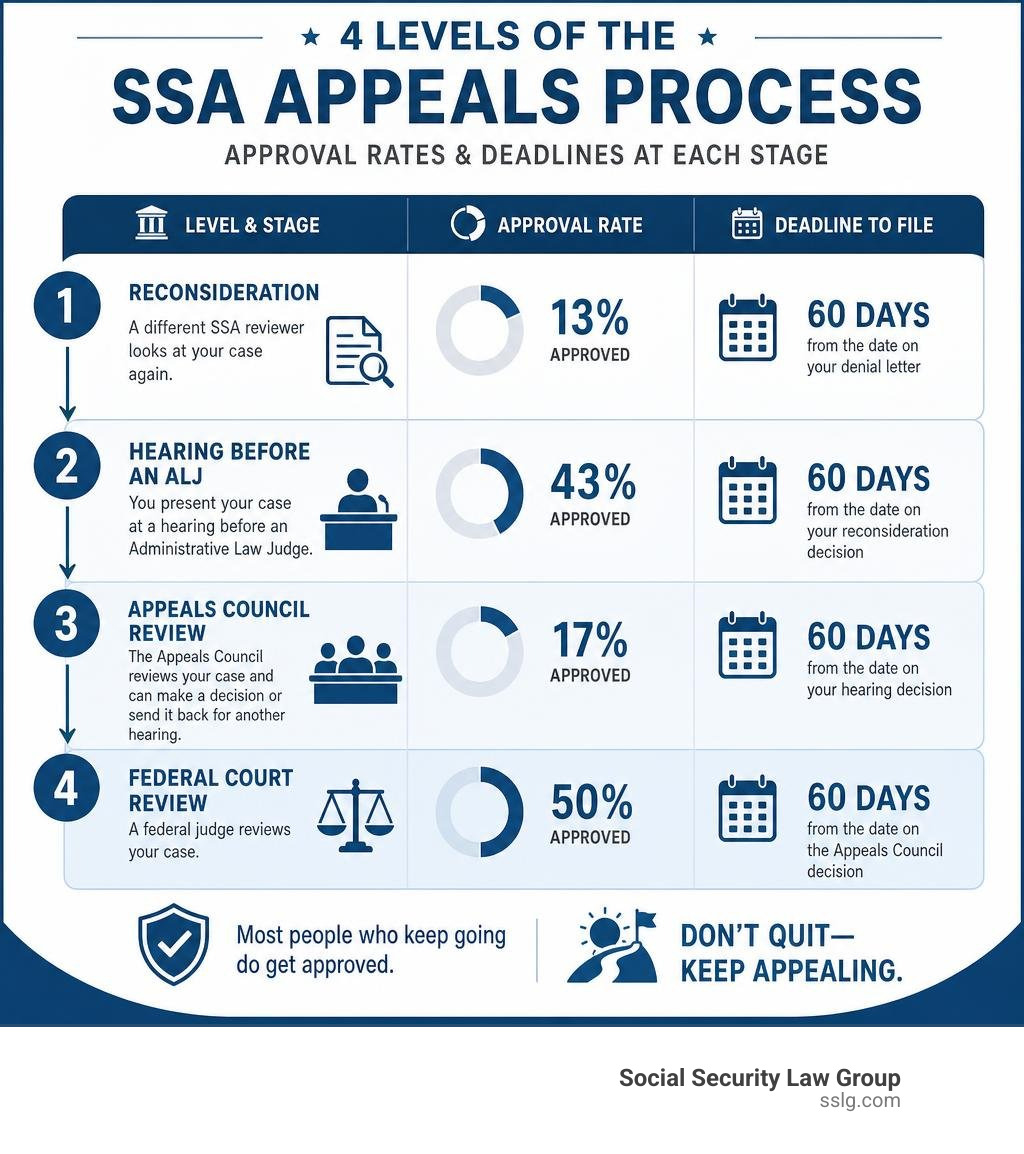
The very first step after receiving an initial denial is requesting a reconsideration. You must file this request within exactly 60 days of receiving your denial letter. If you miss this deadline, you will have to restart the entire application process from scratch.
Historically, the reconsideration stage is a difficult hurdle. According to the SSA Annual Statistical Report, only about 15% of claims are approved at the reconsideration level. Most denials occur because of two primary pitfalls:
- Incomplete Medical Records: The SSA did not receive or request all of your treatment history.
- Lack of Functional Proof: Your files show a diagnosis, but they fail to prove how that diagnosis prevents you from working.
To avoid these traps, you must submit a formal appeal package. You can find detailed instructions on how to initiate this in our guide on How Do I Appeal a Disability Claim?. Additionally, you will need to fill out and submit the official SSA Appeal Form to keep your case active.
Step 2: Gather Critical Medical Evidence on How to Win a Disability Appeal Without a Lawyer
Your medical records are the foundation of your appeal. To win, you must prove that your condition meets or medically equals one of the official conditions listed in the SSA Blue Book.
Objective medical evidence is highly prioritized by the SSA. This includes:
- X-rays, MRIs, and CT scans for musculoskeletal issues.
- Spirometry test results for respiratory conditions.
- Nerve conduction studies for carpal tunnel or neuropathy.
- Clinical, objective mental health evaluations for psychiatric conditions.
Beyond raw medical data, you need to prove your Residual Functional Capacity (RFC). The RFC is the SSA’s assessment of the maximum physical or mental activities you can perform in a work environment. You can read more about this in our article on How to Appeal an SSDI Denial.
To secure a strong RFC, schedule a dedicated appointment with your treating physician. Ask your doctor to complete an official RFC form, which outlines specific limitations, such as how many minutes you can stand, how many pounds you can lift, and your ability to maintain focus. The SSA heavily weights the clinical notes and opinions of treating physicians, as detailed in the SSA Guide on Medical Evidence, provided they are backed by objective clinical findings.
Step 3: Organize and Submit Your Case File to Meet SSA Deadlines
A common mistake pro se claimants make is submitting disorganized stacks of paper at the last minute. The SSA enforces a strict 5-day submission rule under SSA Hearing Regulations. This means all medical evidence must be submitted to the Administrative Law Judge (ALJ) at least 5 business days before your scheduled hearing. If you submit evidence after this window, the judge may refuse to consider it.
To organize your file:
- Create a Chronological Timeline: List your treatments, surgeries, and diagnoses in order of date.
- Identify Gaps: Ensure there are no long periods where you did not receive medical care, as the SSA may interpret gaps as a sign that your condition improved.
- Draft a Summary Letter: Use our template for a Disability Appeal Letter to clearly summarize your medical conditions and functional limits for the judge.
You can monitor your records and upload new documents directly through the SSA Electronic Folder Access portal.
Step 4: Prepare for the ALJ Hearing and Vocational Expert Testimony
The hearing before an Administrative Law Judge is your best opportunity to win. Nationally, about 50% of claimants who reach a hearing receive a favorable decision.
During the hearing, the ALJ will ask a Vocational Expert (VE) to testify. The VE’s role is to identify if there are any jobs in the national economy that a person with your specific limitations can perform.
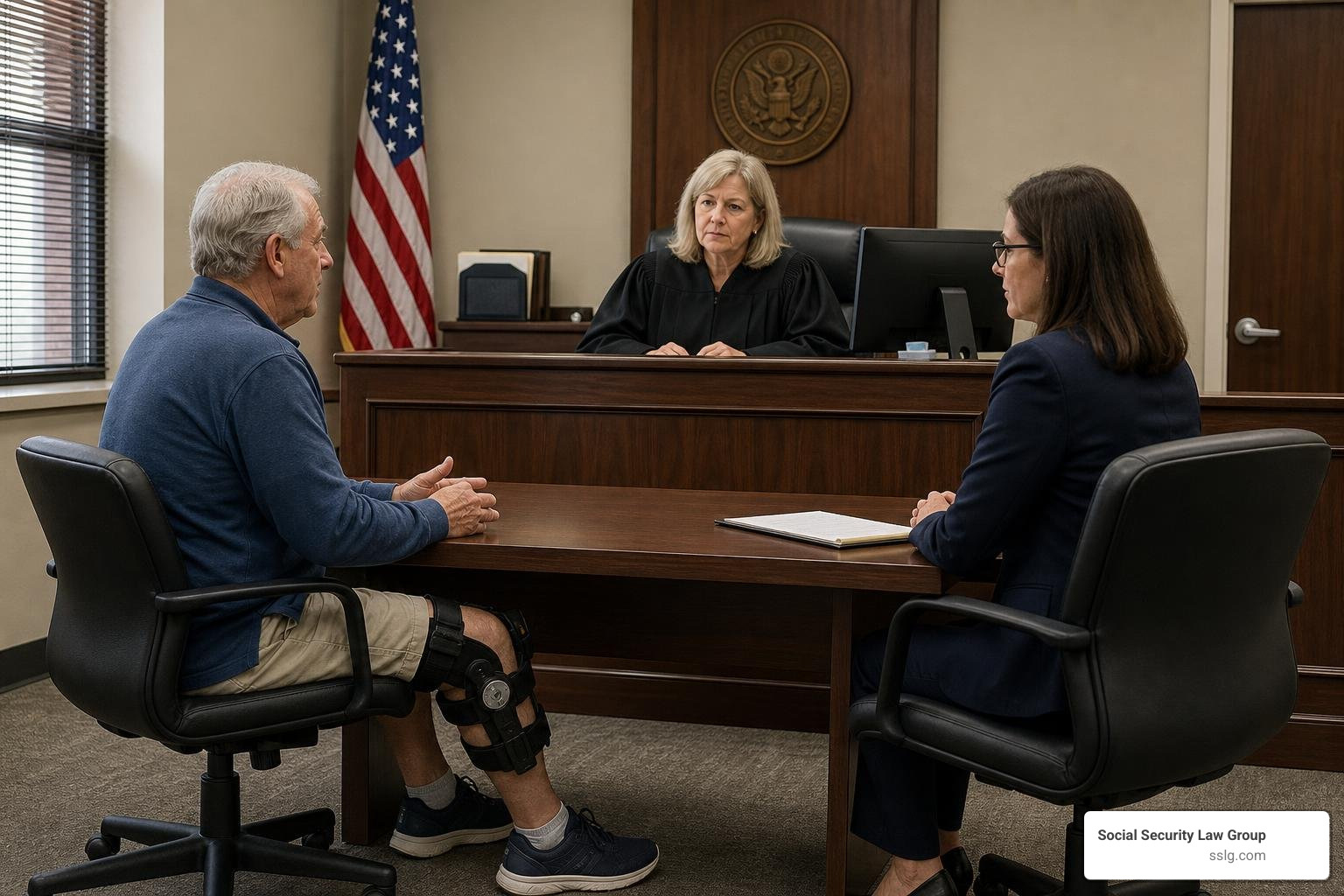
To win, you must understand the key thresholds the VE will discuss:
- Off-Task Time: If your condition forces you to be off-task (due to pain, breaks, or cognitive limits) for 15% or more of the workday, the VE will typically testify that no competitive jobs exist.
- Absenteeism: If you must miss 2 or more days of work per month due to your symptoms or medical treatments, the VE will generally state that you cannot maintain employment.
You can learn specific tactics for this stage in our guide on How to Win a Social Security Disability Hearing.
Step 5: Present Clear Testimony on Your Worst Days
When testifying, you must be honest, specific, and detailed. Do not describe your average days or your best days; focus your testimony on your worst days.
Avoid vague generalizations. Instead of saying, “My back hurts and I cannot do much,” use precise functional examples:
- “I can only stand for 10 minutes before the burning pain in my lower back forces me to sit down.”
- “Due to my medication side effects, I must lie down for two hours every afternoon.”
- “I cannot grip a pen or type for more than 5 minutes because my hands go completely numb.”
Keep a daily symptom journal tracking your pain levels, fatigue, and missed activities leading up to your hearing. This diary serves as a powerful reference during your testimony, helping you stay consistent with the Social Security Disability Appeal Process guidelines.
Evaluating Your Chances of Success Pro Se
While it is entirely possible to learn how to win a disability appeal without a lawyer, it is important to look at the statistical reality. According to SSA ALJ Hearing Statistics, claimants who represent themselves face a much steeper climb than those with legal representation.
| Appeal Level | Pro Se Success Rate | Represented Success Rate |
|---|---|---|
| Initial Application | ~33% | ~35% |
| Reconsideration | ~10% to 15% | ~15% to 20% |
| ALJ Hearing | ~25% to 30% | ~60% |
The Reality of How to Win a Disability Appeal Without a Lawyer
Self-representation requires you to act as your own paralegal, medical expert, and advocate. You must track down records from uncooperative clinics, monitor strict deadlines, write pre-hearing briefs, and cross-examine the Vocational Expert at your hearing.
Under the 2026 guidelines outlined in the SSA Annual Report, the rules regarding medical evidence and vocational grids remain highly technical. If you are unfamiliar with how the SSA evaluates age, education, and transferable skills, you may struggle to counter the VE’s testimony effectively.
When to Hire a Professional Instead of Going Pro Se
You should seriously consider hiring a professional if your case involves:
- Complex Medical Evidence: You have rare, difficult-to-diagnose conditions, or mental health impairments without extensive objective testing.
- Multiple Conditions: You suffer from a combination of physical and mental limitations that must be evaluated together.
- Prior Hearing Denials: You have already been denied by an ALJ in the past.
If you are on the fence, you can review our breakdown of the Chances of Winning Disability with a Lawyer.
What Happens If Your Appeal Is Denied?
If the ALJ issues an unfavorable decision, you still have options, though they become increasingly narrow.
- The Appeals Council: You can request a review of the ALJ’s decision. However, according to the SSA Appeals Council Statistics, the Appeals Council reverses ALJ decisions or sends them back for a new hearing only about 3% of the time. They primarily look for procedural errors made by the judge, rather than re-evaluating your medical conditions.
- Federal District Court: If the Appeals Council denies your request, your final step is to file a civil lawsuit in a U.S. District Court. This is a highly formal legal process that involves writing detailed legal briefs and arguing constitutional or administrative law.
If you are navigating an SSI claim specifically, you can find tailored advice in our guide on How to Win an SSI Appeal.
Frequently Asked Questions about Disability Appeals
How long does a disability appeal take without a lawyer?
The timeline is generally the same whether you have a lawyer or not. It takes an average of 18 months to progress through the reconsideration and hearing levels, as shown in the SSA Hearing Wait Times Chart. High-volume offices in cities like Chicago, Atlanta, Miami, and Detroit may experience longer wait times.
What is the most important medical evidence for a disability appeal?
Objective clinical evidence, such as imaging studies, laboratory results, and formal cognitive testing, is the most critical. This should always be accompanied by a detailed RFC form completed by your primary treating doctor, in line with the SSA Medical Evidence Guidelines.
Can I appeal a denial online?
Yes. You can file your reconsideration request and your ALJ hearing request online through the SSA Online Appeals Portal. You must complete the forms and upload your supporting documents within the strict 60-day limit.
Conclusion
Learning how to win a disability appeal without a lawyer is a challenging but possible path. By carefully tracking your deadlines, organizing your medical files, obtaining detailed RFC forms, and preparing honest testimony about your worst days, you can build a strong case.
However, you do not have to carry this heavy burden alone. At Social Security Law Group, we have spent over three decades helping claimants secure the benefits they deserve. With our 97% success rate and our no-win, no-fee guarantee, we provide expert advocacy with zero financial risk to you.
Whether you are located in Denver, Boston, Dallas, Ft Lauderdale, Miami, Orlando, Sarasota, St Louis, Wichita, Raleigh, Fayetteville, Clark, Uniondale, San Antonio, Jefferson, Southfield, Las Vegas, Jacksonville, Tampa, Bremerton, Fairhaven, Detroit, Phoenix, Atlanta, Houston, Charlotte, Seattle, or Chicago, we are here to help.
Ready to discuss your case? Apply for Disability with us today for a free, no-obligation consultation.
The information provided in this blog article is intended to be general in nature and should not be construed as legal advice. Social Security laws and regulations are subject to, and often change. Please consult the official Social Security Administration (SSA) website or contact SSLG for advice regarding your specific legal matters.