


When You Need a Local Disability Lawyer: Here Is How to Find One
A local disability lawyer can be the difference between winning and losing your Social Security Disability claim. If you need to find one near you, here is where to start:
How to find a local disability lawyer:
- Search the Social Security Administration’s representative search tool for accredited representatives in your area
- Contact your state bar association’s referral service for licensed disability attorneys nearby
- Reach out to a firm like Social Security Law Group, which supports clients nationwide with no upfront costs
- Look for attorneys who offer a free consultation and work on a no-win, no-fee basis
- Confirm your lawyer has direct experience with Social Security Disability Insurance (SSDI) and Supplemental Security Income (SSI) claims
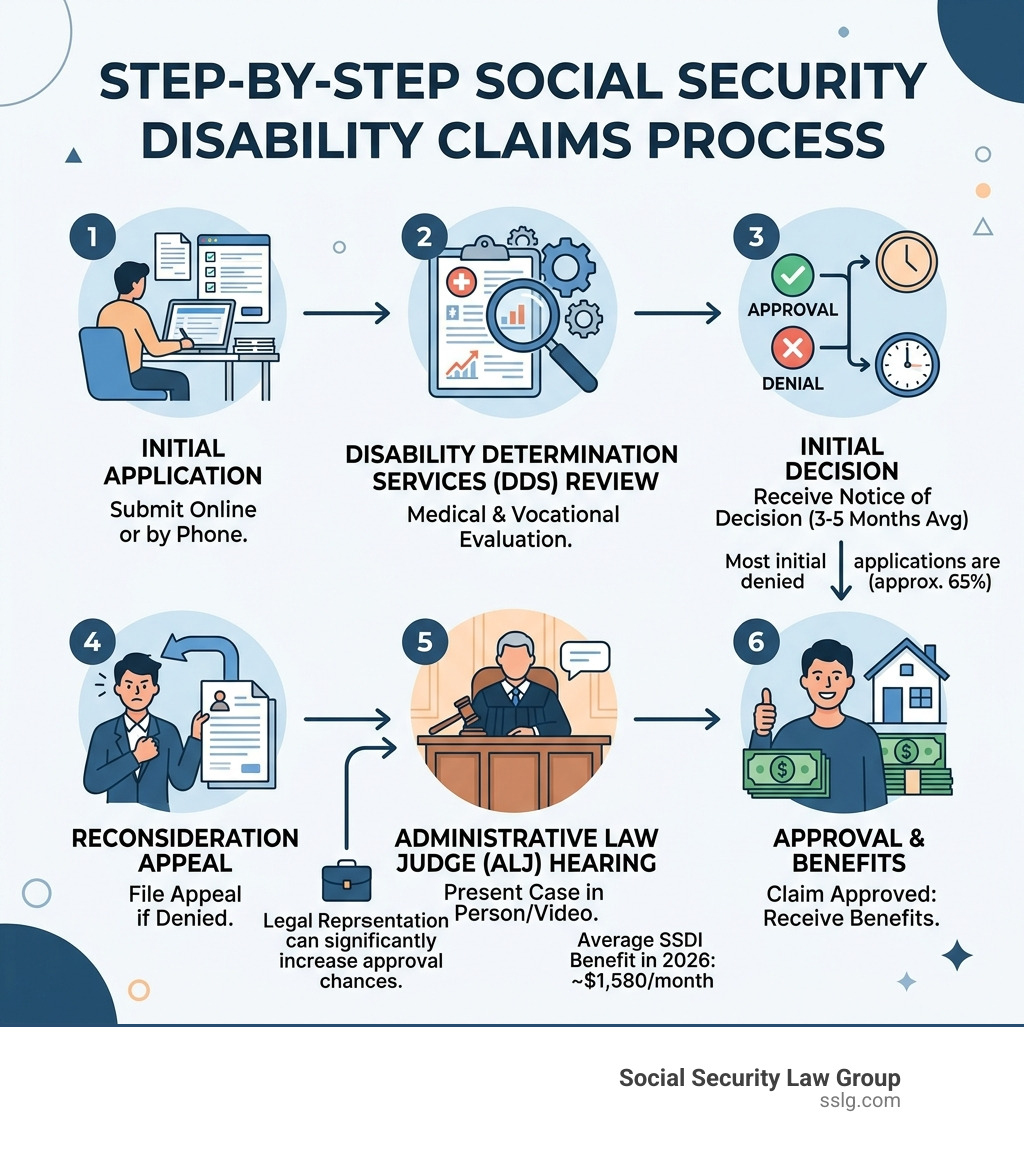
Finding the right legal help matters more than most people realize. The Social Security Administration denies about 65% of first-time SSDI applications. And according to the U.S. Government Accountability Office, claimants with legal representation are 2.9 times more likely to be approved for benefits.
If you are dealing with a serious health condition and cannot work, the disability claims process can feel overwhelming. The forms are complex. The rules change. And the stakes are high, with SSDI paying an average of $1,580 per month in 2026 according to the Social Security Administration.
The good news is that experienced local representation is available, and you do not have to pay anything unless you win.
The information provided in this article is intended to be general in nature and should not be construed as legal advice. Social Security laws and regulations are subject to change without notice. Please consult the official Social Security Administration website or contact SSLG for advice regarding your specific legal matters.
Why You Need a Local Disability Lawyer for Your Claim

When you are navigating the complex world of Social Security, having a local disability lawyer by your side provides a level of personal attention that national “big box” firms often cannot match. We believe that you are a person, not a case number. By working with a representative in your specific area, whether you are in Chicago, Dallas, or Orlando, you gain the advantage of local expertise.
One of the biggest benefits of choosing a local representative is their familiarity with the local Social Security offices and the Administrative Law Judges (ALJs) who preside over hearings. Every judge has specific preferences regarding how evidence is presented and how testimony is delivered. A lawyer who frequently appears in the St. Louis or Detroit hearing offices will know these nuances, which can be pivotal for your case.
Furthermore, a local attorney can assist more effectively with medical evidence gathering. We can coordinate with your local doctors and hospitals in cities like Phoenix or Boston to ensure that your records are complete and accurately reflect your limitations. This is vital because the Social Security Administration denies an estimated 65 percent of all first-time SSDI applications, often due to a lack of sufficient medical proof.
The data supports the value of professional help. According to the U.S. Government Accountability Office, claimants are 2.9 times more likely to be approved for benefits if they have representation. At Social Security Law Group, we take this a step further with our 97 percent success rate, helping our clients navigate the system with confidence.
More info about disability lawyer near me services
Preparing for Your Free Consultation with a Local Disability Lawyer
Before you meet with a local disability lawyer for a free consultation, it helps to be organized. This initial meeting is your chance to show the attorney why you qualify for benefits. You should bring:
- A complete list of your medical providers and their contact information.
- A summary of your work history for the last 15 years.
- A list of your current medications and their side effects.
- Documentation of any “Blue Book” impairments, which are specific conditions the SSA recognizes as automatically disabling if they meet certain criteria.
Whether you are seeking Dallas County Social Security Disability Attorneys or help in another region, being prepared allows us to give you an honest assessment of your claim’s strength right from the start.
How a Local Disability Lawyer Improves Your Odds at an ALJ Hearing
If your initial application and reconsideration are denied, the next step is a hearing before an Administrative Law Judge (ALJ). This is often the most critical stage of the process. In our experience, the average wait time to appear in front of an ALJ in many areas is about 10 to 12 months, according to the Social Security Administration.
During this hearing, your local disability lawyer will:
- Prepare you for the types of questions the judge will ask.
- Cross-examine vocational experts who might testify that you can still work.
- Present witness testimony from family or former employers to bolster your claim.
- Argue how your specific limitations prevent you from performing any gainful activity.
Having someone who knows the local court system in cities like Seattle or Houston can significantly reduce your stress during this long wait.
More info about social security disability appeal attorney services
Understanding SSDI vs. SSI Eligibility in 2026
It is common to feel confused about the difference between Social Security Disability Insurance (SSDI) and Supplemental Security Income (SSI). While both programs provide monthly payments to those who cannot work due to a medical condition, the eligibility rules are quite different.
SSDI is essentially an insurance program. You “pay in” through Social Security taxes on your paychecks. To qualify, you must have earned enough “work credits” based on your employment history. Generally, you need to have worked five out of the last ten years to be covered.
SSI, on the other hand, is a needs-based program for people with limited income and resources. You do not need a work history to qualify, but you must meet strict asset caps. In 2026, the SSA looks closely at your income and things you own, such as cash, stocks, or secondary property.
It is a sobering fact that around 5 percent of American workers experience some kind of short term disability each year, as noted by the Bureau of Labor Statistics. Whether your condition is short term or permanent, organizations like Disability Law Colorado and our team at SSLG are here to help you determine which program fits your situation.
Comparing SSDI and SSI Requirements in 2026
| Feature | SSDI (Insurance) | SSI (Needs-Based) |
|---|---|---|
| Work History | Required (Work Credits) | Not Required |
| Financial Limits | No Asset Limits | Strict Income/Asset Caps |
| Avg/Max Payment | $1,580 Avg (2026) | $967 Max Individual (2026) |
| Medical Requirement | Must meet SSA Disability Definition | Must meet SSA Disability Definition |
| Health Coverage | Medicare (after 24 months) | Medicaid (usually immediate) |
Sources: Social Security Administration Fact Sheet
More info about SSI appeal lawyer services
Navigating the Appeals Process and Overcoming Denials
Receiving a denial letter in the mail can be heartbreaking, but it is not the end of the road. In fact, for many people in cities like San Antonio or Charlotte, the real work begins after the first denial. You have a 60 day appeal window to file for “reconsideration.” If you miss this deadline, you may have to start the entire process over, losing months of potential back pay.
If reconsideration is also denied, we move to the ALJ hearing. If the judge denies the claim, we can escalate the case to the Appeals Council. In some rare instances, a local disability lawyer may even take your case to federal court.
Common reasons for denial include:
- The SSA believes your condition is not “severe” enough.
- They think you can return to a previous job or find a new, lighter type of work.
- A lack of consistent medical treatment.
- Failure to follow prescribed therapies.
We help you overcome these hurdles by filling the gaps in your medical records and providing a clear narrative of your daily struggles.
More info about social security denial attorneys services
Common Medical Conditions That Qualify for Benefits
The SSA uses a manual called the Listing of Impairments (the Blue Book) to evaluate claims. While you can qualify for benefits with almost any condition that prevents work, some are more common than others. These include:
- Musculoskeletal Issues: Degenerative disc disease, severe arthritis, or spinal injuries.
- Mental Disorders: Bipolar disorder, schizophrenia, severe depression, or PTSD.
- Cardiovascular Conditions: Congestive heart failure or chronic venous insufficiency.
- Immune System Disorders: Rheumatoid arthritis, Lupus, or HIV/AIDS.
- Neurological Disorders: Multiple Sclerosis, Parkinson’s disease, or epilepsy.
If you are suffering from any of these, a local disability lawyer can help ensure your specific symptoms are documented correctly to meet the SSA’s high standards.
More info about best social security disability lawyers services
Costs and Fees: How Disability Representation Works
One of the most common questions we hear is, “How can I afford a lawyer if I am not working?” The answer is simple: we work on a contingency fee basis. This means there are no upfront costs or hourly fees. We only get paid if we win your case.
Our fee is paid out of the “back pay” the Social Security Administration owes you. When your claim is approved, the SSA calculates the benefits you should have received from the time you became disabled. Federal law sets SSA fee caps on how much an attorney can charge, ensuring that the bulk of your back pay stays in your pocket.
This structure allows anyone, regardless of their financial situation in places like Las Vegas or Tampa, to have access to high quality legal representation. It also means we are just as motivated as you are to get a successful result!
More info about attorneys for social security claims services
Frequently Asked Questions about Local Disability Representation
How long does the Social Security Disability claims process usually take?
Patience is a virtue, especially when dealing with the government. Typically, an initial decision takes about 3 to 4 months. If you have to file for reconsideration, add another 3 to 4 months. Because of the backlog for hearings, the total process often exceeds 2 years for many claimants. According to the Social Security Administration, wait times for hearings can vary by region, but a local disability lawyer can often help expedite things if there is a dire financial or medical emergency.
What additional benefits can a disability lawyer assist with?
Beyond your monthly check, winning a disability claim opens doors to other essential services. Most SSDI recipients become eligible for Medicare after a two year waiting period. SSI recipients usually qualify for Medicaid immediately. Furthermore, we can assist with Disabled Widow(er) Benefits.
What is the 2026 COLA for Social Security Disability?
The Cost of Living Adjustment (COLA) is an annual increase designed to help your benefits keep up with inflation. For 2026, these adjustments ensure that your monthly payment retains its buying power even as the cost of groceries and housing rises. You can check the latest figures on the Social Security Administration website to see how these changes affect your specific payment.
Conclusion
Finding a local disability lawyer is the first step toward reclaiming your financial stability. At Social Security Law Group, we have been providing expert representation since 1994. Our 97 percent success rate is a testament to our dedication and our use of modern client technology to stay connected with you every step of the way.
Whether you are in Detroit, St. Louis, Wichita, Dallas, Raleigh, or Sarasota, we are ready to fight for you. We use a no-win, no-fee structure, so there is absolutely no risk in reaching out for help. You have worked hard your whole life; now, let us work hard for you.
Get help with your supplemental security income claim
The information provided in this article is intended to be general in nature and should not be construed as legal advice. Social Security laws and regulations are subject to change without notice. Please consult the official Social Security Administration website or contact SSLG for advice regarding your specific legal matters.