


Why Your Disability Onset Date Can Make or Break Your Claim
The disability onset date is the specific date the Social Security Administration (SSA) determines you became unable to work due to your medical condition, according to SSA policy. It is one of the most important dates in any SSDI or SSI claim.
Here is what you need to know at a glance:
- What it is: The first day your impairment prevented you from doing substantial gainful activity (SGA), which is $1,690 per month in 2026 for non-blind individuals
- Why it matters: It determines when your benefits begin, how much back pay you may receive, and when Medicare coverage starts
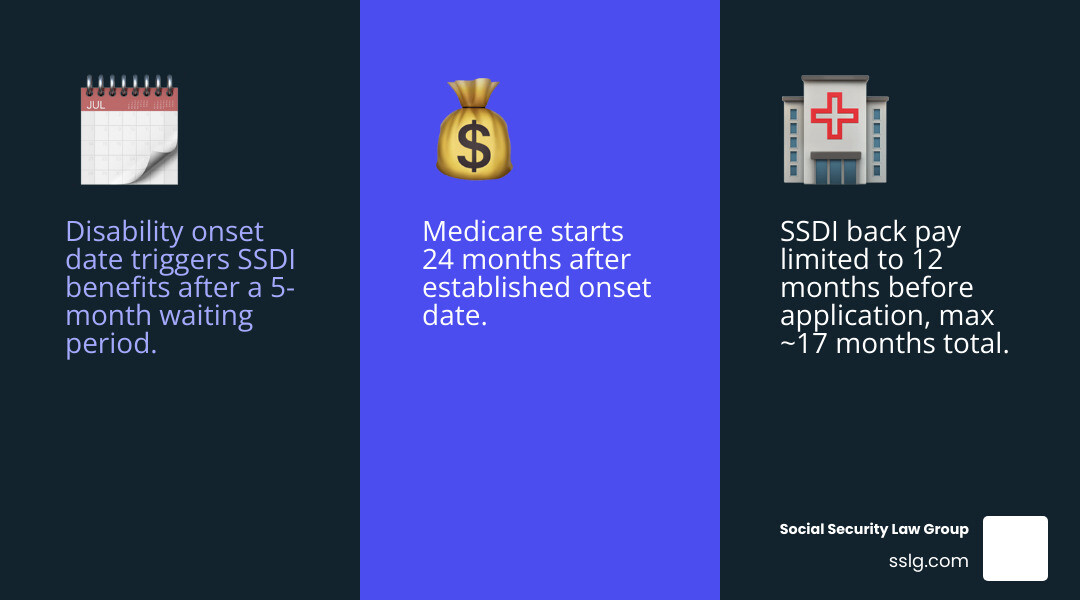
- SSDI back pay: Calculated from five months after your onset date, with a maximum retroactive period of about 17 months before your application date, per SSA guidelines
- Medicare: Eligibility begins 24 months after your established onset date, according to SSA
- SSI difference: For SSI, benefits generally start the month after you apply, not based on onset date
Getting this date wrong, even by a few months, can cost you thousands of dollars in back pay and delay your access to health coverage. Many applicants choose a date that is too early or too late, or fail to support it with the right medical evidence, leading to denials or reduced benefits.
At Social Security Law Group, we have provided expert legal representation for SSDI and SSI claims since 1994. With a 97% success rate and a no-win, no-fee structure, we help our clients understand exactly how work affects their eligibility. We support clients nationwide, from California, Oregon, and Washington, to Texas, Florida, and Massachusetts, using modern technology to ensure your claim is handled with the precision it deserves.
This guide explains the rules clearly so you know what to expect and how to protect your claim.
Understanding the Disability onset date and Its Impact on Benefits

When we sit down with clients in our offices in Denver, Boston, or Seattle, the first thing we often discuss is the timeline. The disability onset date is not just a line on a form; it is the foundation of your financial recovery. For Social Security Disability Insurance (SSDI), this date proves you met the Social Security Disability Requirements while you were still insured by your work credits, according to SSA work credit rules.
If the SSA agrees with your timeline, you become eligible for SSDI back payments which are calculated from five months after the onset date. This five month period is known as the “waiting period”. During these five months, the SSA does not pay benefits, even if you are clearly disabled. However, once that period passes, your monthly entitlement begins.
Another massive factor is health insurance. For many of our clients in Houston, Chicago, or Phoenix, getting onto Medicare is as important as the monthly check. Under federal law, Medicare eligibility begins 24 months after the established onset date plus the five month waiting period. Essentially, you are eligible for Medicare 29 months after the date the SSA says your disability began. Understanding your Ssdi Eligibility helps us ensure you don’t leave money or health coverage on the table, as defined by SSA qualification standards.
How the Disability onset date Affects SSDI Back Pay
Back pay is often the largest single check a claimant receives. It covers the time between when you became disabled and when your claim was finally approved. However, there are strict retroactive limits. For SSDI, benefits may be paid up to 12 months prior to the date of application.
To calculate your back pay, we look at the onset date, add the five month waiting period, and then look at your application date, following SSA handbook guidelines. Because the SSA only pays for up to 12 months of “retroactive” time before you actually applied, the maximum retroactive period is usually 17 months (12 months of pay plus the 5 month waiting period). If you wait too long to apply after your disability onset date, you could lose thousands of dollars in SSDI back pay, according to SSA retroactive payment rules.
Choosing the Right Disability onset date for SSI Claims
Supplemental Security Income (SSI) works differently. Unlike SSDI, SSI does not offer retroactive pay for the time before you applied. In the eyes of the SSA, SSI benefits generally begin the month after the application is filed.
For our clients in Atlanta or Detroit applying for SSI, we focus on the “protective filing date”. This is the date you first told the SSA you intended to apply. Even if your medical condition started years ago, your SSI Disability Benefits Eligibility is tied to your application date, per SSI eligibility rules. Therefore, for SSI-only claims, the disability onset date is usually set as the date of the application to simplify the burden of proof.
Alleged Onset Date (AOD) vs. Established Onset Date (EOD)
When you fill out your initial paperwork, you provide what is known as the Alleged Onset Date (AOD). As defined by the SSA, the AOD is the date the claimant alleges they became unable to work due to their condition. This is your “claim” or your “opinion” of when the disability started.
However, the SSA has the final say. After reviewing your medical records and work history, an adjudicator will determine the Established Onset Date (EOD). The POMS: DI 25501.200: Overview of Onset Policy dictates that the EOD must be supported by medical evidence. If you say you became disabled on January 1st, but you didn’t see a doctor until June 1st, the SSA might push your EOD back to June. This discrepancy is one reason why How Long Does It Take To Get Disability can vary so much between cases, according to SSA processing timelines.
How the SSA Determines the Disability Onset Date
The SSA doesn’t just take your word for it. They use a specific set of criteria to find the exact moment your health crossed the line from “impaired” to “disabled”.
- Substantial Gainful Activity (SGA): You generally cannot have a disability onset date on a day you were working and earning over the limit. The SGA threshold is $1,690 per month in 2026 for non-blind individuals. If you earned more than this, the SSA will likely set your onset date for the day after you stopped working.
- Medical Records: This is the most critical factor. The SSA looks for the first date a doctor documented limitations that would prevent full-time work.
- The Nature of the Condition: The rules change depending on how your disability started.
According to SSA: POMS: DI 25501.460: Determining Onset for Non-traumatic Static and Progressive Impairments, the SSA must look at the “longitudinal” history of your illness. They want to see the progression over time.
| Condition Type | How Onset is Set | Key Evidence |
|---|---|---|
| Traumatic Injury | Usually the date of the accident or injury. | Emergency room records, accident reports. |
| Progressive Disease | The date the condition became “disabling”. | Specialist notes, MRIs, failed work attempts. |
| Mental Impairment | Often inferred from hospitalizations or therapy. | Psychiatric evaluations, third-party statements. |
| Statutory Blindness | The date medical criteria for blindness were met. | Ophthalmologist testing and visual field exams. |
Strategic Evidence and Amending Your Onset Date
Sometimes, the date you chose on your application isn’t the best one for your case. We often help clients in San Antonio, Charlotte, or Jacksonville amend their AOD to increase their chances of approval. Knowing How To Get Approved For Disability The First Time often involves aligning your onset date with the “Grid Rules”, as outlined in the Medical-Vocational Guidelines.
The SSA uses a Medical-Vocational Guidelines table, often called the “Grids”. These rules become much more favorable once you reach a certain age. For example, there is a significant age 50 threshold for Medical Vocational Guidelines. If a claimant is 49 and their medical evidence is weak, we might strategically amend the onset date to their 50th birthday. While this might mean losing a few months of back pay, it significantly increases the likelihood of an “Approved” decision.
Another vital concept is the “Date Last Insured” (DLI). For SSDI, you must prove your disability onset date occurred before your DLI. If your insurance expired in 2023 and you claim you became disabled in 2024, your claim will be denied regardless of how sick you are. We carefully check these dates before your How Long After SSDI Hearing For Decision period begins to ensure the judge has a clear path to approval, following SSA hearing procedures.
Frequently Asked Questions about Onset Dates
What evidence is used to establish the onset date?
The SSA relies primarily on medical records from “acceptable medical sources” like MDs, specialists, and psychologists. However, when records are missing or unclear, the SSA follows SSA: POMS: DI 25501.450: Inferring Onset for the Established Onset Date (EOD). This allows them to use Work History Reports to see when your earnings dropped or your job duties changed, as well as Lay Evidence consisting of statements from family, friends, or former employers about your behavior or physical decline. At a hearing, a judge may ask a medical expert to “infer” when a condition like Multiple Sclerosis or COPD became disabling based on later tests.
While SSR 83-20 was the long-standing rule for this, the SSA has updated its internal manuals to emphasize that the EOD must be a “convincing” date based on the totality of the evidence.
Can you change your alleged onset date after filing?
Yes, you can amend your onset date at almost any point before a final decision is made. This is usually done through a written notification to the SSA or during a hearing with an Administrative Law Judge (ALJ).
Why would you do this? To avoid a “Date Last Insured” problem, to align with a birthday that puts you in a more favorable “Grid Rule” category, or to move the date past a period where you earned too much money (SGA).
If we represent you, we handle these negotiations. Legal representative fees are generally 25% of back benefits up to a $9,200 cap in 2026, and we only get paid if we win.
What happens if the SSA sets a later onset date?
This results in a “partially favorable” decision. It means the SSA agrees you are disabled, but they think it started later than you claimed. This can be frustrating because it reduces your back pay and delays your Medicare.
You have the right to appeal this decision, but be careful. Appeals must be filed within 60 days of the decision. When you appeal the onset date, you are essentially asking the SSA to look at the whole case again. In rare instances, an overzealous reviewer could decide you aren’t disabled at all, potentially costing you the benefits you already won. We always weigh the risks and rewards before recommending an appeal of a partially favorable decision.
Conclusion
Navigating the disability onset date policy is one of the most technical aspects of Social Security law. Whether you are in Raleigh, St. Louis, or Las Vegas, the date chosen for your disability will dictate your financial future for years to come.
At Social Security Law Group, we specialize in maximizing your Maximum Social Security Disability Back Pay by ensuring your onset date is accurate and fully supported by medical evidence, according to SSA back pay guidelines. At Social Security Law Group, we have provided expert legal representation for SSD and SSI claims since 1994. With a 97% success rate and a no-win, no-fee structure, we help our clients understand exactly how work affects their eligibility. We support clients nationwide, from California, Oregon, and Washington, to Texas, Florida, and Massachusetts, using modern technology to ensure your claim is handled with the precision it deserves.
We serve clients in Denver, Boston, Dallas, Ft. Lauderdale, Miami, Orlando, Sarasota, St. Louis, Wichita, Raleigh, Fayetteville, Clark, Uniondale, San Antonio, Jefferson, Southfield, Las Vegas, Jacksonville, Tampa, Bremerton, Fairhaven, Detroit, Phoenix, Atlanta, Houston, Charlotte, Seattle, and Chicago. Our no-win, no-fee structure means you can get professional legal guidance without any upfront costs.
Don’t leave your back pay to chance. Contact us today to ensure your disability onset date is protected.
The information provided in this blog article is intended to be general in nature and should not be construed as legal advice. Social Security laws and regulations are subject to, and often change. Please consult the official Social Security Administration (SSA) website or contact SSLG for advice regarding your specific legal matters.