


What You Need to Know About High Blood Pressure and Disability Benefits
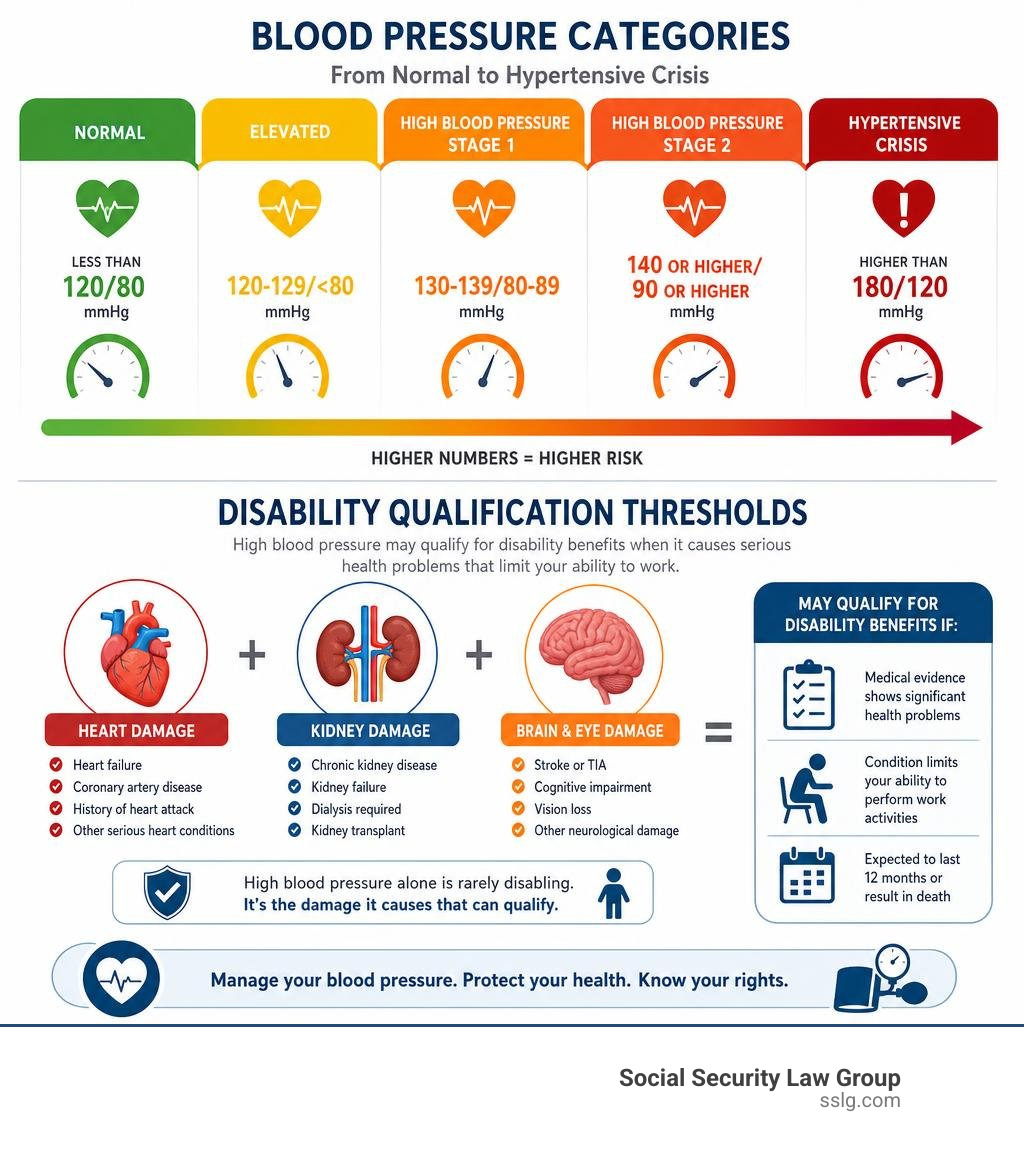
Is high blood pressure a disability? Yes, it can be. The Social Security Administration (SSA) recognizes high blood pressure, known medically as hypertension, as a potentially disabling condition when it prevents you from working.
Here is a quick answer based on your situation:
| Situation | Can You Qualify for Disability? |
|---|---|
| High blood pressure alone, well-controlled | Unlikely |
| High blood pressure causing heart failure, stroke, or kidney damage | Yes, very possible |
| High blood pressure with multiple conditions limiting work | Yes, strong case |
| High blood pressure resistant to treatment, limiting daily function | Yes, possible through RFC assessment |
According to the CDC, nearly half of all adults with a disability have high blood pressure, twice the rate of those without a disability. Yet many people living with severe hypertension do not realize they may be entitled to monthly financial support through SSDI or SSI.
The SSA does not treat hypertension as a standalone disabling condition. Instead, it looks at the damage hypertension causes to your heart, kidneys, brain, and eyes. If that damage stops you from working, you may qualify. In 2026, the average monthly disability benefit for hypertension-related claims is around $1,613.93, with SSDI paying up to $4,152 per month.
This guide covers everything you need to know, from how the SSA evaluates your condition to what benefits you can receive and how to build a strong claim. Whether you are in California, Texas, Florida, Massachusetts, Oregon, or Washington, Social Security Law Group has helped clients nationwide navigate this process since 1994.
Is High Blood Pressure a Disability Under Federal Law?
Federal law looks at disability through different lenses depending on whether you are seeking workplace accommodations or monthly financial assistance. To understand if your condition qualifies, you must look at both the Americans with Disabilities Act (ADA) and the Social Security Administration (SSA) guidelines.
Under the Americans with Disabilities Act, a disability is defined as a physical or mental impairment that substantially limits one or more major life activities. The civil rights protections of the ADA mean that if your high blood pressure or its side effects limit your ability to perform basic daily activities, your employer must provide reasonable accommodations. This might include allowing extra rest breaks, adjusting your workstation, or modifying your schedule to reduce stress.
For monthly cash benefits, the SSA uses a much stricter standard. The SSA defines a disability as the inability to engage in any substantial gainful activity due to a medically determinable physical or mental impairment. This impairment must be expected to result in death or must have lasted (or be expected to last) for a continuous period of at least 12 months.
To determine if your condition meets this threshold, the SSA uses a medical guide known as the Blue Book. The Blue Book lists specific medical criteria for various body systems. While hypertension is listed under the cardiovascular section of the Blue Book, the SSA does not grant benefits for high blood pressure alone. Instead, the agency evaluates how the condition affects your overall health and your ability to sustain full-time work.
According to the Centers for Disease Control and Prevention (CDC) Blood Pressure Resources, uncontrolled high blood pressure is a major risk factor for heart disease and stroke, which are leading causes of death and long-term disability in the United States. If your hypertension has progressed to the point where it has caused permanent damage to your organs, your condition may meet the SSA definition of a disability.
How the SSA Evaluates Hypertension and Organ Damage
Because high blood pressure is often a silent condition, the SSA focuses its evaluation on the objective physical damage the disease causes over time. The agency reviews your longitudinal medical records, typically covering at least three months of treatment, to see how your body has responded to prescribed therapies.

The SSA evaluates these complications under Section 4.00 of the Blue Book, which covers the Cardiovascular System. According to the National Institutes of Health Hypertension Guidelines, chronic high blood pressure forces your heart to work much harder to pump blood, which can eventually lead to severe cardiovascular and systemic complications.
When reviewing your medical records, the SSA looks for specific diagnostic tests and clinical findings. This documentation is essential to prove that your condition meets the severity requirements outlined in the SSA Blue Book Cardiovascular Evaluation. The agency will assess whether your hypertension has caused listing-level damage to your heart, kidneys, brain, or eyes.
Determining when is high blood pressure a disability based on organ damage
To successfully establish that your high blood pressure has become a disability, you must document the specific organ damage it has caused. The SSA will evaluate these complications under their respective Blue Book listings:
- Heart Failure: If chronic hypertension has weakened or stiffened your heart muscle, it can lead to chronic heart failure. The SSA evaluates this under Listing 4.02. You must provide objective imaging, such as an echocardiogram showing ventricular dysfunction, along with evidence that your heart failure limits your physical abilities despite following your doctor’s treatment plan.
- Kidney Disease: High blood pressure can damage the blood vessels in your kidneys, leading to chronic kidney disease. This is evaluated under Section 6.00 of the Blue Book. The SSA will review your laboratory results, including your glomerular filtration rate (GFR) and serum creatinine levels, to determine the level of kidney impairment.
- Stroke and Cerebrovascular Damage: Hypertension is the primary risk factor for stroke. If you have suffered a stroke, the SSA will evaluate your neurological limitations under Section 11.04. This includes assessing your ability to walk, stand, balance, or communicate effectively.
- Vision Loss: Severe high blood pressure can damage the delicate blood vessels in your eyes, a condition known as hypertensive retinopathy. The SSA evaluates vision loss under Section 2.00, looking at your remaining visual acuity and peripheral vision.
If you want to explore how other health conditions might qualify for benefits, you can read our detailed guide on What Medical Conditions Qualify for Social Security Disability.
Secondary hypertension and other qualifying conditions
In some cases, high blood pressure is not the primary diagnosis but is instead a symptom of an underlying medical issue. This is known as secondary hypertension. When applying for benefits, documenting the root cause of your high blood pressure can significantly strengthen your claim.
Common underlying conditions that cause secondary hypertension include:
- Adrenal Tumors: Tumors on your adrenal glands, such as pheochromocytomas, can cause your body to overproduce hormones that spike your blood pressure.
- Thyroid Issues: Both overactive and underactive thyroid glands can disrupt your metabolism and lead to severe cardiovascular strain.
- Congenital Heart Defects: Structural heart issues present from birth can cause localized or systemic high blood pressure, forcing the right or left side of your heart to work under dangerous levels of pressure.
By presenting a complete picture of your health, including any secondary conditions, you give the SSA a better understanding of your limitations. To learn more about how the SSA views these complex claims, you can review our articles on Qualifying Disabilities for Social Security and What Conditions Automatically Qualify You for Disability.
SSDI vs. SSI: Financial Benefits for Hypertension in 2026
If your high blood pressure and its complications prevent you from working, you may qualify for one of two federal disability programs: Social Security Disability Insurance (SSDI) or Supplemental Security Income (SSI). While both programs use the exact same medical criteria to determine disability, their financial eligibility requirements are very different.
| Feature | Social Security Disability Insurance (SSDI) | Supplemental Security Income (SSI) |
|---|---|---|
| Primary Eligibility | Based on your work history and Social Security tax contributions | Based on limited income and financial resources |
| Work History Required | Yes, must have earned sufficient work credits | No work history required |
| 2026 Maximum Benefit | Up to $4,152 per month | Up to $994 per month |
| Average Monthly Check | Approximately $1,613.93 for hypertension-related claims | Varies based on other household income |
| Asset Limits | No resource or asset limits | Individual assets must be under $2,000; couples under $3,000 |
| Health Insurance | Medicare (available after a 24-month waiting period) | Medicaid (usually available immediately upon approval) |
These figures are updated annually by the federal government to reflect cost-of-living adjustments, as detailed in the SSA 2026 Fact Sheet.
Financial eligibility and when is high blood pressure a disability for SSI
Supplemental Security Income is a needs-based program designed to assist individuals who have limited income and resources, regardless of their work history. If you have not worked enough years to qualify for SSDI, SSI may be your primary option for financial support.
To qualify for SSI, your countable income must fall below the federal benefit rate, which is $994 per month for an individual in 2026. Additionally, your countable assets must be worth $2,000 or less (or $3,000 or less for a married couple). The SSA does not count your primary home or one vehicle toward this limit, but it does count cash, bank accounts, stocks, and secondary property.
If you meet these strict financial limits and your medical records show that your high blood pressure has caused severe, work-limiting organ damage, you can qualify for monthly payments. For more information on navigating this specific program, you can read our resources on SSI Disability Benefits.
SSDI work credits and maximum monthly payouts
Social Security Disability Insurance is funded through payroll taxes. To qualify for SSDI, you must have worked in jobs covered by Social Security and accumulated a specific number of work credits.
Work credits are based on your total yearly wages or self-employment income. You can earn up to four credits each year. The number of credits you need to qualify for disability benefits depends on your age when your disability began, though most workers need 40 credits, 20 of which must have been earned in the 10 years immediately preceding the onset of the disability.
In 2026, the maximum monthly SSDI benefit is $4,152. Your actual monthly payment is calculated based on your average lifetime earnings before you became disabled, not the severity of your medical condition. If you want to calculate your potential payments or learn more about the work credit system, you can explore our guide on Social Security Disability Benefits.
Frequently Asked Questions About Hypertension Disability
Applying for disability benefits can be a complex and overwhelming process. To help you navigate your claim, we have compiled answers to some of the most common questions we receive from individuals living with severe high blood pressure. For general guidelines on working while disabled or navigating SSA rules, you can also consult the SSA Red Book Guide to Work Support.
Can you get disability if your blood pressure is controlled by medication?
If your high blood pressure is successfully controlled by medication and you do not experience severe side effects or organ damage, you are unlikely to qualify for disability benefits. The SSA focuses on how your condition limits your ability to work, and well-controlled hypertension generally does not prevent gainful employment.
However, you may still qualify if:
- You experience severe medication side effects: Some blood pressure medications can cause debilitating fatigue, dizziness, frequent urination, or severe chronic coughs that interfere with your ability to perform basic work tasks.
- The damage is already done: Even if medication now keeps your blood pressure in a safer range, any permanent damage to your heart, kidneys, or brain that occurred before your blood pressure was controlled remains a qualifying impairment.
- You have treatment-resistant hypertension: Some individuals have blood pressure that remains dangerously high despite taking multiple prescribed medications.
A National Library of Medicine Study on Hypertension and Disability highlights that the physical limitations caused by advanced cardiovascular strain can persist even after a patient begins a strict medication regimen.
How long does the Social Security disability application process take?
The application process for Social Security disability benefits is notoriously long. For the average person, it takes anywhere from several months to over a year just to receive an initial decision.
If your initial application is denied, which happens to the majority of first-time applicants, the appeals process can add another year or more to the timeline. This process typically involves requesting a Reconsideration and, if necessary, requesting a hearing before an Administrative Law Judge.
Because the timeline is so extensive, it is critical to submit a complete, well-documented application the first time to minimize delays. For strategic tips on how to present your medical evidence clearly, you can read our guide on How to Get Approved for Disability the First Time.
Do I need a disability lawyer to apply for benefits?
While you are not legally required to hire a lawyer to apply for Social Security disability benefits, doing so can significantly improve your chances of success. The application process requires gathering extensive medical records, documenting functional limitations, and navigating complex federal regulations.
An experienced disability attorney can help you by:
- Analyzing your medical records to ensure they meet specific Blue Book listings.
- Obtaining detailed RFC statements from your treating physicians.
- Ensuring all application forms are filled out accurately and submitted on time.
- Representing you at an appeal hearing before an Administrative Law Judge, where legal representation can triple your chances of winning.
If you are dealing with multiple health issues, including physical and mental health limitations, a lawyer can help present a cohesive case to the SSA. To understand how the SSA evaluates complex or subjective claims, you can read our article on Is It Harder to Get Disability for Mental Illness.
Conclusion
Living with severe, uncontrolled high blood pressure can turn daily life into a constant struggle. If the complications of hypertension have made it impossible for you to sustain full-time employment, you do not have to navigate the complex federal disability system alone.
At Social Security Law Group, we have specialized in disability law since 1994. We are proud of our 97% success rate and operate on a compassionate, no-win, no-fee structure. This means you pay absolutely nothing upfront, and we only get paid if we successfully secure your benefits. Our modern client technology allows us to represent you efficiently and keep you updated every step of the way.
We provide dedicated local support and strategic representation across our offices nationwide, including:
- Texas
- Florida
- Massachusetts
- Illinois
- Washington
- Missouri
- Kansas
- North Carolina
- New Jersey
- New York
- Michigan
- Arizona
- Georgia
- Colorado
- Nevada
If you are ready to take the next step toward securing your financial future, explore our SSI Disability Services or contact us today for a free, no-obligation consultation.
At Social Security Law Group, we have provided expert legal representation for SSD and SSI claims since 1994. With a 97% success rate and a no-win, no-fee structure, we help our clients understand exactly how work affects their eligibility. We support clients nationwide, from California, Oregon, and Washington, to Texas, Florida, and Massachusetts, using modern technology to ensure your claim is handled with the precision it deserves.
The information provided in this blog article is intended to be general in nature and should not be construed as legal advice. Social Security laws and regulations are subject to, and often change. Please consult the official Social Security Administration (SSA) website or contact SSLG for advice regarding your specific legal matters.