
What You Need to Know About Working While Disabled
Working while disabled is possible without automatically losing your Social Security benefits, but the rules are strict and the stakes are high.
Here is a quick overview of what you need to know:
- SSDI recipients can earn any amount during a Trial Work Period of up to 9 months without losing benefits
- The 2026 SGA limit is $1,690 per month for non-blind individuals and $2,830 per month for blind individuals
- SSI recipients keep some benefits as earnings rise, thanks to income exclusions built into the formula
- Work incentives like the Ticket to Work program, PASS plans, and Impairment-Related Work Expense deductions can protect your benefits while you transition back to work
- Healthcare coverage does not stop immediately, as Medicare can continue for up to 93 months after your Trial Work Period ends
- California residents may also qualify for the 250% Working Disabled Program, which now comes with zero-dollar premiums
Many people assume that taking any job means losing everything. That fear is understandable, but it is not always accurate. The Social Security Administration has built a layered system of protections specifically designed to let you test your ability to work without permanently giving up your safety net.
At Social Security Law Group, we have helped clients navigate these rules since 1994, supporting individuals across California, Oregon, Washington, Texas, Florida, Massachusetts, and nationwide. This guide breaks down every major work incentive, earnings limit, and reporting requirement so you can make informed decisions about your situation.
Disclaimer: The information in this article is general in nature and does not constitute legal advice. Social Security laws and regulations are subject to change. Please consult the official SSA website or contact Social Security Law Group for guidance specific to your circumstances.
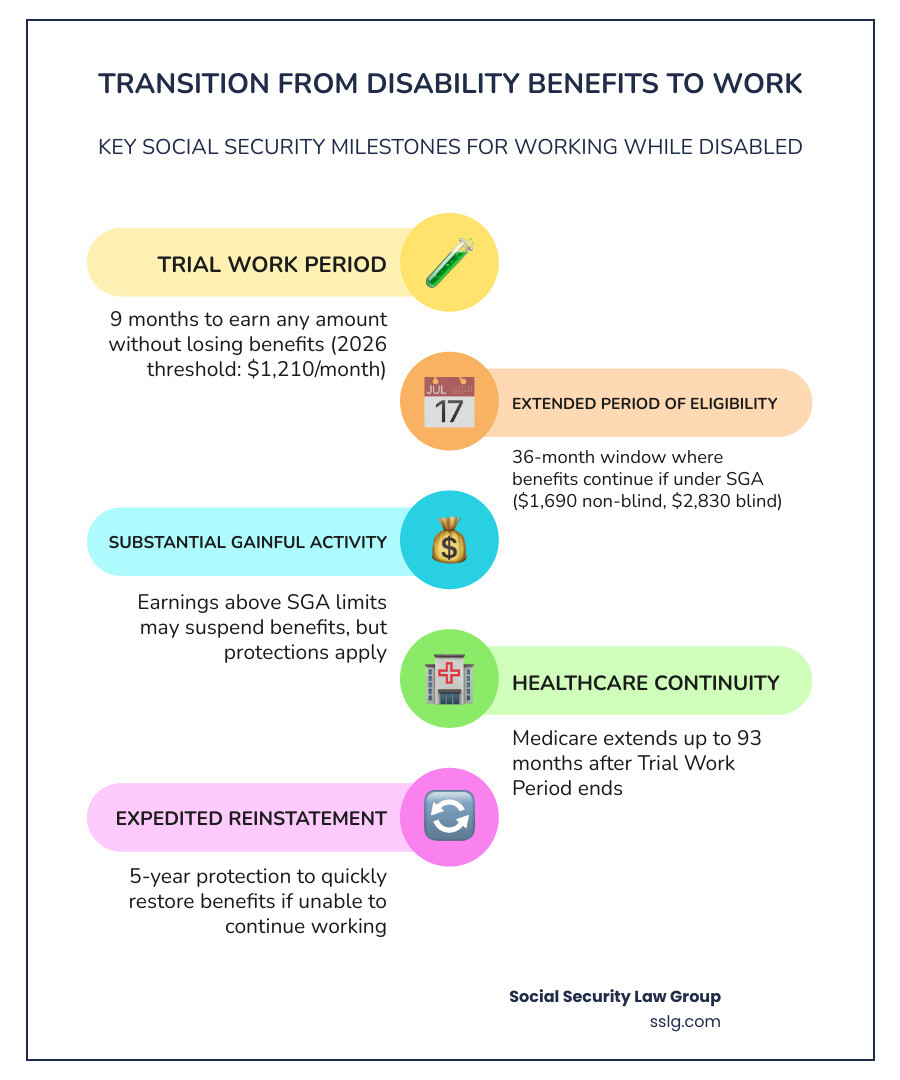
Basic working while disabled terms:
Understanding Substantial Gainful Activity and 2026 Earnings Limits
When we discuss working while disabled, the most critical concept to master is Substantial Gainful Activity (SGA). The Social Security Administration (SSA) uses this metric to determine if your work constitutes “significant” physical or mental activities performed for pay or profit. If you can engage in SGA, the SSA generally considers you no longer “disabled” under their strict definition.
For 2026, the SSA has adjusted the monthly SGA earnings limits to reflect changes in national average wages. These limits are the “ceiling” for your monthly gross earnings.
| Category | 2026 Monthly SGA Limit |
|---|---|
| Non-Blind Individuals | $1,690 |
| Blind Individuals | $2,830 |
It is important to remember that SGA is not just about the money you take home. It is an evaluation of your earning capacity. If you are self-employed, the SSA may look at the value of your work to the business or the number of hours you put in, rather than just your net profit. For those in cities like Denver, Boston, or Chicago, staying under these limits is the primary way to maintain continuous benefit eligibility while exploring part-time employment.
The Roadmap for Working While Disabled: SSDI Work Incentives
If you receive Social Security Disability Insurance (SSDI), the SSA provides a specific roadmap to help you transition back to the workforce. This journey is primarily defined by two phases: the Trial Work Period (TWP) and the Extended Period of Eligibility (EPE).

Trial Work Period Thresholds for Working While Disabled
The Trial Work Period is a nine-month window that allows you to test your ability to work without any risk to your monthly benefit check. During these nine months, you can earn an unlimited amount of money and still receive your full SSDI payment, provided you still have a disabling impairment.
In 2026, any month where your total earnings exceed $1,210 is considered a “service month” that counts toward your nine-month total. These nine months do not have to be consecutive; they can occur anytime within a rolling 60-month window. For self-employed individuals, a service month is also triggered if you work more than 80 hours in a month. You can find more details on these thresholds in the SSA guide to working while disabled.
Extended Period of Eligibility
Once your nine-month Trial Work Period ends, you enter the Extended Period of Eligibility (EPE). This is a 36-month window where the SSA evaluates your earnings on a month-to-month basis.
During the EPE, if your earnings fall below the SGA limit ($1,690 in 2026), you receive your full benefit check. If your earnings exceed the SGA limit, your benefits are suspended for that month. However, if your earnings drop again the following month, your benefits can be reinstated without a new application. This 36-month “safety net” is designed to give you peace of mind as you determine if your part-time work can become a permanent career.
Reporting Requirements for Working While Disabled
Transparency with the SSA is non-negotiable. We always advise our clients in locations like Dallas, Houston, and Seattle to report any work activity immediately. You must notify the SSA if:
- You start or stop work.
- Your duties, hours, or pay change.
- You have new expenses related to your disability that are necessary for work.
The SSA often uses Form SSA-821-BK (Work Activity Report) to collect this data. Failure to report earnings can lead to overpayments, which the SSA will eventually seek to recover, often by withholding your entire monthly check. Using the “my Social Security” online account is an efficient way to manage these reports and keep your records accurate.
Note: Unless you’re a former client and you contacted us and followed our protocols, SSLG does not help individuals to resolve overpayments with SSA.
SSI Work Incentives and the Plan to Achieve Self-Support
Supplemental Security Income (SSI) operates differently than SSDI. Because SSI is a needs-based program, your benefit amount is directly tied to your other income. However, the SSA uses a specific formula to ensure that working while disabled still leaves you with more total monthly income than if you relied on benefits alone.
The SSI income formula works like this:
- The SSA ignores the first $20 of any income (general exclusion).
- The SSA ignores the first $65 of your earned income (earned income exclusion).
- The SSA then excludes one-half of the remaining earnings.
For example, if you earn $1,085 in a month, the SSA only counts $500 of that against your SSI check. This ensures that your total take-home pay increases even as your SSI payment decreases.
Plan to Achieve Self-Support (PASS)
A Plan to Achieve Self-Support (PASS) is one of the most powerful tools for SSI recipients. It allows you to set aside income or resources for a specific work goal, such as starting a business, paying for college, or purchasing specialized equipment. The money set aside in an approved PASS does not count toward the SSI resource limits ($2,000 for individuals) or income limits.
To start, you must complete Form SSA-545-BK and outline your work goal, the steps to achieve it, and the expenses required. This is an excellent option for those looking to move toward financial independence.
Student Earned-Income Exclusion (SEIE)
For younger individuals under age 22 who are regularly attending school, the Student Earned-Income Exclusion (SEIE) provides even more flexibility. In 2026, students can exclude up to $2,410 of monthly earnings, with an annual maximum exclusion of $9,730. This allows students in cities like St. Louis or Phoenix to gain work experience without jeopardizing their SSI eligibility.
Deductions and Subsidies: Reducing Countable Income
When the SSA calculates your “countable” income for SGA purposes, they do not just look at your gross wages. We help our clients apply various deductions that reflect the true cost of working while disabled.
Impairment-Related Work Expenses (IRWEs)
An IRWE is a cost for an item or service that you need in order to work because of your physical or mental impairment. These expenses are deducted from your gross earnings when the SSA determines if you are engaging in SGA. Common examples include:
- Specialized transportation (e.g., modified vans or paratransit).
- Attendant care services performed in the work setting.
- Medical devices, braces, or prosthetics.
- Prescription drugs required to manage your condition so you can work.
Employer Subsidies and Special Conditions
Sometimes, an employer provides extra support that makes it possible for you to work. This is called a “subsidy.” If your employer pays you the same as other workers but gives you more supervision, fewer duties, or more frequent breaks, the SSA may determine that your “real” earnings are lower than your actual pay. For instance, if you are only 80% as productive as a non-disabled peer due to your condition, the SSA may only count 80% of your wages toward the SGA limit.
Unincurred Business Expenses
For the self-employed, “unincurred business expenses” are items or services provided to you for free that would normally be deductible business expenses. For example, if a vocational rehabilitation agency provides you with a computer for your graphic design business, the value of that computer can be deducted from your net earnings when the SSA evaluates SGA. This is a vital distinction for those exploring roles as content creators.
Healthcare Continuity and California’s 250% Working Disabled Program
One of the biggest fears of working while disabled is losing medical coverage. Fortunately, federal and state laws provide significant protections to ensure you stay covered.
Medicare Continuation
If your SSDI cash benefits stop because of your earnings, your Medicare Part A coverage will continue for at least 93 months (7 years and 9 months) after your Trial Work Period ends. After that time, you may have the option to buy into Medicare by paying a monthly premium. This ensures that residents in Florida, Massachusetts, and beyond have long-term access to healthcare while building their careers.
Medicaid and 1619(b) Status
For SSI recipients, Section 1619(b) of the Social Security Act allows your Medicaid coverage to continue even if your earnings become too high to receive SSI cash payments. To qualify, you must still have a disability, meet all other SSI requirements, and need Medicaid to continue working. Each state has a different “threshold” for earnings, but the SSA can often calculate an individualized threshold if your medical expenses are particularly high.
California’s 250% Working Disabled Program (WDP)
In California, the 250% WDP is a specialized Medi-Cal program for working individuals with disabilities. To qualify, your net family income must be less than 250% of the federal poverty level.
The most significant recent update to this program occurred on July 1, 2022, when premiums were reduced to zero dollars for all participants. This means you can earn a significant income, maintain your Medi-Cal coverage, and pay $0 in monthly premiums. Whether you are working a corporate job in San Francisco or collecting recyclables in Los Angeles, this program is designed to keep you insured.
Returning to Benefits: Expedited Reinstatement and Ticket to Work
What happens if you try to work and your condition worsens? The SSA has created “fast-track” options to ensure you are not left without support.
Ticket to Work Program
The Ticket to Work program is a free, voluntary program that connects you with employment networks (ENs) or state vocational rehabilitation agencies. These organizations provide career counseling, job training, and placement services. One of the primary benefits of participating in Ticket to Work is that the SSA will not conduct a scheduled medical Continuing Disability Review (CDR) as long as you are making timely progress toward your work goals. You can learn more about how this works via our Ticket to Work overview.
Expedited Reinstatement (EXR)
If your benefits stopped because of your earnings, but you become unable to work again within five years because of your original medical condition, you can request Expedited Reinstatement. You do not have to file a brand-new application. While the SSA reviews your request, they can provide up to six months of temporary “provisional” benefits and Medicare/Medicaid coverage. This is a critical safety net for our clients in cities like Detroit, Atlanta, and Charlotte.
Frequently Asked Questions about Working While Disabled
What happens if I exceed the SGA limit in 2026?
If you are in your Trial Work Period, nothing happens to your benefits. However, if you have finished your TWP and are in the Extended Period of Eligibility, exceeding the $1,690 limit ($2,830 if blind) will cause your benefit for that month to be suspended. It is vital to report these earnings to avoid an overpayment notice later.
How does the Ticket to Work program protect me from medical reviews?
As long as you are “assigning” your ticket to an employment network and meeting the SSA’s requirements for “timely progress” (which usually involves specific levels of education or earnings), the SSA will pause your regularly scheduled medical reviews. This allows you to focus on your career without the stress of proving your disability status every few years.
Can I reinstate my benefits if my disability prevents me from working again?
Yes. If you are within five years of your benefits ending due to work, you can apply for Expedited Reinstatement (EXR). This process is much faster than a standard application and allows for provisional payments while your case is being reviewed.
Conclusion
Navigating working while disabled requires a careful balance of ambition and administrative diligence. The rules regarding SGA, trial periods, and healthcare continuity are designed to be a bridge, not a trap. However, the complexity of these regulations often leads to confusion and costly errors.
At Social Security Law Group, we specialize in turning that complexity into clarity. With a 97% success rate and nearly three decades of experience, we provide the legal expertise you need to protect your benefits while pursuing your professional goals. Whether you are in Denver, Ft. Lauderdale, or Seattle, our modern technology and “no-win, no-fee” structure ensure you have world-class representation at your side.
If you have questions about how your specific income will affect your SSDI or SSI, do not leave it to chance. Contact us today for a consultation and let us help you move forward with confidence.